

On this page
At 150 km/h, facing a cricket ball becomes less about physical speed and more about predicting the future. The margin for error vanishes when the ball travels that fast, turning a sporting event into a fascinating physics problem.
How much time does a batter get against a 150 km/h ball?
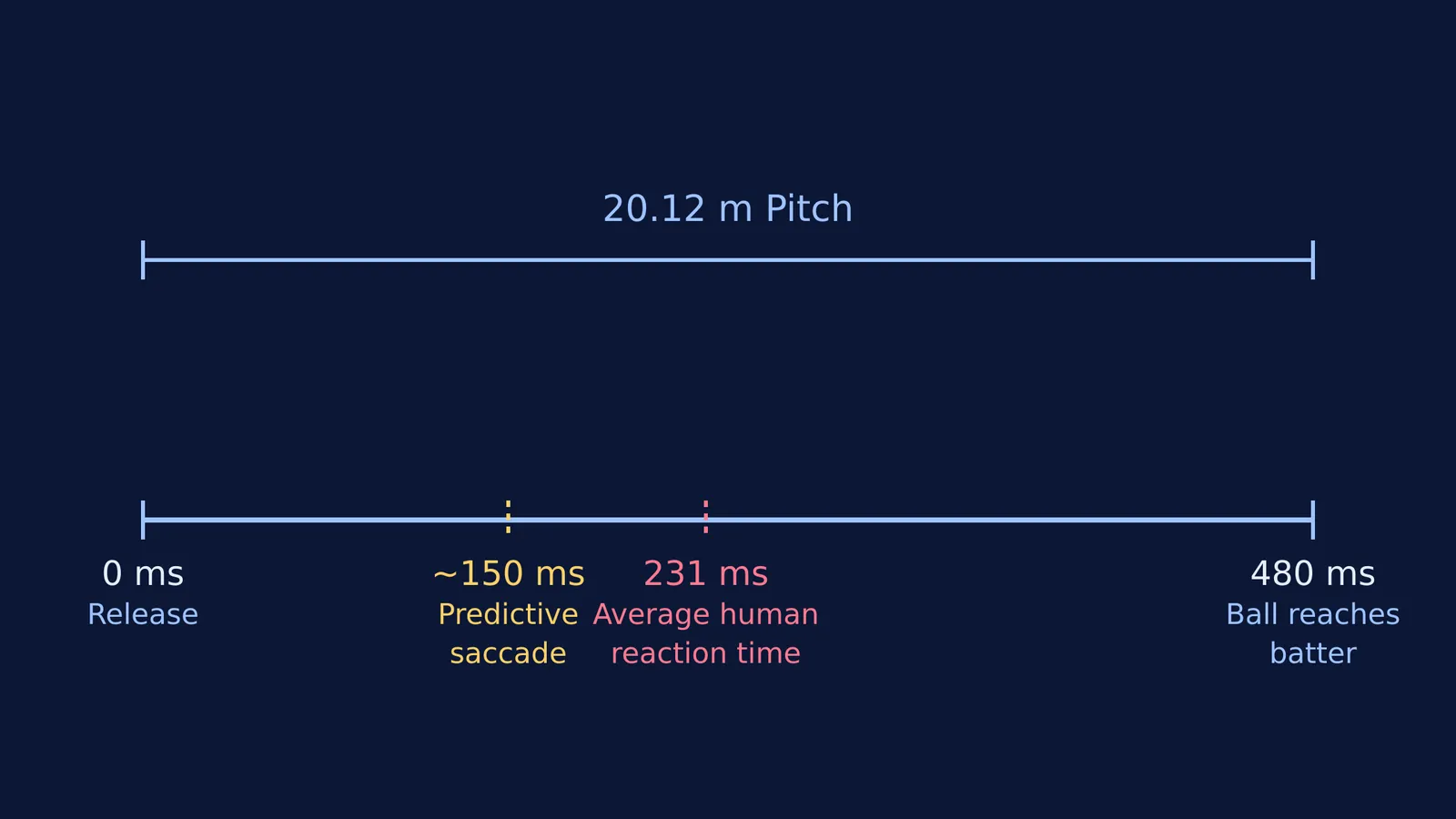
A standard cricket pitch measures exactly 20.12 metres from stump to stump according to Wikipedia. To find the time the ball takes to arrive, we first convert 150 km/h to metres per second by dividing by 3.6, which gives 41.67 m/s.
Using the basic kinematics equation for time (t = d/v), a ball travelling at a constant 41.67 m/s covers 20.12 m in 0.48 seconds. The batter gets approximately 480 milliseconds to complete three distinct steps:
See the ball leave the bowler's hand
Choose the correct shot to play
Swing the bat into position
In reality, the ball slows down slightly due to air resistance and bouncing, but the release point is also about a metre ahead of the stumps, keeping the usable time near that half-second mark.
What is the average human visual reaction time?
For most people, catching up to a 150 km/h delivery is biologically impossible. A 2015 study of 1,469 participants found that the average human simple visual reaction time is 231 milliseconds (Woods et al., 2015). This is just the time taken to press a single button after seeing a light flash.
Choosing between a pull shot and a defensive block requires a "choice reaction time", which is significantly slower. By the time a casual player's brain processes the ball leaving the bowler's hand and sends a signal to move the bat, the ball has already travelled half the length of the pitch.
How do elite batters hit a fast ball?
If they cannot simply react, how do players face express pace? A landmark 2000 study published in Nature Neuroscience discovered that skilled batters do not watch the ball continuously (Land & McLeod, 2000).
Instead, they make a predictive saccade—a rapid eye movement—to the expected bounce point. They wait for the ball to bounce and follow its trajectory for 100 to 200 milliseconds after the bounce (Land & McLeod, 2000). Getting the eyes in position early gives their brains enough time to process the trajectory and coordinate the complex physics of the batting stroke.
Linking physics to active learning
The time and distance of a cricket pitch make a perfect real-world kinematics problem. When you learn to calculate equations of motion, applying them to constraints like a split-second window helps the math make sense.
If you struggle to picture how velocity and time interact, the Fermi Simulation Lab provides interactive simulations for the ideas that are easier to see than to read. Rather than staring at static formulas, you can change the initial speed and watch the trajectory update instantly.
You can also ask Fermi's AI tutor to set up custom kinematics challenges based on sports. Because the tutor works out what you already know and builds a plan for the session, you can walk through the distance in the nth second or map out a horizontal projectile from a cliff with expert guidance. By breaking down the physics of the game, you can see exactly why facing a fast bowler is one of the hardest tasks in sport.


