

On this page
When fast bowlers like Jasprit Bumrah or Mohammed Shami bowl with a new red ball, it curves through the air and darts off the pitch. Behind both effects lies the raised equatorial seam.
Why does a cricket ball have a raised seam?
At its simplest, the seam binds the ball. In aerodynamic investigations published in the Proceedings of the Royal Society of London A, mathematician N. G. Barton documented the physical standards under Law 4 of the Marylebone Cricket Club: a men's cricket ball weighs 155.9 to 163 grams with a circumference of 22.4 to 22.9 centimetres. Inside sits a cork core wrapped in twine, encased in two leather hemispheres joined by six rows of stitching.
This stitching creates an equatorial ridge of 70 to 85 stitches standing roughly 1 millimetre proud of the surface. Barton's analysis showed that this ridge breaks the sphere's geometric symmetry. Bowlers grip these stitches directly with their index and middle fingers, gaining the friction needed to impart stabilizing backspin at release.
How does the seam create conventional swing in the air?
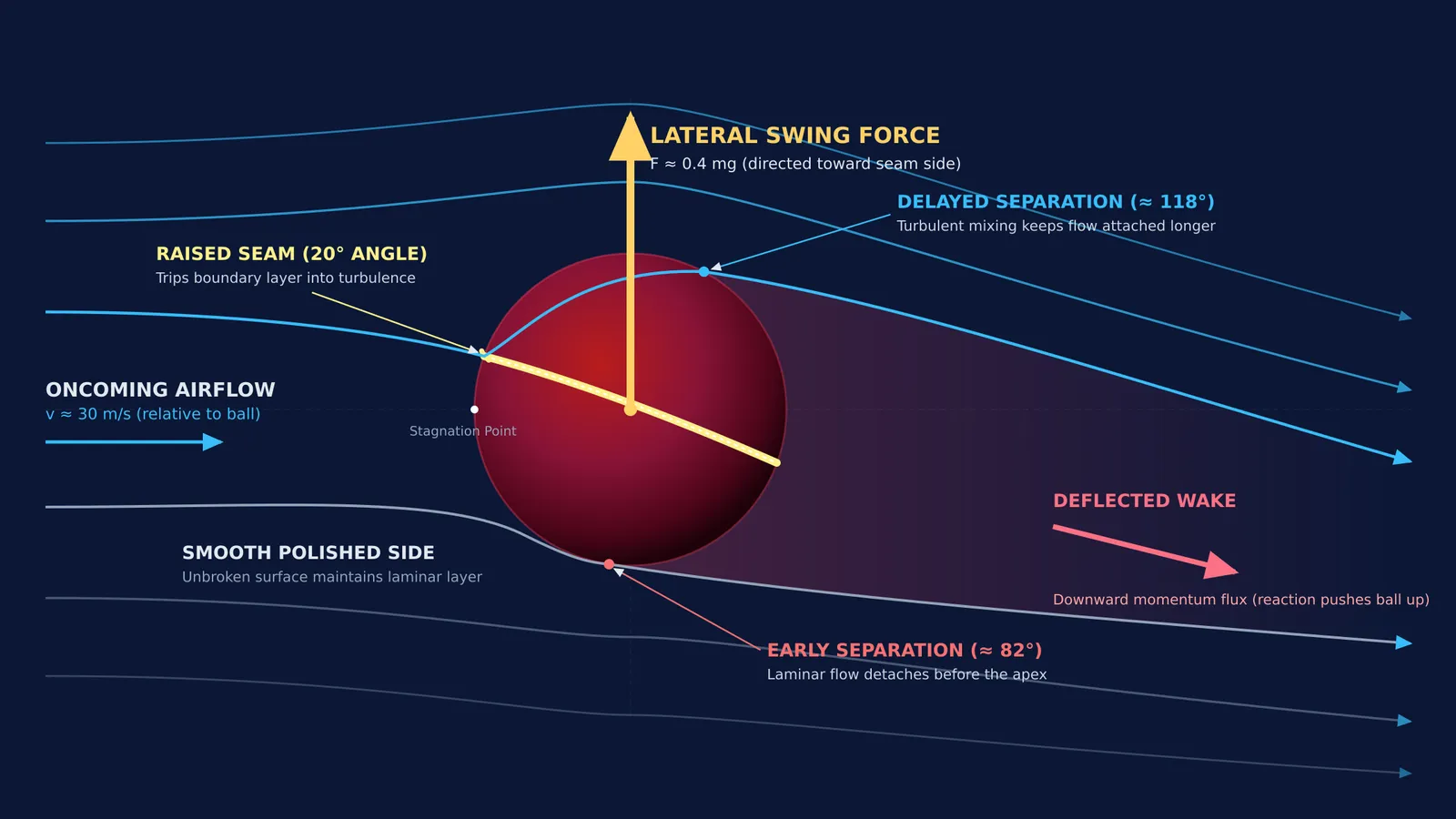
In wind-tunnel research published in Sports Engineering and Nature, aerodynamicist Rabindra Mehta established that at bowling speeds between 25 and 35 metres per second (90 to 126 kilometres per hour), thin boundary layers form along both hemispheres. Tilting the seam at 15 to 20 degrees to the flight path splits the airflow into two distinct regimes:
Smooth side: Air flows over uninterrupted leather. The boundary layer remains laminar and separates early from the surface at roughly 80 to 85 degrees from the front apex.
Seam side: The 1 millimetre raised ridge acts as a turbulator. It trips the flow into a turbulent boundary layer that mixes with faster outer air, delaying separation until 100 to 120 degrees.
Because air stays attached longer on the seam side, the trailing wake is deflected toward the smooth side. By Newton's third law of motion, redirecting this wake exerts an equal and opposite side force pushing the ball toward the seam. Mehta's measurements demonstrated that this lateral force can reach 40% of the ball's weight.
To visualize how fluid drag and boundary layers alter trajectories, the Fermi Simulation Lab offers interactive simulations for ideas easier to see than read, connecting with our guide to projectile motion with air resistance.
What happens when the seam hits the pitch?
While swing happens in flight, seam movement occurs upon ground impact. In the American Journal of Physics, physicist Rod Cross demonstrated that sports balls touch a surface for only 0.001 to 0.003 seconds (1 to 3 milliseconds).
When the ball lands on smooth leather, friction is moderate and the ball skids through reliably. But when it lands on the 1 millimetre seam, three physical effects take over:
Pressure bite: The narrow ridge concentrates normal force over a tiny area, creating intense pressure that embeds stitches into the turf.
Eccentric torque: If the seam hits at a tilt, the reaction force does not pass through the center of mass. As highlighted in rotational motion common mistakes and our look at torque and rotation simulations, this creates an impulsive torque (τ = r × F) that alters the ball's spin axis.
Lateral deviation: The seam's grip prevents slip, exerting an impulsive lateral friction force that deflects the rebound by 1 to 4 degrees—producing roughly 15 centimetres of deviation at the crease.
How can you calculate and predict the sideways movement?
In the American Journal of Physics, Rod Cross demonstrated how lateral aerodynamic forces on raised seams produce measurable sideways deflection across flight trajectories. Using these aerodynamics, the lateral movement of a swinging ball provides a direct application of Newton's second law:
Parameters: A ball of mass m = 0.16 kilograms travels at horizontal speed v = 30 metres per second over a distance d = 20 metres.
Flight time: Time in the air is t = d / v = 20 / 30 ≈ 0.67 seconds.
Transverse force: At a 20-degree seam angle, Mehta's measurements give an average side force F ≈ 0.30 newtons.
Acceleration: By Newton's second law, lateral acceleration is a = F / m = 0.30 / 0.16 ≈ 1.875 metres per second squared.
Deflection: Total sideways drift across the 20-metre delivery path to the batting crease is s = (1/2) a t² = 0.5 × 1.875 × (0.67)² ≈ 0.42 metres (42 centimetres).
A total drift of 42 centimetres easily exceeds the 22.86-centimetre wicket width (9 inches under Law 8), making late flight deviation lethal to batters. To master these dynamics:
Tilt the seam 15 to 20 degrees toward the slips for outswing, or toward leg slip for inswing.
Impart backspin along the seam at 10 to 15 revolutions per second to stabilize its orientation through gyroscopic inertia.
Land the seam upright to maximize eccentric bite off the turf for unpredictable deviation.
For numericals on drag or rotational dynamics, the Fermi Problem Library offers worked problems with a step-by-step solver that explains the reasoning rather than printing an answer.


