

On this page
A perfectly pitched spin delivery seems to defy physics. First, it drifts away from the batsman in the air, deceiving them in its flight. Then, it bites into the pitch and turns sharply in the opposite direction.
This movement is not magic; it is the precise application of torque, fluid dynamics and surface friction. For a spin bowler, the delivery is broken down into two distinct phases: what happens in the air, and what happens off the pitch.
How does the ball drift in the air?
Before the ball even bounces, it moves laterally—a phenomenon called drift. This is caused by the Magnus effect, a physical principle entirely different from the conventional swing used by fast bowlers. While fast bowlers use the angle of the seam to trip the boundary layer of air from laminar to turbulent, spinners rely on the rotation of the ball itself.
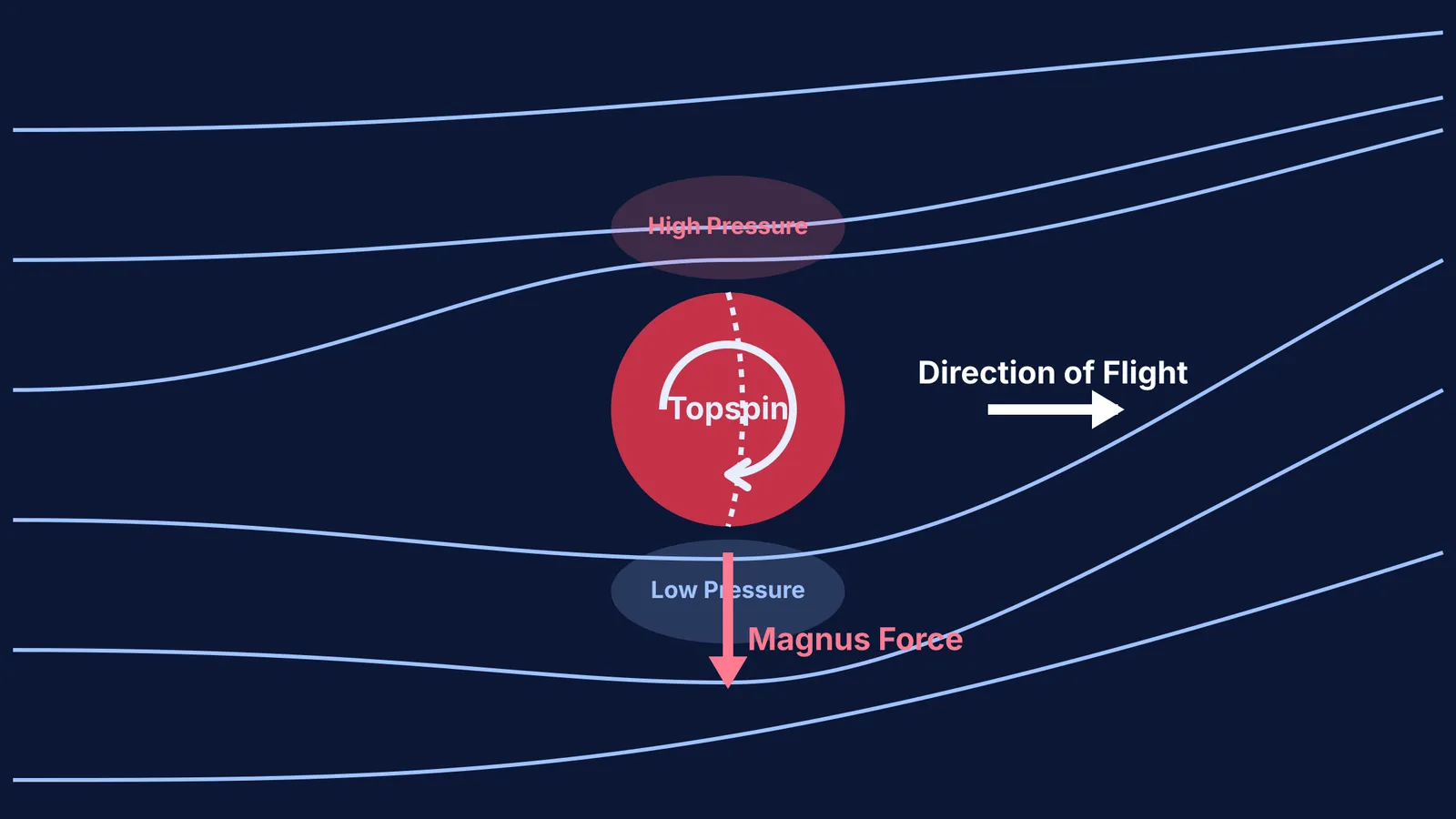
As the bowler releases the ball with intense rotation, the spinning surface drags a thin boundary layer of air around with it. When this rotating layer interacts with the oncoming air, it creates an imbalance. On one side of the ball, the surface moves in the same direction as the airflow, speeding the air up and dropping the pressure. On the opposite side, the surface moves against the airflow, slowing it down and raising the pressure. The ball is pushed toward the low-pressure side.
A 2024 study in *Physics of Fluids* showed that high spin rates expand and intensify these low-pressure zones to shift the ball's trajectory mid-flight. Depending on the axis of rotation, the Magnus effect can push the ball sideways (drift) or downwards (dip). Topspin creates a downward force that makes the ball drop faster than gravity alone would dictate, often pulling the batsman out of their crease.
Visualising how pressure fields deflect the air is one of those ideas that are easier to see than to read. In the Fermi Simulation Lab, you can run interactive simulations to watch the forces behind the Magnus effect and how they change an object's path.
Why does the ball turn sideways on the pitch?
While the Magnus effect dictates the flight, the sharp turn after the bounce is entirely down to friction.
When the spinning ball hits the ground, it grips the surface. The rotational kinetic energy of the ball is suddenly converted into lateral linear velocity, propelling the ball sideways. The amount of turn depends heavily on the coefficient of friction between the ball and the pitch.
Dry, dusty, and deteriorating pitches offer the highest friction, allowing the ball to grip rather than skid. A study in the *European Journal of Sport Science* found that a bespoke pitch with a 43.28% sand content produced significantly larger deviation than a common pitch with 7.44% sand. The softer, sandier soil allows the ball to dig in, effectively increasing the contact time and the friction applied.
The same study also highlighted the importance of the seam. Regardless of the pitch type, when the raised seam of the ball impacted the surface, the ball turned more sharply and lost more pace. The smaller contact area of the seam increases the local pressure, allowing the ball to "bite" into the soil more effectively than the smooth leather sides.
If you are working through the mathematics of torque, friction and rolling motion for your exams and get stuck, Fermi's AI tutor can help. It works out what you already know and builds a plan for the session, teaching you through the free-body diagrams step by step.
How do different spin types affect the trajectory?
Spinners alter their wrist and finger positions to change the ball's axis of rotation, which directly changes the physics of the delivery.
Sidespin: The ball rotates like a top spinning on a table. This maximises horizontal drift in the air and lateral turn off the pitch. A leg-spinner's stock delivery is heavily reliant on sidespin.
Topspin: The ball rotates forward in the direction of flight. The Magnus force acts straight down, causing a steep dip in the air and extra bounce off the pitch, but with minimal sideways turn.
Backspin: The ball rotates backward. The Magnus force opposes gravity, creating "lift" that makes the ball hang in the air longer. Deliveries like the flipper use backspin to pitch fuller and skid low upon bouncing.
The physics checklist for a turning ball
For a bowler trying to maximise deviation, the physics points to three critical factors to focus on during practice:
Maximise revolutions: More rpm means a stronger Magnus force in the air and more rotational kinetic energy available to be converted into lateral movement on the pitch.
Control the axis: Pure sidespin is needed for the widest turn, while adding topspin trades some of that turn for a sharp, deceptive dip in flight.
Target the seam: Angling the axis so that the ball lands on its pronounced seam increases the grip, leading to a slower, sharper turn that gives the batsman less time to react.


