On this page
Control and coordination is Chapter 6 of the current NCERT Class 10 Science textbook (NCERT, jesc106, reprint 2026-27). The CBSE 2026-27 Class X Science syllabus covers its plant movements, plant hormones, nervous system, types of action and animal hormones. For the full chapter plan, see our Control and coordination Class 10 chapter guide.
What do stimulus, receptor and neuron mean?
Stimulus and response: a stimulus is a change the organism detects; the response is what it does about it. Example: touching a hot pan (stimulus), pulling your hand back (response).
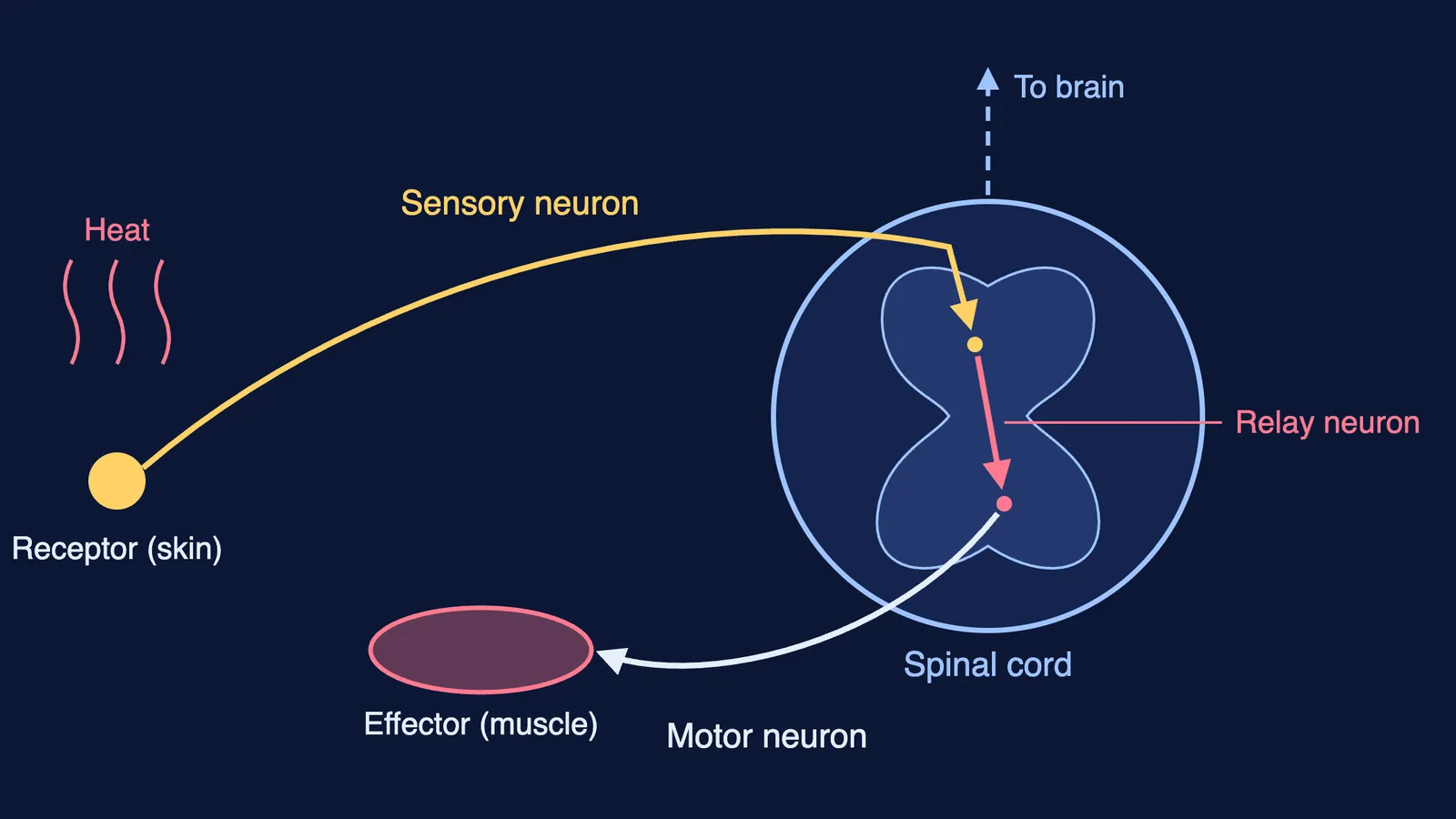
Receptor: the tip of a nerve cell that picks up a change around us. Most sit in sense organs. Example: heat receptors in the skin.
Gustatory and olfactory receptors: receptors for taste (tongue) and for smell (nose). A blocked nose dulls taste because smell is missing.
Neuron (nerve cell): the cell that carries messages as electrical impulses.
Dendrite: the branched end where a neuron picks up information.
Axon: the long fibre carrying the impulse from the cell body to the neuron's end. Don't confuse with: dendrite, which receives, while the axon sends on.
Synapse: the gap between two neurons; chemicals released at the axon's end cross it and start a new impulse in the next neuron.
Neuromuscular junction: where a neuron passes its signal to a muscle cell.
Effector: the muscle or gland that carries out the response, like the arm muscle.
What is a reflex arc?
Reflex action: a quick, automatic response that happens without thinking first. Example: blinking or narrowing the pupil in bright light.
Reflex arc: the short pathway that makes a reflex fast, linking input and output nerves in the spinal cord. The message still reaches the brain.
Sensory neuron: carries the impulse from receptor to spinal cord.
Relay neuron: connects the sensory and motor neurons inside the spinal cord.
Motor neuron: carries the instruction to the effector.
Voluntary action: an action you decide to do. Example: writing, moving a chair.
Involuntary action: an action that happens without conscious control and that you cannot easily stop. Example: heartbeat, salivation. Don't confuse with: reflex action, a sudden response to one stimulus.
Which parts of the brain and nervous system should you know?
Central nervous system (CNS): the brain and spinal cord. They collect messages from all over the body and put them together to decide what to do.
Peripheral nervous system (PNS): cranial nerves (from the brain) and spinal nerves (from the spinal cord) linking the CNS to the body.
Fore-brain: the main thinking part. It receives messages from the senses, decides what to do, moves the muscles we control and has a centre that tells us we are full.
Medulla: a part of the hind-brain that runs actions we do not choose, such as keeping blood pressure steady, making saliva and vomiting.
Cerebellum: another part of the hind-brain; it makes the movements we choose smooth and accurate and keeps us steady and balanced. Example: riding a bicycle or walking in a straight line. Don't confuse with: medulla.
How do plants respond without nerves?
Movement independent of growth: a fast response in which plant cells change shape by gaining or losing water. Example: chhui-mui (sensitive plant) leaves folding when touched. Don't confuse with: growth movements, which are slow.
Tendril: a thin, touch-sensitive part that coils around a support because the side away from the support grows faster. Example: pea plant.
Tropism: directional growth towards or away from a stimulus.
Phototropism: growth in response to light; shoots bend towards it, roots away from it.
Geotropism: growth in response to gravity; roots grow down, shoots grow up.
Hydrotropism and chemotropism: growth in response to water and to chemicals. Example: a pollen tube growing towards the ovule (chemotropism).
Plant hormones: chemicals made in one part of a plant that spread to another part to control growth.
Auxin: made at the shoot tip; with light from one side it diffuses to the shady side, where cells grow longer, so the shoot bends towards light.
Gibberellins: like auxin, they help the stem grow.
Cytokinins: help cells divide, so there is more of them where cells divide fast, such as in fruits and seeds.
Abscisic acid: a hormone that slows or stops growth; one of its effects is wilting of leaves. Don't confuse with: the three growth promoters above.
How do hormones work in animals?
Hormone: a chemical messenger carried by blood to target organs; slower than a nerve impulse but able to reach every cell.
Endocrine gland: a gland that releases hormones straight into the blood.
Adrenaline: made by the adrenal glands when we are scared; it speeds up heartbeat and breathing and sends more blood to the muscles of the arms and legs.
Thyroxin: made by the thyroid gland, needs iodine, and controls how the body uses carbohydrates, proteins and fats for growth.
Goitre: a swollen neck that can result from too little iodine in the diet, so iodised salt is advised.
Growth hormone: made by the pituitary gland; too little in childhood leads to dwarfism.
Releasing hormones: made by the hypothalamus; they tell the pituitary to release hormones.
Testosterone and oestrogen: made by the testes and ovaries; they cause the changes of puberty.
Insulin: made by the pancreas; it regulates blood sugar, and too little lets blood sugar rise, as in diabetes.
Feedback mechanism: the effect of a hormone controls how much more of it is released. Example: rising blood sugar makes the pancreas release more insulin; falling sugar reduces it.
How to learn these terms
Learn mixed-up terms in pairs: dendrite and axon, reflex and involuntary action, cerebellum and medulla, auxin and abscisic acid.
Draw the neuron and the reflex arc from memory, then label each part with its one-line job. See our CBSE Class 10 Science diagrams guide.
Make a table of hormone, gland and job from the chapter's Table 6.1.
If a term still feels vague, look it up in the Fermi Concept Library, where each biology concept has its own lesson. Going on to Class 11? The neural control and coordination Class 11 guide builds on the same ideas.