On this page
This sheet covers Chapter 5 of the NCERT Class 12 Mathematics Part I textbook, the Reprint 2026-27 edition of Continuity and Differentiability. The CBSE 2026-27 mathematics syllabus lists the chapter's topics: continuity and differentiability, the chain rule, derivatives of sin⁻¹x, cos⁻¹x and tan⁻¹x, implicit functions, exponential and log functions, logarithmic differentiation, parametric forms and second order derivatives. Rolle's theorem and the mean value theorem are not in the current chapter, so they are left out here.
In every formula below, log x means the natural logarithm (base e), as the NCERT chapter uses it. For full board answers, see our continuity and differentiability board answer guide.
What does it mean for a function to be continuous at a point?
Continuity at c: f is continuous at a point c of its domain if lim (x→c) f(x) = f(c).
Working form: left hand limit = right hand limit = f(c).
Continuous function: continuous at every point of its domain.
Algebra: if f and g are continuous at c, so are f + g, f − g, f·g, and f/g where g(c) ≠ 0.
Composite: if g is continuous at c and f is continuous at g(c), then f∘g is continuous at c.
Worked example: f(x) = kx + 1 for x ≤ 2 and 3x − 1 for x > 2. The right hand limit at 2 is 3(2) − 1 = 5. The left side and f(2) both give 2k + 1. Setting 2k + 1 = 5 gives k = 2.
Watch for: a point outside the domain is not a point of discontinuity. 1/x is continuous, because 0 is not in its domain.
When is a function differentiable, and how is that different?
Derivative at c: f′(c) = lim (h→0) [f(c + h) − f(c)] / h, provided the limit exists.
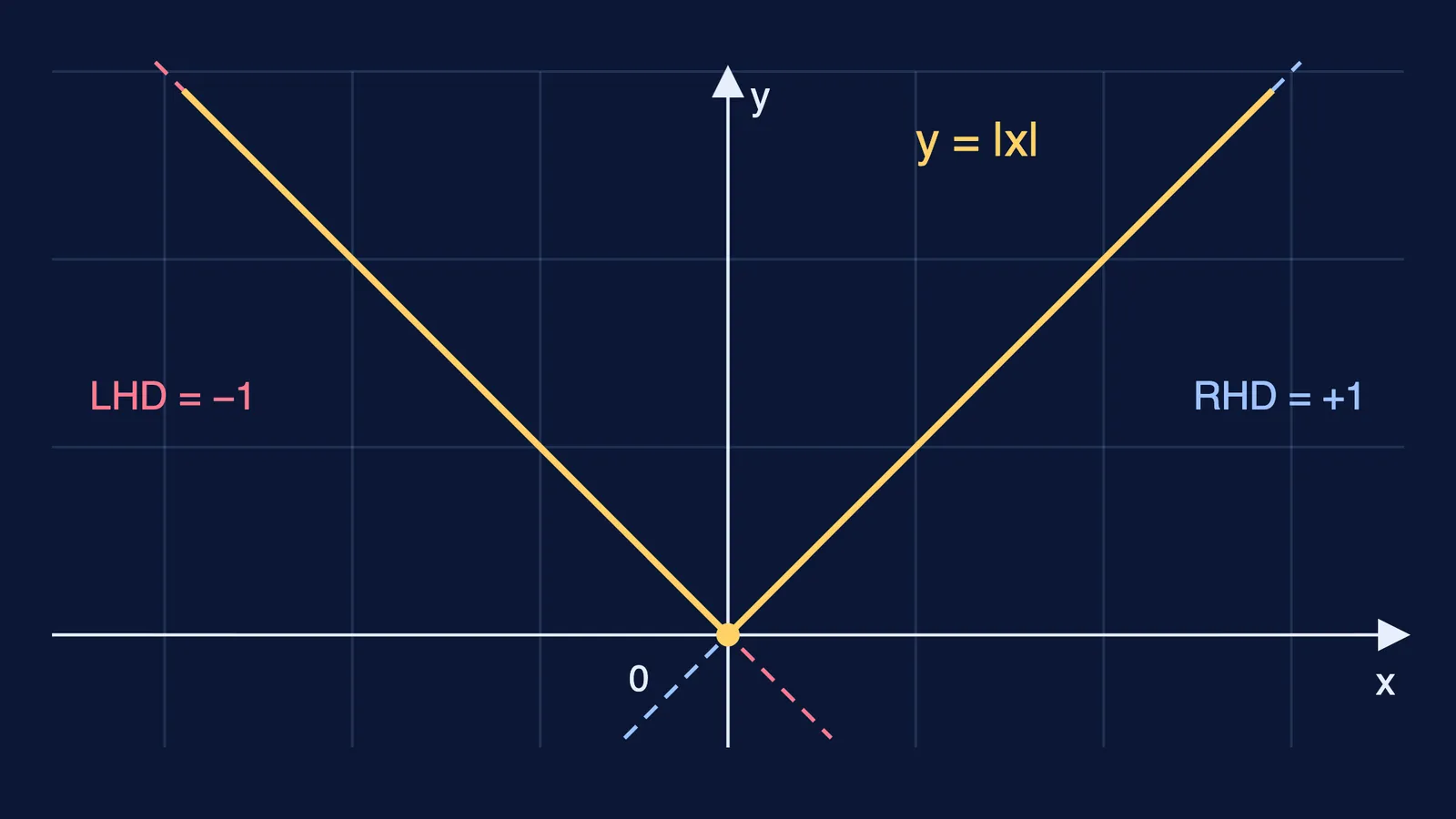
Differentiable at c: the left hand derivative (h→0⁻) and right hand derivative (h→0⁺) are both finite and equal.
Differentiable implies continuous: if f is differentiable at c, it is continuous at c.
The converse is false: f(x) = |x| is continuous at 0 but not differentiable there.
Worked example: f(x) = |x − 3| at x = 3. For h < 0, [f(3 + h) − f(3)] / h = |h| / h = −1. For h > 0 it is +1. The one-sided derivatives are −1 and +1, so f is continuous at 3 but not differentiable there.
Watch for: showing continuity does not prove differentiability. Compute both one-sided derivatives separately.
Which standard derivatives and rules do you need?
Standard derivatives (d/dx of each function, with its condition):
xⁿ → n xⁿ⁻¹, wherever xⁿ is defined
sin x → cos x, for all real x
cos x → −sin x, for all real x
tan x → sec²x, for cos x ≠ 0
sin⁻¹x → 1/√(1 − x²), for −1 < x < 1
cos⁻¹x → −1/√(1 − x²), for −1 < x < 1
tan⁻¹x → 1/(1 + x²), for all real x
eˣ → eˣ, for all real x
log x → 1/x, for x > 0
aˣ → aˣ log a, where a > 0
Sum rule: (u ± v)′ = u′ ± v′.
Product rule: (uv)′ = u′v + uv′.
Quotient rule: (u/v)′ = (u′v − uv′)/v², where v ≠ 0.
Chain rule: if y = v(t) and t = u(x), then dy/dx = (dy/dt)·(dt/dx), when both derivatives exist.
Worked example: y = tan⁻¹(x²). Put t = x², so dy/dx = [1/(1 + t²)]·2x = 2x/(1 + x⁴). At x = 1, dy/dx = 2/2 = 1.
Watch for: stopping at 1/(1 + x⁴) and dropping the inner derivative 2x.
How do implicit and logarithmic differentiation work?
Implicit: differentiate both sides with respect to x, treating y as a function of x, so d/dx(y²) = 2y·dy/dx and d/dx(sin y) = cos y·dy/dx.
Logarithmic: for y = [u(x)]^v(x), take log y = v·log u, then dy/dx = y·[v·u′/u + v′·log u].
Condition: u(x) and y must be positive, since log is defined only for positive numbers.
Log rules used: log(pq) = log p + log q, log(p/q) = log p − log q, log pⁿ = n log p, for p, q > 0.
Worked example: y = xˣ, x > 0. Then log y = x log x, so (1/y)·dy/dx = log x + 1 and dy/dx = xˣ(1 + log x). At x = 2, dy/dx = 4(1 + log 2) ≈ 6.77.
Watch for: treating xˣ as a power (x·xˣ⁻¹) or as an exponential (xˣ log x). Both base and exponent vary.
How do you differentiate parametric forms and find second derivatives?
Parametric: if x = f(t) and y = g(t), then dy/dx = (dy/dt)/(dx/dt) = g′(t)/f′(t), provided f′(t) ≠ 0.
Second order: d²y/dx² = d/dx(dy/dx), also written f″(x), y″ or y₂.
Parametric second derivative: d²y/dx² = [d/dt(dy/dx)] ÷ (dx/dt).
Worked example: x = t², y = t³ at t = 2. Here dy/dx = 3t²/(2t) = 3t/2 = 3. Then d/dt(3t/2) = 3/2, so d²y/dx² = (3/2)/(2t) = 3/(4t) = 3/8. For t > 0 the curve is y = x^(3/2), and differentiating that directly at x = 4 gives the same 3 and 3/8.
Watch for: d²y/dx² is not (d²y/dt²)/(d²x/dt²). That shortcut gives 6t/2 = 6 at t = 2, which is wrong.
How to revise this formula sheet
Learn the ten standard derivatives as pairs, then cover the right column and write it from memory, with each condition.
For every piecewise question, write three lines: left hand limit, right hand limit, f(c). Then do the same with left and right derivatives.
Practise xˣ, x^(sin x) and (sin x)^x by logarithmic differentiation, stating x > 0 or sin x > 0 each time.
When a step goes wrong and you cannot see why, the Fermi Problem Library has worked problems with a step-by-step solver that explains the reasoning rather than printing an answer.
These derivatives feed straight into the next chapter; our application of derivatives Class 12 guide picks up from here, and differentiability for JEE takes corners and modulus functions further.