On this page
Contemporary South Asia is Chapter 3 of NCERT's Contemporary World Politics. It asks how democracy has fared inside each country of the region, and how the countries disagree and cooperate. This guide follows the current text, marked Reprint 2026-27 (NCERT Chapter 3).
How many marks is Contemporary South Asia worth in 2026-27?
The CBSE 2026-27 Political Science curriculum gives the chapter 6 of the 80 theory marks. It lists six topics: military and democracy in Pakistan and Bangladesh, monarchy and democracy in Nepal, ethnic conflict and democracy in Sri Lanka, India-Pakistan conflicts, India and its neighbours, and peace and cooperation.
The same curriculum says the map question comes from Book 2, Politics in India since Independence. This chapter is in Book 1, so expect passage, cartoon and written questions, though the learning outcomes still ask you to identify the seven countries.
The 2026-27 sample paper shows the pattern. It has two 1-mark questions from this chapter (on the Maldives, and a mismatched pair across four countries) and a 4-mark question on how South Asia widened the global idea of democracy. The marking scheme builds that answer from the region's mixed record, citizens' support for democracy and Nepal's move from monarchy.
What is South Asia, according to NCERT?
NCERT uses South Asia to mean seven countries: Bangladesh, Bhutan, India, the Maldives, Nepal, Pakistan and Sri Lanka (NCERT Chapter 3). Afghanistan and Myanmar are often discussed with it; China is an important player but not part of it.
How did democracy develop in each country?
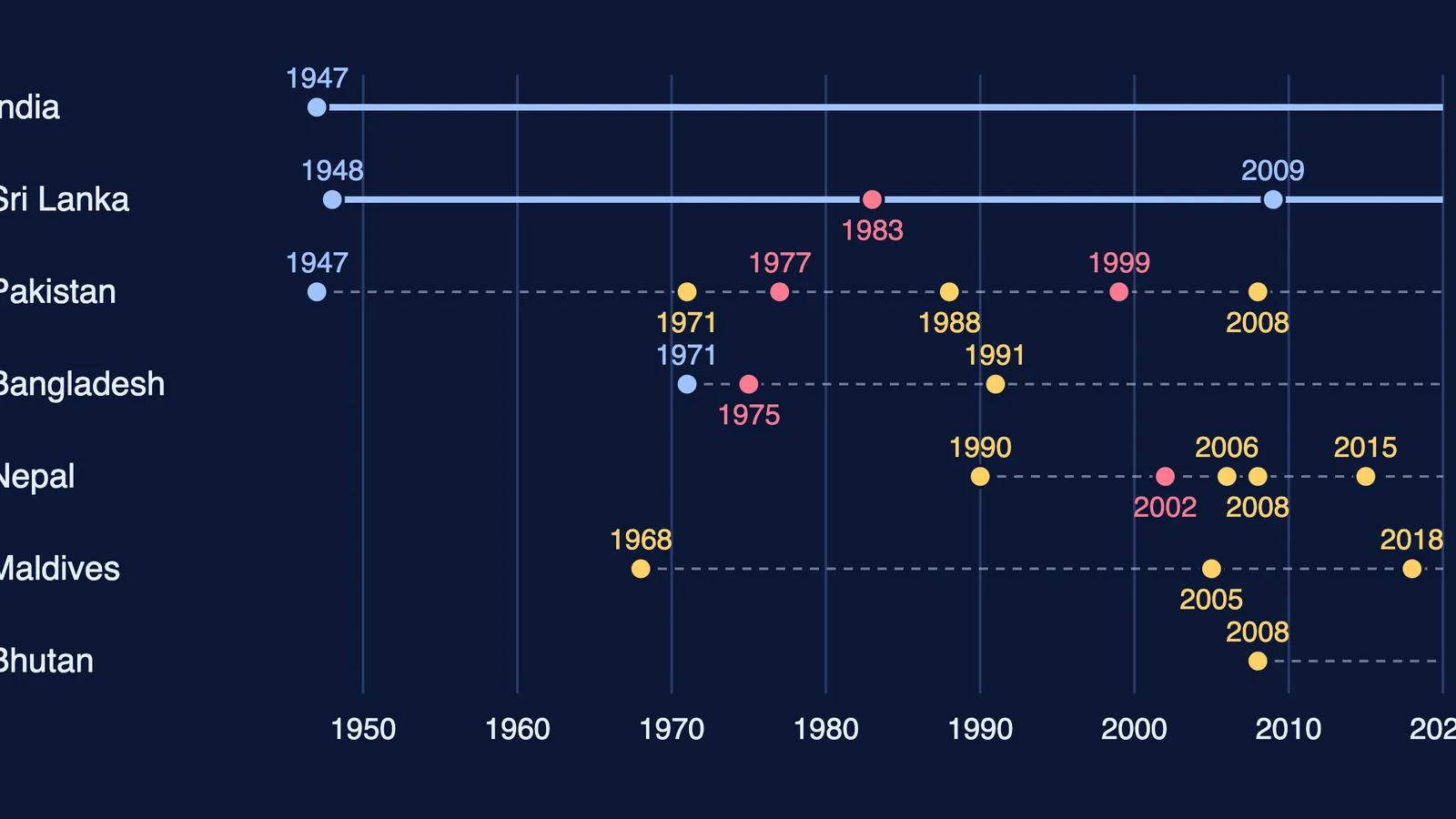
The timeline above puts the chapter's dates side by side. NCERT calls the record mixed, with a shared wish for democracy.
India and Sri Lanka: NCERT notes that both have run democratic systems since independence (1947 and 1948).
Pakistan: an elected government under Zulfikar Ali Bhutto (1971-1977) was removed by General Zia-ul-Haq in 1977. Elected government returned under Benazir Bhutto in 1988, in 1999 the army stepped in again when General Pervez Musharraf ousted Nawaz Sharif's government, and elected leaders have governed since 2008. NCERT cites the social dominance of the military, clergy and landowners, and also a strong pro-democracy sentiment and a relatively free press.
Bangladesh: part of Pakistan from 1947 to 1971. In 1975 the constitution moved to a presidential system with a single party, and Sheikh Mujib-ur Rahman was assassinated that August. Military leaders held power, at times through elections, until protests made General Ershad step down in 1990; multi-party democracy has worked since the 1991 elections.
Nepal: after a pro-democracy movement the king agreed in 1990 to a new democratic constitution, dissolved parliament in 2002, and restored it after the April 2006 movement. Nepal became a republic in 2008 and adopted a new constitution in 2015.
Sri Lanka's ethnic conflict: from 1983 the LTTE fought for a separate Tamil state; Indian troops went in after a 1987 accord and left without meeting their objective; the LTTE was defeated in 2009.
Maldives and Bhutan: the Maldives became a republic in 1968 and adopted a multi-party system in 2005; Bhutan became a constitutional monarchy in 2008.
What are the main conflicts and areas of cooperation?
For India and Pakistan, NCERT lists Kashmir (wars in 1947-48 and 1965), Siachen, an arms race that turned nuclear in the 1990s (both tested in 1998), and Sir Creek. Each government accuses the other of stirring up trouble on its territory. The Indus Waters Treaty, signed in 1960 with World Bank help, has lasted despite later conflicts (NCERT Chapter 3).
With other neighbours, NCERT pairs disagreements with cooperation: river waters and migration with Bangladesh, alongside the 2015 enclave exchange; open borders and trade disputes with Nepal; a free trade agreement and post-tsunami help for Sri Lanka; hydroelectric projects with Bhutan; and India's 1988 response to the Maldives' request for help. Smaller neighbours fear Indian dominance while India often feels exploited, and India is the only country bordering all the others.
SAARC began in 1985. SAFTA, agreed in 2004 and in force from 1 January 2006, aims to cut trade tariffs; NCERT notes that political differences have limited SAARC's success. China and the United States are named as key outside players.
How should you practise for the exam?
Try these original questions:
(1 mark) Which military ruler's exit in 1990 opened the way to Bangladesh's 1991 elections?
(2 marks) Give one reason Nepal's 2006 movement is called a turning point.
(4 marks) Contrast the main obstacle to democracy in Pakistan (the army) with the one in Nepal (the monarchy), two points each.
(6 marks) Set out India's view of SAFTA and some neighbours' concerns about it, then explain how India's size and central position shape regional cooperation.
Build answers from the timeline: one point, one date, one country. For the chapter that opens this book, see our End of bipolarity Class 12 guide; for answer style across humanities, try Framing the Constitution Class 12. Thinking past the boards? Read about BA political science career options.
If you are juggling several subjects, Fermi's AI tutor can work out what you already know and build a plan for the session, so you sit down to a clear next step.