On this page
Chapter 3 of the new NCERT Class 7 book Exploring Society: India and Beyond, Part 1 (code gees1, First Edition April 2025) explains why India holds snowy peaks, a hot desert and rain-soaked coasts. CBSE publishes no separate 2026-27 curriculum for Classes 6 to 8; these classes follow the NCERT book, and the chapter is assessed by the school.
What is the difference between weather, seasons and climate?
The chapter separates three easily confused words (NCERT, Chapter 3):
Weather is what you feel today or this hour: rain, sunshine, wind. It keeps changing.
Seasons repeat yearly, each bringing its own weather.
Climate is the pattern of weather in a region over a long time, at least several decades.
The book also lists six traditional ṛitus, from vasanta (spring) to śhiśhir (winter).
What are the types of climates in India?
The book surveys seven climate types (NCERT, Chapter 3):
Alpine in the high Himalayas: cold, snowy winters and cool summers.
Temperate in lower hills, home to many hill stations.
Subtropical in the northern plains, where most of India's wheat grows.
Arid in the Thar Desert: very hot days, cool nights, little rain.
Tropical wet on the western coastal strip, good for rice and spices.
Semi-arid on the central Deccan Plateau.
Tropical in eastern India and the southern peninsula, with wet and dry periods set by monsoon winds.
Which factors decide the climate of a place?
The chapter names five factors: latitude, altitude, proximity to the sea, winds and topography (NCERT, Chapter 3). Near the Equator the Sun's rays fall almost straight down and concentrate their heat; near the poles slanting rays spread it thinly. Higher places are cooler, the sea moderates temperature, winds carry hot, cold or moist air, and the Himalayas and Karakoram partly shield India from cold Central Asian winds.
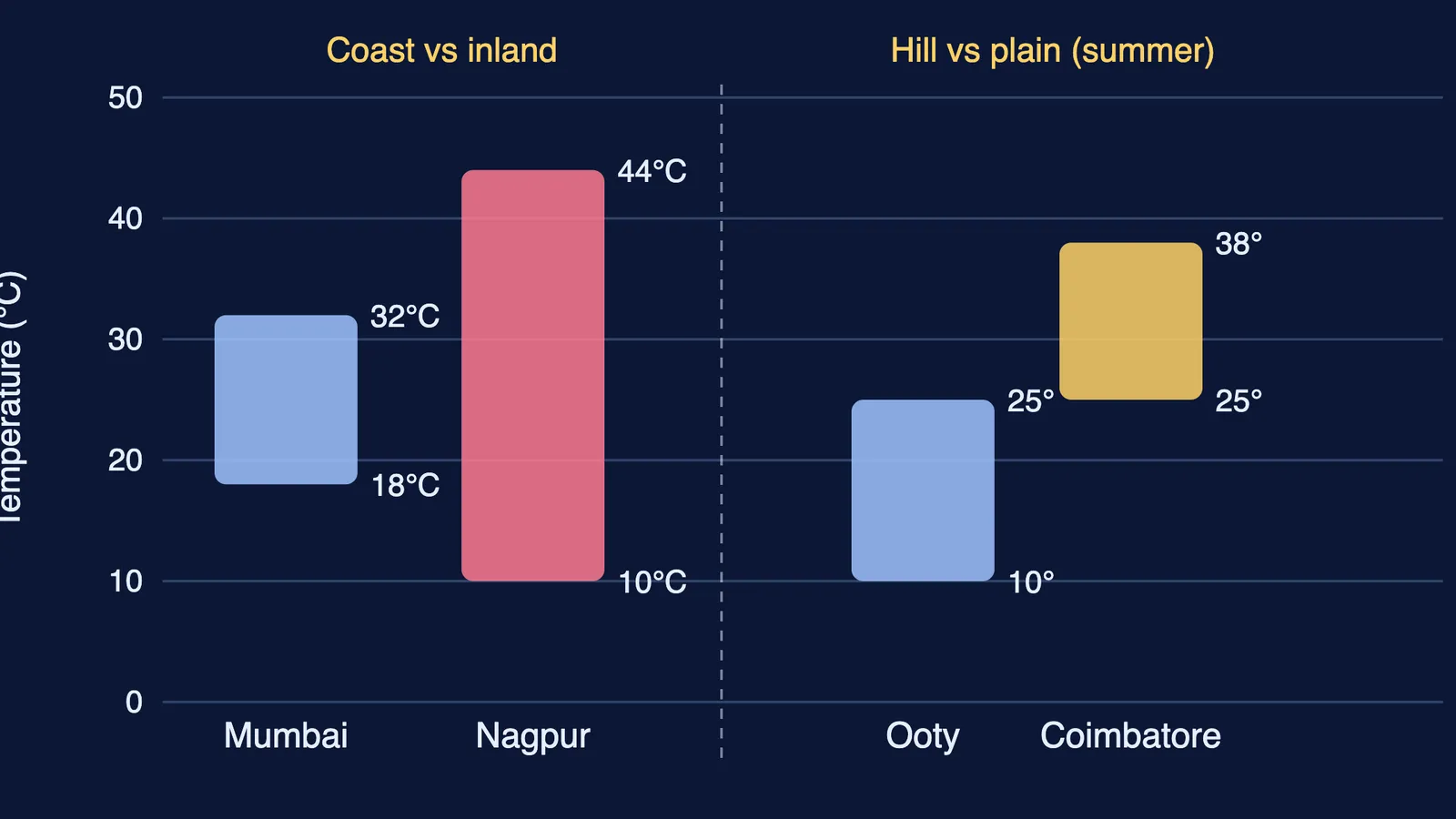
Worked example: the temperature range. The range is the highest temperature minus the lowest. The book gives Mumbai, on the coast, about 32°C in summer and 18°C in winter, so its range is 32 − 18 = 14°C. Nagpur, at a similar latitude but inland, reaches up to 44°C and drops to about 10°C, so its range is 44 − 10 = 34°C (NCERT, Chapter 3). Nagpur's range is 20°C wider, and the sea explains it.
The same method shows altitude at work. Ooty and Coimbatore lie at nearly the same latitude, yet the book gives Ooty's summer temperatures as 10–25° and Coimbatore's as 25–38° (printed as plain degrees, without the C). Ooty's summer maximum only equals Coimbatore's minimum, because Ooty sits higher.
The chapter also introduces microclimates, such as urban heat islands.
How do the monsoons form?
The word monsoon comes from the Arabic mausim, meaning season, and strictly refers to seasonal winds (NCERT, Chapter 3). In summer the Asian landmass heats faster than the ocean, creating low pressure over land; moist ocean air rushes in and falls as rain. This is the southwest monsoon. The book says the rains usually reach India's southern tip in early June and cover the whole subcontinent by mid-July. The Western Ghats catch much of the rain on their western slopes, leaving the Deccan drier.
In winter the land cools faster and the winds reverse. Air crossing the Bay of Bengal gathers moisture and rains on parts of east and south India: the northeast monsoon. The book also notes that Mawsynram in Meghalaya receives the world's highest average annual rainfall, about 11,000 mm (11 metres). Our guide to a break in the monsoon explains mid-season pauses.
How does climate affect our lives?
The book links climate to festivals, farming and prices. A 'monsoon failure' hurts crops, makes food costlier and can push labourers to migrate to cities (NCERT, Chapter 3). It then covers cyclones (tracked by the IMD), floods, landslides and forest fires. Its glacial-burst example is Uttarakhand in 2013, triggered by days of heavy rain; the book records about 6,000 deaths, many of them pilgrims.
Climate change, the book says, has been driven since the 19th century largely by human activity such as burning fossil fuels. The book's example: early in 2025, India's average temperature was 1 to 3°C above normal, giving a shorter, milder winter. The topic returns in Atmosphere and Climate for Class 9.
Practice questions for Climates of India Class 7
Our own questions; marks are our suggestion.
Give one example each of weather, a season and climate from your town. (3 marks)
Town P (fictional, on the coast) has 33°C in summer and 21°C in winter. Town Q (fictional, inland, same latitude) has 45°C and 7°C. Find both ranges and explain the difference. (3 marks) Answer: P is 12°C, Q is 38°C, a gap of 26°C; the sea moderates P.
Why does the western slope of the Western Ghats get more rain than the Deccan? (2 marks)
Explain why monsoon winds reverse between summer and winter. (3 marks)
Name one natural and one human cause of landslides. (2 marks)
Stuck on why land and sea heat differently? Fermi's AI tutor works out what you already know and builds a plan for the session.