On this page
Eight new JEE Advanced-style kinetics questions, easy to hard, each with a solution and the trap behind the tempting wrong option.
The official JEE (Advanced) 2026 syllabus lists rate laws, half-life, integrated rate laws for zero and first order only, the Arrhenius equation and catalysis; every question stays inside it. Catalyst facts follow NCERT Class 12 Chemistry, Unit 3 (Reprint 2026-27). For the chapter plan, read how to prepare chemical kinetics for JEE Advanced.
How should you use this practice set?
Allow 35 minutes. Cover the solutions; write the order and equation before reading options.
In "one or more options correct" questions, judge each option alone; our guide to JEE Advanced question types explains the formats.
Easy: rate laws and what a catalyst can do
Q1 (easy, single-correct). For A + 2B → products, initial rates (mol L⁻¹ s⁻¹) are 1.6 × 10⁻⁴ at [A] = 0.10, [B] = 0.20 mol L⁻¹; 4.8 × 10⁻⁴ at 0.30, 0.20; and 8.0 × 10⁻⁵ at 0.20, 0.10. Which is correct?
(A) rate = k[A][B]², k = 4.0 × 10⁻² L² mol⁻² s⁻¹ (B) rate = k[A][B]², k = 4.0 × 10⁻² mol² L⁻² s⁻¹ (C) rate = k[A]²[B], k = 8.0 × 10⁻² L² mol⁻² s⁻¹ (D) rate = k[A][B], k = 8.0 × 10⁻³ L mol⁻¹ s⁻¹
Answer: (A). Runs 1 and 2: tripling [A] triples the rate, so first order in A. Runs 1 and 3: [A] doubles, [B] halves and the rate halves, so 2 × (½)ⁿ = ½ and n = 2. So k = 1.6 × 10⁻⁴ ÷ 0.004 = 0.040 L² mol⁻² s⁻¹. Trap: (D) treats run 3 as if only [B] changed.
Q2 (easy, one or more options correct). Which statements about catalysts are correct?
(A) A catalyst added to a mixture at equilibrium leaves its composition unchanged. (B) A suitable catalyst can drive a reaction with ΔG > 0. (C) Ammonia decomposing on hot platinum at high pressure is zero order because the surface is saturated. (D) A catalyst raises the rate without changing the activation energy.
Answer: (A), (C). NCERT: a catalyst speeds both directions equally, leaving K unchanged (A); it does not alter ΔG or catalyse non-spontaneous reactions (not B); it lowers Ea (not D). (C) is NCERT's own zero-order example. Trap: (B), "catalysts make reactions happen".
Medium: pressure data, two reactants and temperature
Q3 (medium, single-correct). In a rigid vessel, 2A(g) → B(g) + 3C(g) runs on a saturated metal surface with −dp(A)/dt = 2.0 × 10⁻³ bar s⁻¹ (zero order), starting from pure A at 0.80 bar. When is the total pressure 1.40 bar?
(A) 150 s (B) 300 s (C) 600 s (D) 700 s
Answer: (B). If A falls by x, the total is 0.80 − x + x/2 + 3x/2 = 0.80 + x. So x = 0.60 bar and t = 300 s. Trap: (A) writes the total as 0.80 + 2x; (C) halves the rate for the coefficient 2.
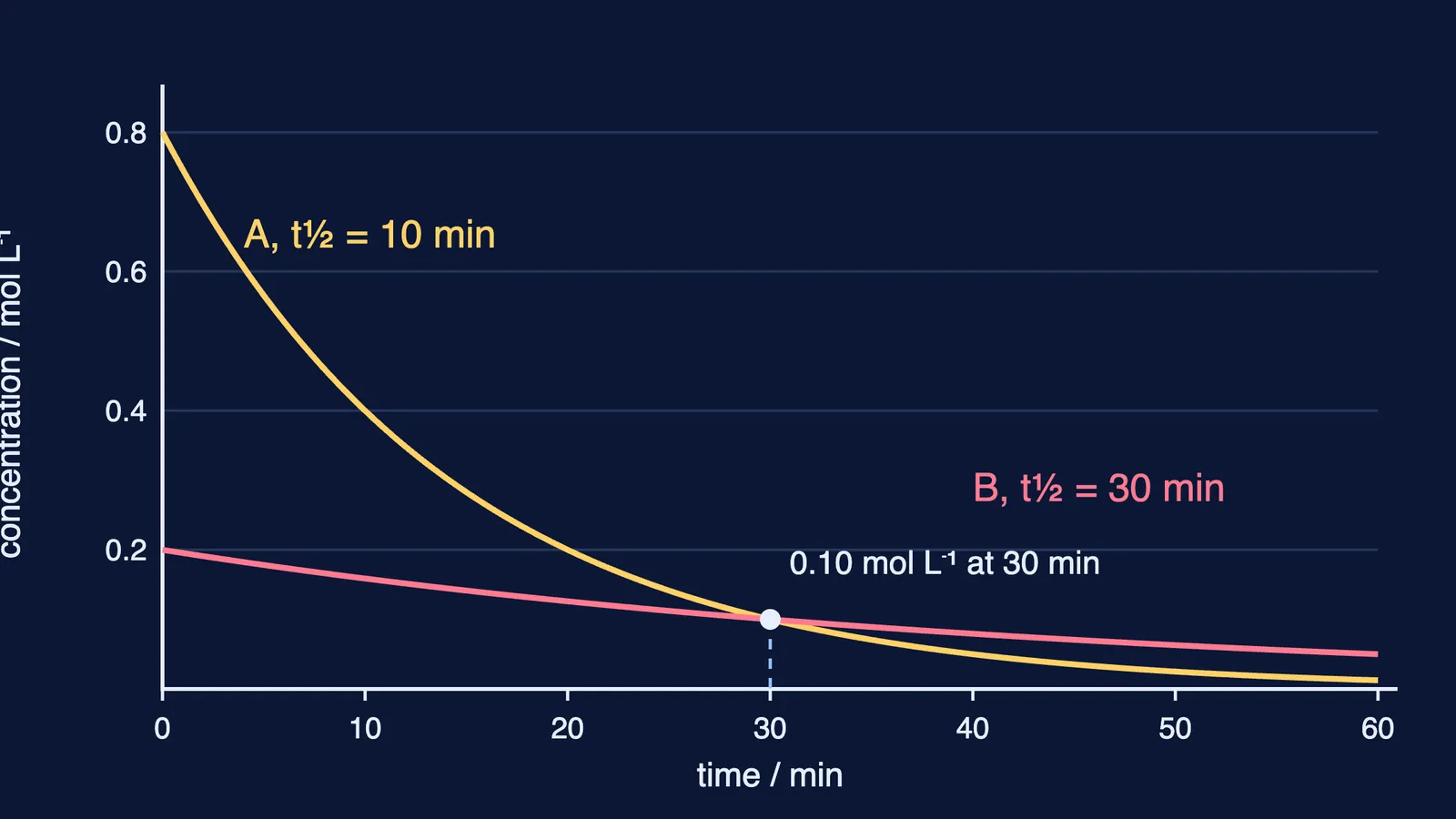
Q4 (medium, numerical-value). Separately, A (0.80 mol L⁻¹, t½ = 10 min) and B (0.20 mol L⁻¹, t½ = 30 min) decay by first-order kinetics. After how many minutes are their concentrations equal?
Answer: 30. From 0.80 e^(−k_A t) = 0.20 e^(−k_B t), t = ln 4 ÷ (k_A − k_B) = 30 min. Check: A has halved three times and B once, both to 0.10. Trap: adding the rate constants gives 15.
Q5 (medium, single-correct). A catalyst lowers Ea from 100 to 80 kJ mol⁻¹ with the pre-exponential factor unchanged, and the catalysed reaction runs at 300 K. At what temperature does the uncatalysed reaction have the same rate constant?
(A) 240 K (B) 320 K (C) 375 K (D) 416 K
Answer: (C). Equal k and equal A need equal Ea/T: 100/T = 80/300, so T = 375 K. Trap: (D) applies the rough "rate doubles every 10 K" rule to the factor of about 3,000.
Hard: combining laws and mechanisms
Q6 (hard, numerical-value). A first-order reaction has t½ = 69.3 min at 300 K and Ea = 60 kJ mol⁻¹ (R = 8.314 J K⁻¹ mol⁻¹). At what temperature (nearest whole K) is 75% used up in 15.0 min?
Answer: 331. k₁ = 0.693/69.3 = 0.0100 min⁻¹. 75% used is two half-lives, so k₂ = ln 4 / 15.0 = 0.0924 min⁻¹. Then 1/T₂ = 1/300 − (R/Ea) ln(k₂/k₁), so T₂ = 330.6 K. Trap: reading "75% used" as 25% used gives about 308 K.
Q7 (hard, one or more options correct). For 2A + B₂ → 2AB, the proposed mechanism is B₂ ⇌ 2B (fast equilibrium, constant K), then A + B → AB (slow, rate constant k₂). Which are correct?
(A) Rate = k[A][B₂]^½, so the overall order is 3/2. (B) Tripling [B₂] at fixed [A] triples the rate. (C) The rate-determining step is bimolecular. (D) The overall reaction is termolecular.
Answer: (A), (C). Rate = k₂[A][B] with [B] = (K[B₂])^½, so k = k₂K^½ and the order is 1 + ½ = 3/2. (C) holds: the slow elementary step has two reacting species. (B) fails: the rate rises √3 times. (D) fails: molecularity applies only to elementary steps. Trap: reading order 3 from the balanced equation.
Q8 (hard, list-match). A first-order reaction has t½ = 20 min. Match List-I with List-II.
List-I: (P) minutes for 87.5% to react; (Q) % left after 50 min; (R) initial rate ÷ rate at 30 min; (S) initial rate ÷ average rate over the first 20 min
List-II: (1) 1.39 (2) 2.83 (3) 17.7 (4) 60 (5) 82.3
(A) P→4, Q→3, R→2, S→1 (B) P→4, Q→5, R→2, S→1 (C) P→4, Q→3, R→1, S→2 (D) P→4, Q→5, R→1, S→2
Answer: (A). 87.5% is three half-lives: 60 min. After 50 min, 2^(−2.5) = 17.7% is left. Rate follows concentration: R = 2^1.5 = 2.83. Initial rate (0.693/20)[A]₀ over average 0.5[A]₀/20 gives S = 2 ln 2 = 1.39. Trap: (B) gives the 82.3% that has reacted.
What should you do after this set?
Q1, Q3 or Q7 missed: write the rate law and stoichiometry first.
Q4, Q6 or Q8 missed: sketch the curve first; our explainer on zero and first-order concentration-time graphs shows each shape.
Q2 or Q5 missed: reread NCERT section 3.4.1 on catalysts.
For the weak step, the Fermi Problem Library has worked problems with a step-by-step solver that explains the reasoning rather than printing an answer.