On this page
In JEE Advanced, a kinetics question rarely stops at one formula. You may turn a total pressure into a rate constant, then predict a half-life or a product ratio. Below: the official topics, two original worked examples and a plan.
What does the JEE Advanced syllabus include in chemical kinetics?
The official JEE (Advanced) 2026 Syllabus says it is unchanged from 2025. Its Chemical Kinetics section reads: "Rates of chemical reactions; Order and molecularity of reactions; Rate law, rate constant, half-life; Differential and integrated rate expressions for zero and first order reactions; Temperature dependence of rate constant (Arrhenius equation and activation energy); Catalysis: Homogeneous and heterogeneous, activity and selectivity of solid catalysts, enzyme catalysis and its mechanism."
The 2027 syllabus is not published yet (as of 19 November 2026). The JEE (Advanced) 2027 website says the exam will be held on 23 May 2027 (Sunday), organised by IIT Delhi. To be eligible you must be among the top 2,50,000 candidates in the B.E./B.Tech. paper of JEE (Main) 2027, along with the other eligibility criteria.
What does JEE Advanced add beyond JEE Main?
Compare the list above with Unit 8 of the NTA's Syllabus for JEE (Main) - 2027. Its kinetics unit names the catalyst only as a factor affecting rate. The JEE Advanced list adds:
homogeneous and heterogeneous catalysis
activity and selectivity of solid catalysts
enzyme catalysis and its mechanism
Build on our chemical kinetics guide for JEE Main and Class 12 board guide to chemical kinetics. Question style matters more. JEE (Advanced) 2026 had two compulsory papers of three hours each (2026 Information Brochure); do not rely on a fixed pattern. Practise single-correct, multiple-correct and numerical-answer thinking; our guide to JEE Advanced question types explains each.
Worked example 1: how do you get a rate constant from total pressure?
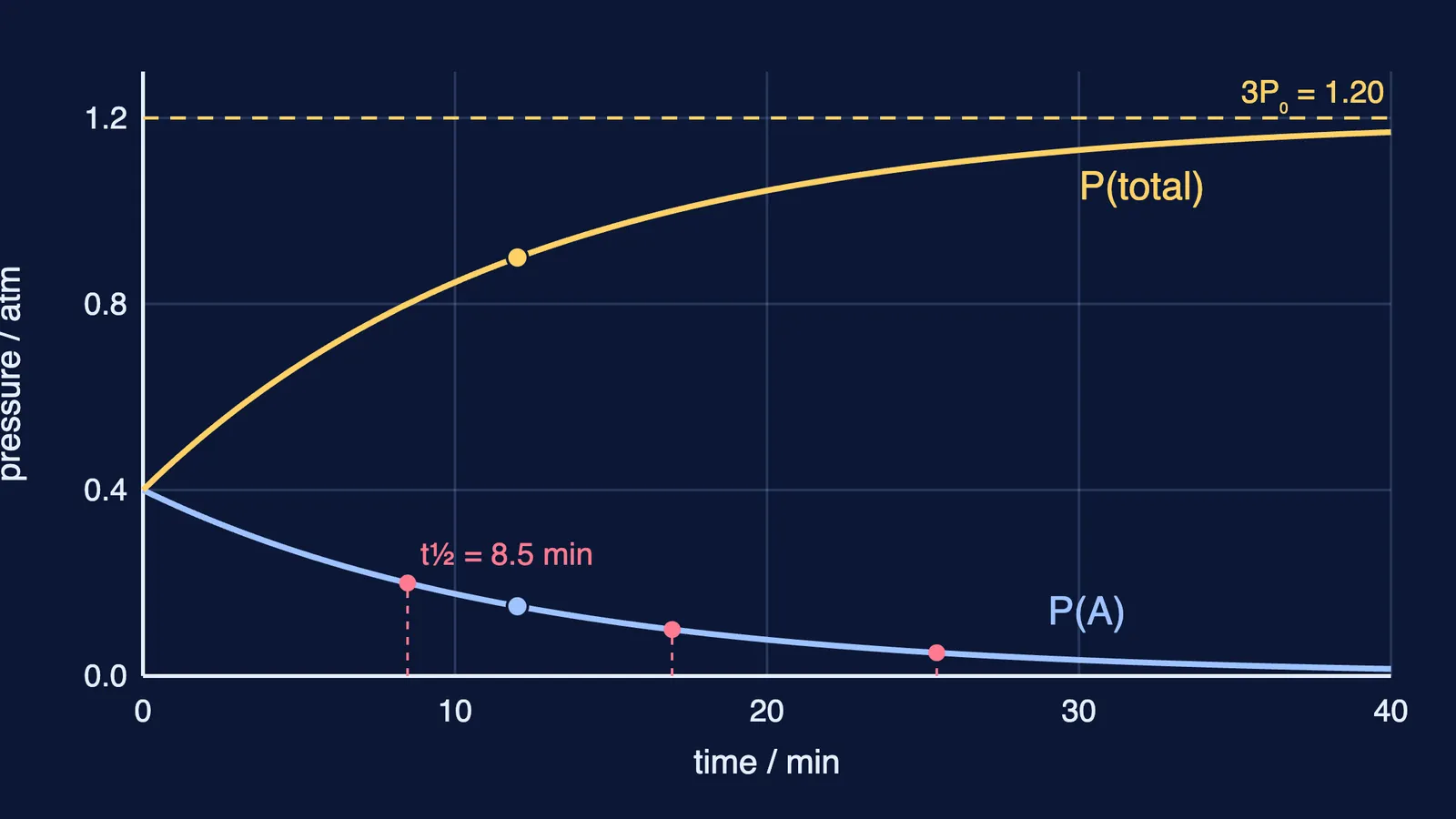
Gas A decomposes by first-order kinetics in a rigid vessel at fixed temperature: A(g) → 2B(g) + C(g). At the start only A is present, at 0.40 atm. After 12.0 minutes the total pressure is 0.90 atm. Find k, the half-life, and the total pressure at 30.0 minutes.
If A falls by x, the total is 0.40 − x + 2x + x = 0.40 + 2x. So 0.90 = 0.40 + 2x, giving x = 0.25 atm and P(A) = 0.15 atm.
First order: k = (1/t) ln(P₀/P) = (1/12.0) ln(0.40/0.15) = 0.0817 min⁻¹.
Half-life: t½ = 0.693/k = 8.48 min.
At 30.0 min: P(A) = 0.40 e^(−0.0817 × 30) = 0.034 atm, so the total is 0.40 + 2(0.366) = 1.13 atm.
Check the limits: the total starts at 0.40 atm and approaches 3P₀ = 1.20 atm, never passing it. The trap is putting the total pressure straight into ln(P₀/P), which gives a negative k.
Worked example 2: how can a catalyst change which product you get?
A reacts by two parallel first-order paths: A → B with Ea = 60 kJ mol⁻¹, and A → C with Ea = 80 kJ mol⁻¹. Both have the same Arrhenius pre-exponential factor. Take R = 8.314 J mol⁻¹ K⁻¹.
For parallel paths, [B]/[C] = k₁/k₂ at every moment.
With equal factors, k₁/k₂ = e^((Ea₂ − Ea₁)/RT). At 300 K: e^(20,000/2494) = e^(8.02), about 3,000.
At 400 K: e^(6.01), about 410. Heating favours the higher-Ea path, so selectivity for B falls.
Now a solid catalyst lowers the Ea of the C path only, to 55 kJ mol⁻¹. At 300 K, k₂/k₁ = e^(5000/2494), about 7.4. C is now the main product.
Traps: the half-life of A uses k₁ + k₂. And a catalyst cannot shift an equilibrium, yet it can change the product ratio under kinetic control.
How should you practise chemical kinetics for JEE Advanced?
Two weeks, about an hour a day:
Days 1-3: rate laws, order versus molecularity, and units of k for each order.
Days 4-6: zero and first order in integrated form, half-lives, and pressure or titre data.
Days 7-9: Arrhenius from two temperatures, and parallel reactions.
Days 10-11: homogeneous and heterogeneous catalysis, and the enzyme mechanism E + S ⇌ ES → E + P; explain why its rate levels off.
Days 12-14: mixed timed sets; note the step behind each miss.
Not sure which step went wrong? The Fermi Problem Library has worked problems with a step-by-step solver that explains the reasoning rather than printing an answer.
Try these original questions:
A reaction on a saturated catalyst surface is zero order, with [A]₀ = 0.80 mol L⁻¹ and k = 0.020 mol L⁻¹ min⁻¹. Find the half-life and the time for complete reaction. Answer: 20 min and 40 min.
An enzyme follows rate = Vmax[S]/(Km + [S]) with Km = 2.0 mM. At what [S] is the rate 90% of Vmax? Answer: 18 mM.
A rate constant triples between 290 K and 320 K. Find Ea. Answer: about 28.3 kJ mol⁻¹.