On this page
These eight original JEE Advanced-style questions on chemical and ionic equilibrium run from easy to hard and mix single-correct, one-or-more-correct, numerical and list-match types. Each has a worked solution and a trap: the option that catches a hurried student.
The official JEE (Advanced) 2026 syllabus covers this unit from the law of mass action and ΔG° to Ksp, buffers and hydrolysis of salts. Every question stays inside it and the NCERT Class 11 Equilibrium chapter (Reprint 2026-27). New to the chapter? Read our guide on how to prepare chemical and ionic equilibrium for JEE Advanced first.
How should you use this practice set?
Allow 30 minutes for all eight, and write one line of reasoning before reading any solution.
Judge each option of a one-or-more-correct question separately; our guide to multiple-correct questions and partial marking covers how to approach them.
Give numerical answers to two decimal places.
Easy: can you apply each idea cleanly?
Q1 (easy, single correct). For X(g) ⇌ 2Y(g), ΔG° = +7.66 kJ mol⁻¹ at 400 K. A mixture at 400 K has pX = 0.40 bar and pY = 0.10 bar. With R = 8.314 J mol⁻¹ K⁻¹, ΔG for this mixture and its direction of change are
(A) −4.61 kJ mol⁻¹, forward (B) +7.66 kJ mol⁻¹, backward (C) −2.00 kJ mol⁻¹, forward (D) +4.61 kJ mol⁻¹, backward
Answer: (A). ΔG° = −2.303RT log Kp gives Kp = 0.10. Q = (0.10)²/0.40 = 0.025, so ΔG = 2.303RT log(Q/K) = 7.66 × log 0.25 = −4.61 kJ mol⁻¹: forward. Trap: (B) reads direction from ΔG°. ΔG° fixes K; ΔG at the actual Q decides direction.
Q2 (easy, one or more correct). A₂(g) ⇌ 2A(g) has ΔH > 0 and is at equilibrium. Which statements are correct?
(A) Adding argon at constant volume leaves the amount of A unchanged. (B) Adding argon at constant total pressure raises the degree of dissociation. (C) Raising the temperature increases Kp. (D) Kp/Kc is the same at every temperature.
Answer: (A), (B), (C). At constant volume, argon changes no partial pressure. At constant total pressure it dilutes A₂ and A like an expansion, favouring the side with more gas moles. An endothermic reaction has larger K at higher T. Trap: (D). With Δn = 1, Kp/Kc = RT, which changes with temperature. See how Kp = Kc(RT)^Δn is derived.
Q3 (easy, numerical). Find the pH of 1.5 × 10⁻⁷ M HNO₃ at 298 K (Kw = 1.0 × 10⁻¹⁴).
Answer: 6.70. Water's own H⁺ now matters. Charge balance gives h = 1.5 × 10⁻⁷ + Kw/h, so h = 2.0 × 10⁻⁷ M and pH = 6.70. Trap: 6.82 counts only the acid's H⁺.
Medium: can you link two quantities?
Q4 (medium, single correct). Pure X₂ (molar mass 80 g mol⁻¹) partly dissociates as X₂(g) ⇌ 2X(g). At equilibrium at 1.0 bar, the mixture's average molar mass is 60 g mol⁻¹. Kp is
(A) 0.13 bar (B) 0.27 bar (C) 0.50 bar (D) 0.67 bar
Answer: (C). Mass is conserved, so 80/60 = 1 + α, α = 1/3. Then Kp = 4α²P/(1 − α²) = (4/9)/(8/9) = 0.50 bar. Trap: (B) takes α = (80 − 60)/80.
Q5 (medium, one or more correct). Solid AgNO₃ is added slowly to a solution 0.010 M in both Cl⁻ and CrO₄²⁻ (volume constant). Ksp(AgCl) = 1.8 × 10⁻¹⁰ and Ksp(Ag₂CrO₄) = 1.1 × 10⁻¹². Which statements are correct?
(A) AgCl starts to precipitate first. (B) Ag₂CrO₄ starts to precipitate when [Ag⁺] reaches about 1.05 × 10⁻⁵ M. (C) When Ag₂CrO₄ first precipitates, over 1% of the Cl⁻ remains in solution. (D) In pure water, Ag₂CrO₄ has a higher molar solubility than AgCl.
Answer: (A), (B), (D). AgCl needs [Ag⁺] = 1.8 × 10⁻⁸ M; Ag₂CrO₄ needs √(1.1 × 10⁻¹²/0.010) = 1.05 × 10⁻⁵ M. By then [Cl⁻] = 1.7 × 10⁻⁵ M, only 0.17% of the start, so (C) is false. In pure water, s(AgCl) = √Ksp = 1.3 × 10⁻⁵ M and s(Ag₂CrO₄) = (Ksp/4)^⅓ = 6.5 × 10⁻⁵ M. Trap: rejecting (D) because Ag₂CrO₄ has the smaller Ksp; Ksp compares solubility only within one formula type.
Q6 (medium, numerical). Find the pH of a solution 0.20 M in HA (Ka = 1.8 × 10⁻⁵) and 0.10 M in HB (Ka = 6.4 × 10⁻⁵).
Answer: 2.50. Each acid suppresses the other through the shared H⁺. With both slightly ionized, [H⁺]² ≈ Ka₁c₁ + Ka₂c₂ = 1.0 × 10⁻⁵, so pH = 2.50; an exact solution agrees. Trap: 2.60 keeps only the stronger acid.
Hard: can you choose the right model?
Q7 (hard, list match). Diprotic H₂A has pKa₁ = 4.0 and pKa₂ = 8.0 at 298 K. Match each solution to its pH.
List I: (P) 0.10 M H₂A; (Q) 0.10 M NaHA; (R) 0.10 M Na₂A; (S) 0.10 M NaHA + 0.10 M Na₂A. List II: (1) 2.5; (2) 6.0; (3) 7.0; (4) 8.0; (5) 10.5.
(A) P→1, Q→3, R→5, S→4 (B) P→1, Q→2, R→5, S→4 (C) P→1, Q→2, R→4, S→5 (D) P→1, Q→4, R→5, S→2
Answer: (B). P: [H⁺] ≈ √(10⁻⁴ × 0.10), pH 2.5. Q: HA⁻ both gives and takes protons, so pH ≈ ½(pKa₁ + pKa₂) = 6.0. R: A²⁻ hydrolyses with Kb = 10⁻⁶, so pOH 3.5 and pH 10.5. S: an equimolar HA⁻/A²⁻ buffer, pH = pKa₂ = 8.0. Trap: (A) assumes a salt like NaHA is neutral.
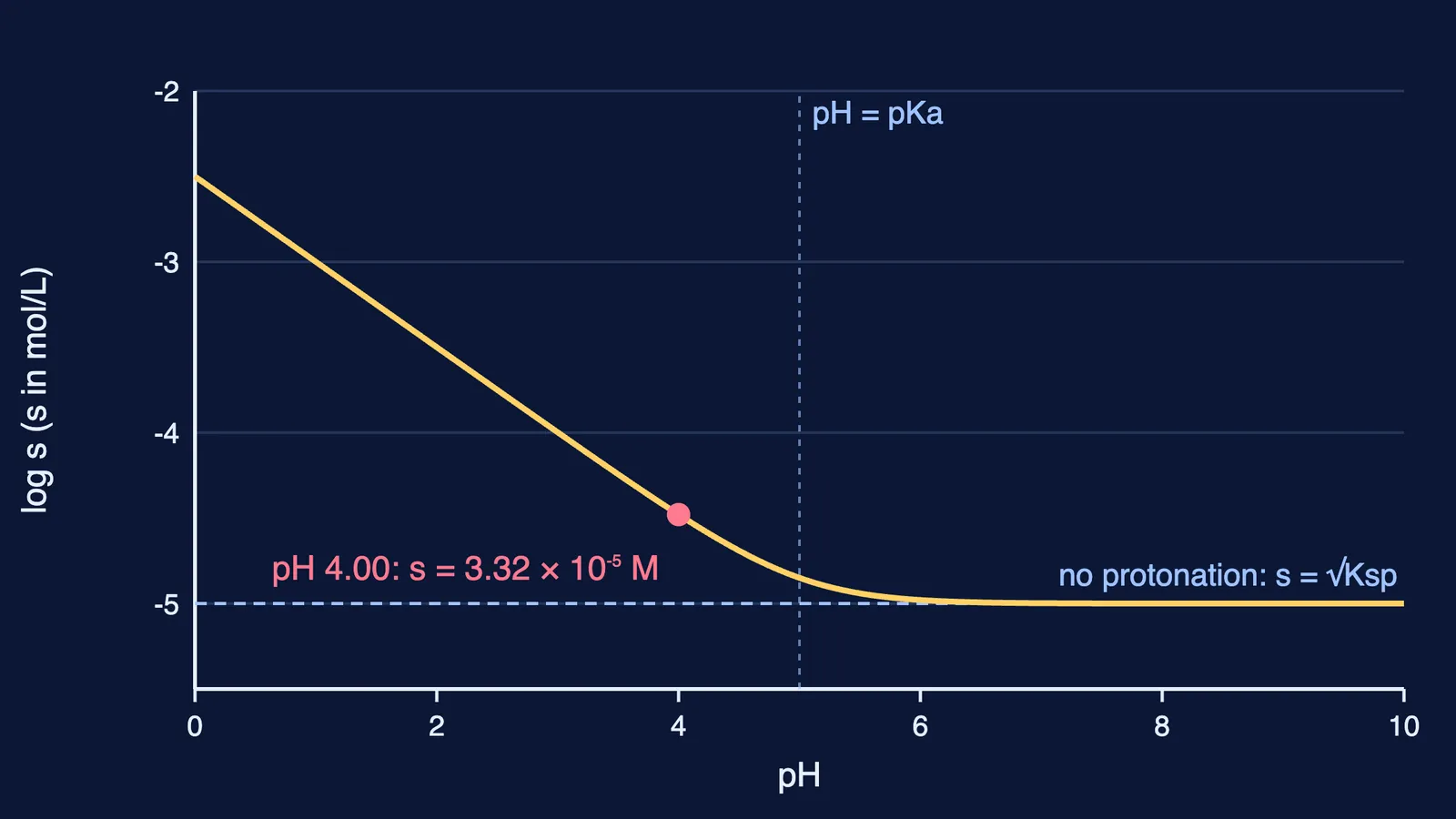
Q8 (hard, numerical). Salt MA has Ksp = 1.0 × 10⁻¹⁰; HA is a weak acid with Ka = 1.0 × 10⁻⁵. In a buffer at pH 4.00, MA dissolves to x × 10⁻⁵ mol L⁻¹. Find x.
Answer: 3.32. Dissolved A⁻ is partly protonated: s = [A⁻] + [HA] = [A⁻](1 + [H⁺]/Ka) = 11[A⁻]. Then Ksp = s²/11, so s = √(11 × 10⁻¹⁰) = 3.32 × 10⁻⁵ M. Trap: 1.00 ignores protonation; 3.16 drops the 1.
What should you do after this set?
Sort misses by trap. Q1 or Q2 wrong means K, Q and ΔG are blurring. Q5, Q7 or Q8 wrong means you reached for a formula before listing the species present; redo them writing every equilibrium first.
If the method keeps slipping, the Fermi Problem Library has worked problems with a step-by-step solver that explains the reasoning rather than printing an answer.