On this page
Cell: The Unit of Life is Chapter 8 of the NCERT Class 11 Biology textbook (reprint 2026-27). The CBSE Class XI Biology syllabus for 2026-27 covers the whole chapter, with no topics excluded. The terms below follow that order. For side-by-side comparisons and practice questions, see our Cell: The Unit of Life Class 11 guide.
What does cell theory say?
Cell: the smallest unit that can live on its own and carry out all life functions.
Cell theory: proposed by Schleiden (plants, 1838) and Schwann (animals, 1839). As held today: all living things are made of cells and cell products, and every cell comes from an existing cell.
Omnis cellula-e cellula: Rudolf Virchow's 1855 statement that new cells form only by division of pre-existing cells. Don't confuse with: Robert Brown, who discovered the nucleus, not the cell.
How is a prokaryotic cell different from a eukaryotic cell?
Prokaryotic cell: a cell with no membrane-bound nucleus and no membrane-bound organelles. Example: bacteria, blue-green algae, mycoplasma, PPLO.
Eukaryotic cell: a cell with a nucleus inside a nuclear envelope and many membrane-bound organelles. Example: protists, fungi, plants, animals.
Plasmid: a small circular DNA outside a bacterium's main chromosome; it can give traits such as antibiotic resistance.
Cell envelope: the three tightly bound layers around many bacteria: glycocalyx outside, then cell wall, then plasma membrane.
Slime layer vs capsule: a loose glycocalyx versus a thick, tough one.
Gram positive vs Gram negative: bacteria that take up Gram's stain versus those that do not.
Mesosome: an infolding of the bacterial plasma membrane that helps in cell wall formation, DNA replication, respiration and secretion. Don't confuse with: chromatophores, pigment-holding membrane extensions in cyanobacteria.
Pili and fimbriae: surface structures that do not move the cell; fimbriae help some bacteria stick to rocks or host tissue. Don't confuse with: bacterial flagella, which do move it.
Inclusion bodies: stored reserves lying free (no membrane) in prokaryotic cytoplasm. Example: glycogen granules.
What do the cell membrane and cell wall do?
Fluid mosaic model: Singer and Nicolson's 1972 model of the membrane: a quasi-fluid lipid bilayer in which proteins can drift sideways.
Integral vs peripheral proteins: proteins buried partly or fully in the membrane versus those sitting on its surface.
Passive transport: movement across the membrane with no energy spent, from higher to lower concentration. Example: simple diffusion of neutral solutes.
Osmosis: diffusion of water across a membrane.
Active transport: moving ions or molecules against their concentration gradient, using ATP. Example: the Na+/K+ pump.
Middle lamella: a layer mostly of calcium pectate that cements neighbouring plant cells together. Don't confuse with: plasmodesmata, the channels through the wall that join the cytoplasm of neighbouring cells.
Which organelles make up the endomembrane system?
The NCERT chapter counts the ER, Golgi complex, lysosomes and vacuoles here because their work is coordinated.
Rough ER vs smooth ER: ER studded with ribosomes, common in cells making and secreting proteins, versus ER without ribosomes, the main site of lipid and, in animals, steroid hormone synthesis.
Golgi apparatus: stacks of flat sacs (cisternae) that receive material from the ER at the convex cis face, modify and package it, and release it from the concave trans face.
Lysosome: a membrane-bound vesicle from the Golgi, packed with hydrolytic enzymes that work best at acidic pH.
Tonoplast: the single membrane around a vacuole; in plants it pumps ions into the vacuole against the gradient.
What are mitochondria, plastids and ribosomes?
Cristae: infoldings of the mitochondrion's inner membrane that add surface area. Mitochondria are the sites of aerobic respiration. Don't confuse with: cisternae, the flat sacs of the Golgi.
Matrix: the dense inner compartment of a mitochondrion, holding circular DNA, RNA and 70S ribosomes.
Chloroplast, chromoplast, leucoplast: plastids with chlorophyll for photosynthesis, with carotenoids that give yellow, orange or red colour, and colourless storage plastids.
Amyloplast, elaioplast, aleuroplast: leucoplasts storing starch (potato), oils and fats, and proteins.
Thylakoids and grana: flat membrane sacs in the chloroplast stroma; stacked like coins they form grana, linked by stroma lamellae.
70S vs 80S ribosomes: per the NCERT chapter, prokaryotic ribosomes (50S + 30S subunits) versus eukaryotic cytoplasmic ribosomes (60S + 40S). S is the Svedberg unit, a sedimentation coefficient.
Microbodies: small membrane-bound vesicles of enzymes found in plant and animal cells.
What are the cytoskeleton, cilia, centrioles and nucleus?
Cytoskeleton: a protein network of microtubules, microfilaments and intermediate filaments for support, motility and shape.
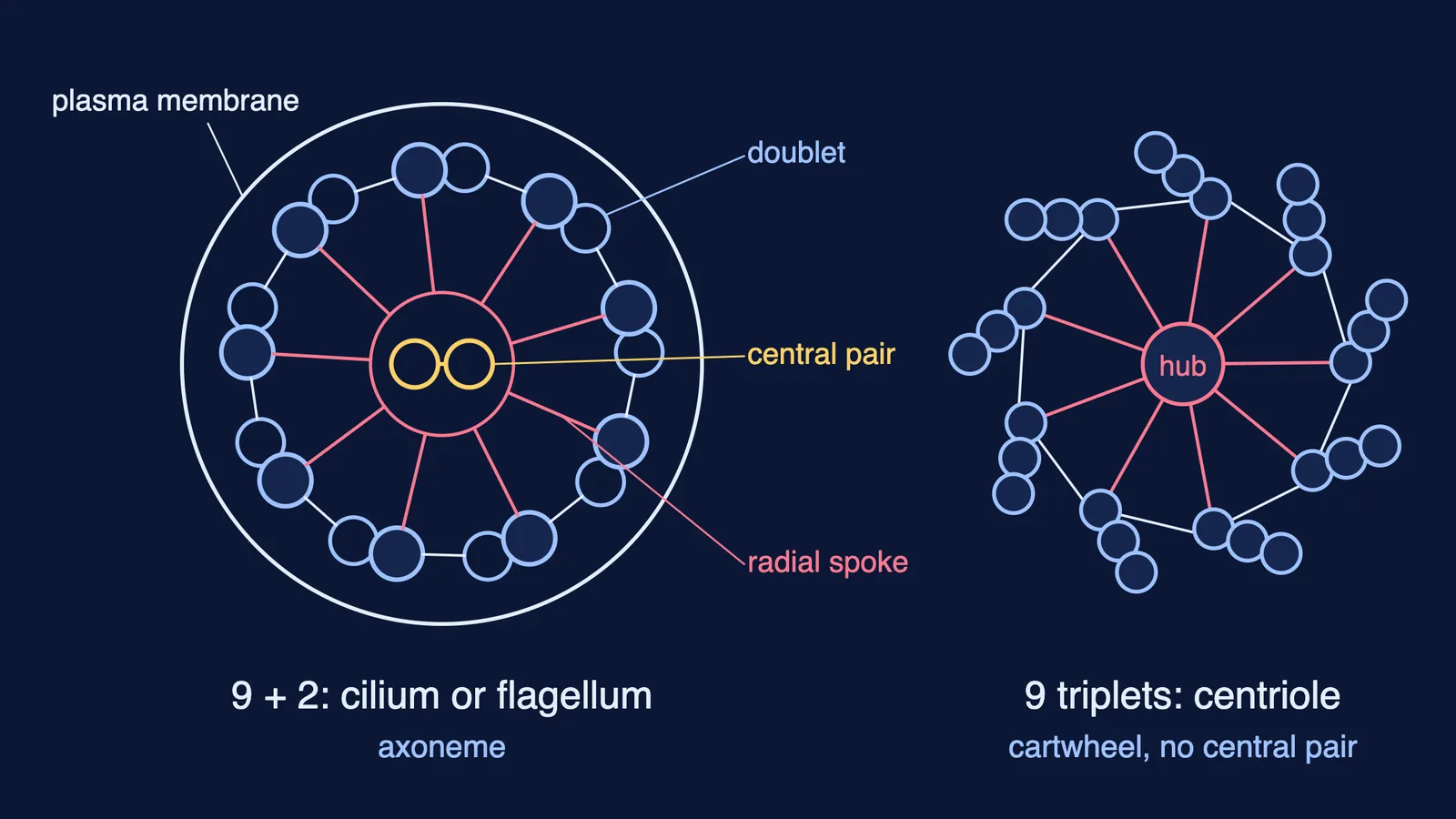
Axoneme: the core of a cilium or flagellum: nine peripheral microtubule doublets around a central pair, the 9+2 array; nine radial spokes run from the central sheath to one tubule of each doublet.
Basal body: the centriole-like structure a cilium or flagellum grows from.
Centriole: a cylinder of nine peripheral tubulin triplets around a central hub, in a cartwheel pattern; a centrosome usually holds two of them at right angles. Don't confuse with: the 9+2 axoneme, which has doublets and a central pair.
Nuclear pore: a gap where the two membranes of the nuclear envelope fuse, letting RNA and proteins pass both ways.
Nucleolus: a non-membrane-bound body in the nucleus where ribosomal RNA is made.
Chromatin: loose nucleoprotein fibres of DNA, histones, non-histone proteins and RNA in a non-dividing nucleus.
Centromere and kinetochore: the primary constriction holding two chromatids, and the disc-shaped structures on its sides.
Metacentric, sub-metacentric, acrocentric, telocentric: chromosomes with the centromere in the middle, slightly off-centre, near one end, and at the very end.
Satellite: a small end segment of a chromosome, set apart (not detached) by a non-staining secondary constriction.
How to learn these terms
Learn the mix-ups as pairs: cristae vs cisternae, mesosome vs chromatophore, 70S vs 80S, slime layer vs capsule, axoneme vs centriole.
Draw the 9+2 and the 9-triplet cross-sections from memory and label doublet, triplet, hub and radial spoke.
Sort organelles into three lists: double membrane (nucleus, mitochondria, chloroplasts), single membrane (ER, Golgi, lysosomes, vacuoles, microbodies) and none (ribosomes, centrioles, nucleolus).
Test yourself with our Cell: The Unit of Life practice questions with solutions.
If a term still feels abstract, the Fermi Concept Library covers every concept in biology, each with its own lesson and its place in the map.