On this page
This second chapter of Unit IV in Class 11 Biotechnology asks how one cell becomes many, how cells signal and how they specialise.
What does the 2026-27 curriculum list for this chapter?
The CBSE Biotechnology (045) curriculum for 2026-27 places this chapter in Unit IV, Cells and Organisms, alongside The Basic Unit of Life. Unit IV carries 25 of the 70 theory marks, shared by both chapters; CBSE prints no separate figure for this one.
Its topic line names six areas: cell division, the cell cycle, cell communication, nutrition, reproduction, and immune response in animals.
The prescribed book is CBSE's A Text Book of Biotechnology for Class XI, with NCERT's book as the reference. We found no official PDF of the CBSE book on cbseacademic.nic.in, so we follow the curriculum's topic list and use Chapter 5, Cellular Processes, of the NCERT Biotechnology textbook (Reprint 2026-27) as the reference. That chapter has no sections titled nutrition or immune response, so check those two against your school's CBSE book.
How is this different from the core Biology chapter?
Core Biology teaches the cell cycle as a stand-alone chapter; our Class 11 Biology guide to cell cycle and cell division covers its stages in detail. The Biotechnology version adds signalling, programmed cell death, stem cells and cell migration, ideas reused when growing cells in culture.
What are the key ideas in cell growth and development?
Cell signalling: a cell answers a chemical signal (ligand) only if it carries the matching receptor. Paracrine signals act over short distances, autocrine signals act on the cell that made them, and endocrine signals (hormones) travel in the blood.
Cell cycle: interphase (G1, S, G2) then M phase. DNA goes from 2C to 4C in S phase while the chromosome number stays the same. Cells that stop dividing leave G1 for G0.
Timing: NCERT puts a typical eukaryotic cell's division time at about 24 hours, varying by organism.
Mitosis and meiosis: mitosis keeps the chromosome number; meiosis halves it and shuffles genes through crossing over, giving four haploid cells for sexual reproduction.
Apoptosis: controlled, energy-dependent cell death, such as the loss of tissue between developing fingers.
Differentiation: cells with identical DNA specialise by expressing different genes. Stem cells are totipotent (zygote), pluripotent (inner cell mass) or multipotent (blood-forming stem cells).
Migration: cells polarise, push out a protrusion that adheres, move the cell body forward, then release and retract the rear. NCERT links this to embryos, wound repair and immune cells moving during inflammation.
How do you calculate cell numbers and DNA content?
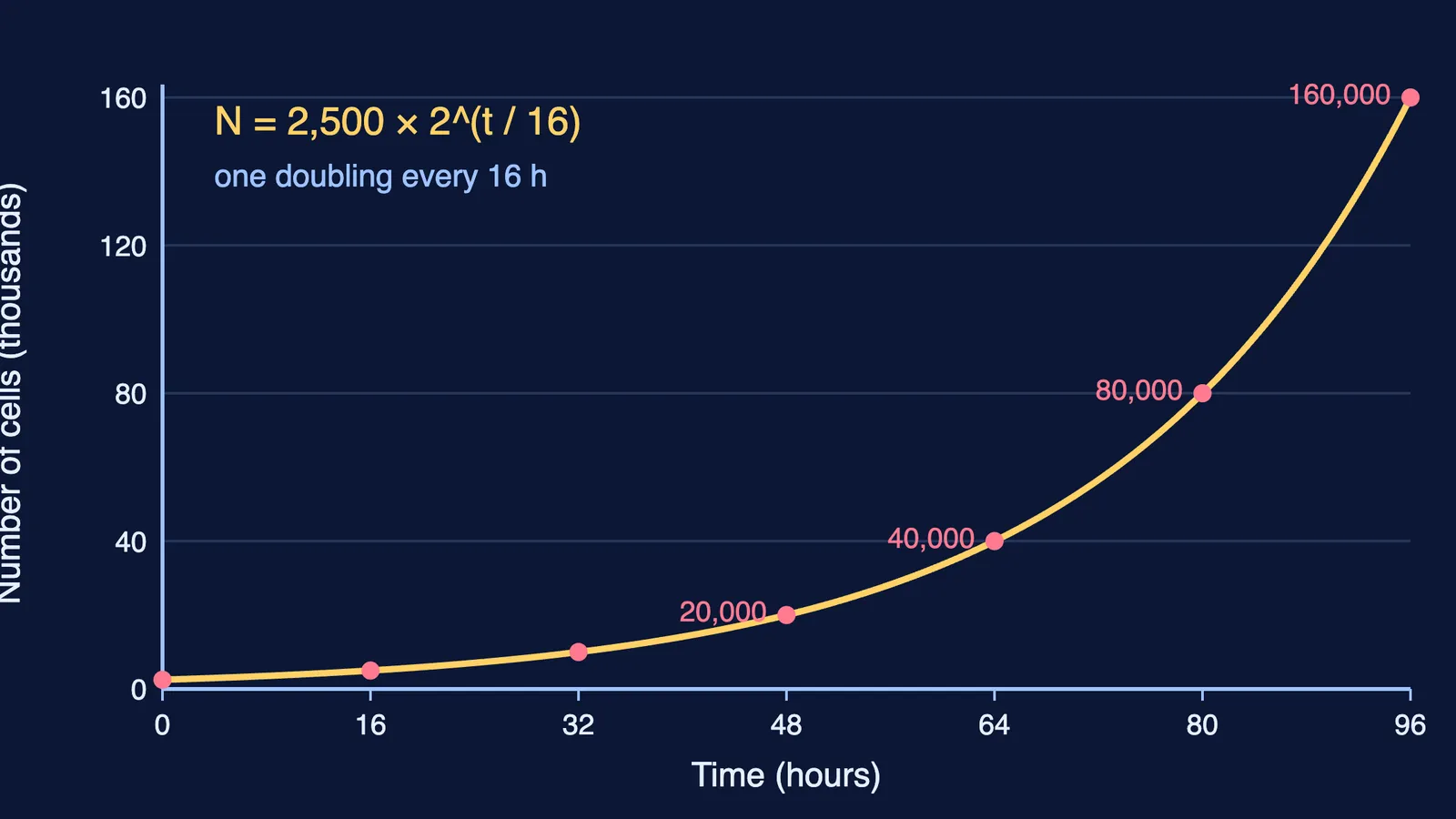
Both use our own numbers; the hero plots the first.
Example 1: cell numbers. A culture starts with 2,500 cells and each cell divides once every 16 hours. After n cycles, N = 2,500 × 2^n.
After 32 hours: 32 ÷ 16 = 2 cycles, so N = 2,500 × 4 = 10,000 cells.
After 80 hours: 5 cycles, so N = 2,500 × 32 = 80,000 cells.
When does the culture reach 1,280,000 cells? 1,280,000 ÷ 2,500 = 512 = 2^9, so 9 cycles × 16 hours = 144 hours.
Example 2: chromosomes and DNA. An animal cell has 2n = 26 and 5 pg of DNA in G1.
G2: 26 chromosomes, 10 pg (DNA doubled in S).
Each daughter cell after mitosis: 26 chromosomes, 5 pg.
Metaphase I: 13 bivalents.
Each cell after meiosis I: 13 chromosomes, 5 pg.
Each cell after meiosis II: 13 chromosomes, 2.5 pg.
What practice questions should you try?
Our own questions; mark labels are our suggestion.
(1 mark) Name the signalling type in which a cell responds to a growth factor it made itself.
(1 mark) Adult stem cells in bone marrow stay non-dividing until injury activates them. Name this state.
(2 marks) A culture of 1,000 cells doubles every 12 hours. How many cells are present after 60 hours?
(2 marks) A gamete made by meiosis has 11 chromosomes and 3.5 pg of DNA. Give the chromosome number and DNA content of its parent cell in G1 and in G2.
(3 marks) In sample A, cells break into membrane-bound pieces that macrophages engulf; in sample B, from crushed tissue, cells spill their contents and the area is inflamed. Name each type of cell death and say which needs energy.
(3 marks) A lab needs cells that can form the placenta and body tissues. Which fits: a zygote, inner cell mass cells or blood-forming stem cells? Why not the other two?
Answers: (1) Autocrine. (2) The quiescent state, G0. (3) 5 cycles, so 32,000 cells. (4) G1: 22 chromosomes, 7 pg; G2: 22 chromosomes, 14 pg. (5) A is apoptosis, B is necrosis; apoptosis is the energy-dependent one. (6) The totipotent zygote; inner cell mass cells are pluripotent and cannot form the placenta, and blood-forming stem cells are multipotent, giving only blood cells.
See also how to prepare cell cycle and cell division for NEET and careers in stem cell research in India.
Not sure which topic to revise first? Fermi's AI tutor works out what you already know and builds a plan for the session.