On this page
These are the key terms of Chapter 10 of the rationalised NCERT Class 11 Biology textbook, Cell Cycle and Cell Division (2026-27 reprint), which the CBSE Class XI Biology syllabus for 2026-27 lists as cell cycle, mitosis, meiosis and their significance. For the chapter plan, see our Cell cycle and cell division Class 11 guide.
What happens in the cell cycle and interphase?
According to NCERT Chapter 10, human cells in culture divide about once every 24 hours, division itself takes about an hour, and interphase fills more than 95% of the cycle.
Cell cycle: one full round of growth, DNA copying and division that turns a single cell into two daughter cells. Example: yeast can finish one in about 90 minutes.
Interphase: the stretch between two divisions. Nicknamed the resting phase, it is when the cell grows and copies its DNA. Don't confuse with: G0.
G1 phase (Gap 1): the first gap after a division; the cell grows and carries on its normal metabolism, but its DNA is not yet being copied.
S phase (Synthesis): DNA is replicated, so DNA per cell rises from 2C to 4C. In animal cells the centriole also duplicates.
G2 phase (Gap 2): growth continues and the cell makes proteins needed for mitosis.
Quiescent stage (G0): a resting state that non-dividing cells move into from G1; they keep their metabolism running but divide again only when the body needs them to. Example: heart cells in adult animals.
DNA content (C) and chromosome number (n): C measures DNA per cell; n counts chromosomes. Don't confuse them: S phase doubles C, but the cell stays 2n because each chromosome now has two chromatids.
Which terms describe mitosis?
NCERT splits nuclear division into four stages but stresses that the process is continuous.
M phase (mitosis): the phase of actual division, called equational division because daughter cells keep the parent's chromosome number. Example: haploid male honey bees also divide by mitosis.
Karyokinesis: division of the nucleus, prophase to telophase. Don't confuse with: cytokinesis.
Cytokinesis: division of the cytoplasm. In animal cells a furrow in the plasma membrane deepens until the cell splits.
Prophase: chromatin condenses into compact chromosomes and the duplicated centrosomes move towards opposite poles; by the end, the nuclear envelope, nucleolus, Golgi complex and ER are not visible.
Aster and mitotic apparatus: an aster is the microtubules radiating from a centrosome; two asters plus spindle fibres make the mitotic apparatus.
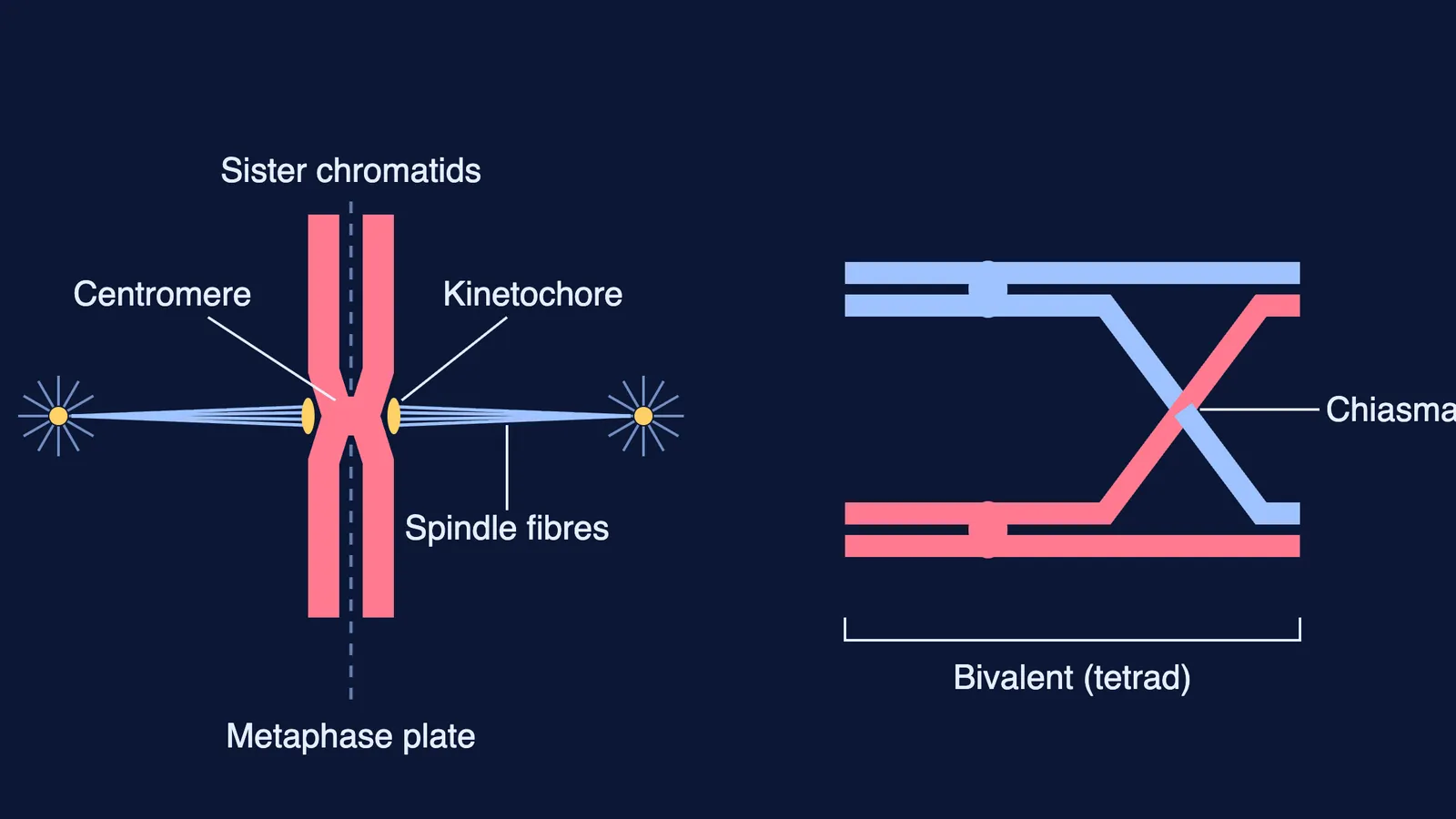
Sister chromatids: the two identical copies of a chromosome made in S phase. Don't confuse with: homologous chromosomes, the two members of a matching pair.
Centromere: the region holding sister chromatids together. Don't confuse with: centrosome, which moves to a pole and radiates the aster.
Kinetochore: a disc-shaped attachment point at the centromere, one per chromatid, where spindle fibres hook on.
Metaphase: begins when the nuclear envelope has fully broken down; condensed chromosomes line up at the equator, sister chromatids tied to fibres from opposite poles. That plane of alignment is the metaphase plate, and this is the best stage for studying chromosome shape.
Anaphase: centromeres split and the chromatids, now daughter chromosomes, move to opposite poles, centromere first.
Telophase: chromosomes reach the poles and decondense; a nuclear envelope forms around each set, and the nucleolus, Golgi complex and ER reappear.
Cell plate: the precursor of the new wall in a dividing plant cell, growing from the centre outwards; it represents the middle lamella. Don't confuse with: metaphase plate, a position, not a structure.
Syncytium: a multinucleate cell formed when karyokinesis is not followed by cytokinesis. Example: the liquid endosperm of coconut.
Nucleo-cytoplasmic ratio: the balance between nucleus and cytoplasm; growth upsets it and division restores it.
What happens in prophase I of meiosis?
NCERT divides prophase I into five substages by chromosome behaviour.
Meiosis (reduction division): division that halves the chromosome number, giving haploid cells, with two divisions but one round of DNA replication. Example: gamete formation.
Homologous chromosomes: the two members of a matching pair, which pair up in meiosis I.
Leptotene: chromosomes compact and become gradually visible.
Zygotene: homologous chromosomes start to pair.
Synapsis: that pairing, accompanied by a structure called the synaptonemal complex.
Bivalent (tetrad): a synapsed homologous pair, four chromatids in all. Don't confuse with: the tetrad of cells after meiosis II.
Pachytene: the four chromatids become distinct and recombination nodules mark where crossing over happens.
Crossing over: exchange of segments between non-sister chromatids of homologous chromosomes, helped by the enzyme recombinase. Don't confuse with: chiasmata, the X-shaped points it leaves.
Diplotene: the synaptonemal complex dissolves and homologues pull apart except at crossovers. In oocytes of some vertebrates it can last months or years.
Chiasmata: the X-shaped points where homologues stay joined in diplotene (singular: chiasma).
Diakinesis: chiasmata terminalise, the spindle assembles, and the nucleolus and nuclear envelope disappear.
Which meiosis terms come after prophase I?
From the same NCERT chapter:
Anaphase I: homologous chromosomes go to opposite poles while sister chromatids stay joined. Don't confuse with: anaphase II, where centromeres split and sister chromatids separate.
Interkinesis: the short gap between telophase I (which leaves a dyad of cells) and meiosis II. Don't confuse with: interphase; no DNA is replicated in interkinesis.
Tetrad of cells: the four haploid cells left after telophase II.
Meiosis keeps each species' chromosome number constant across generations and adds the genetic variation that evolution works on.
How to learn these terms
Track n and C through every stage, and redo the onion example until you can fill it in from memory.
Tag each prophase I substage with one event: leptotene, visible chromosomes; zygotene, synapsis; pachytene, crossing over; diplotene, chiasmata; diakinesis, terminalisation.
Learn look-alikes as pairs: centromere and centrosome, karyokinesis and cytokinesis, interphase and interkinesis, bivalent and tetrad of cells.
Draw a labelled metaphase chromosome and a bivalent; NCERT's exercises ask you to illustrate synapsis, bivalent and chiasmata. If a term still feels abstract, the Fermi Concept Library gives each biology concept its own lesson and its place in the map.
Then test yourself with our cell cycle and cell division practice questions with solutions.