On this page
Three new cases, each with four graded parts and worked answers. For the chapter summary and traps, read our Vector algebra Class 12 board exam guide.
How are case-based questions set in CBSE Class 12 Maths?
The CBSE Class XII Mathematics sample question paper for 2026-27 has 3 case-study questions of 4 marks each, in Section E. The first two have parts worth 1, 1 and 2 marks, the third has two 2-mark parts, and calculators are not allowed.
Vectors sit in Unit IV, "Vectors and Three-Dimensional Geometry", which carries 14 of the 80 theory marks in the CBSE Mathematics curriculum for 2026-27. Every result used below is in the NCERT Vector Algebra chapter (Reprint 2026-27), which stops at the cross product. Every number works out by hand; we checked each in Python.
Case 1: A spraying drone over a Punjab field
A farmer near Ludhiana hires a drone to spray his wheat field from a base station O at one corner. Take the x-axis east, the y-axis north and the z-axis vertically up, all in metres. The drone lifts off and hovers at P, with position vector 6î + 2ĵ + 3k̂. It then flies in a straight line to Q, with position vector 8ĵ + 6k̂, spraying as it goes. The operator marks a point R on PQ to check the tank.
(i) How far is P from the base station? (a) 11 m (b) 49 m (c) 7 m (d) √11 m
(ii) Write the direction cosines of the vector OP.
(iii) Find the vector PQ and the length of the flight from P to Q.
(iv) R divides PQ internally in the ratio 2 : 1. Find the position vector of R.
Answers.
(i) (c) |OP| = √(36 + 4 + 9) = √49 = 7 m.
(ii) Divide each component by the magnitude: l = 6/7, m = 2/7, n = 3/7.
(iii) PQ = Q − P = −6î + 6ĵ + 3k̂, and |PQ| = √(36 + 36 + 9) = √81 = 9 m.
(iv) By the section formula, r = (2q + p)/3 = (2(8ĵ + 6k̂) + 6î + 2ĵ + 3k̂)/3 = (6î + 18ĵ + 15k̂)/3 = 2î + 6ĵ + 5k̂. Check: PR = 6 m, RQ = 3 m.
Case 2: A solar panel on a Jaipur rooftop
An engineer in Jaipur fits a tilted solar panel on a roof. With x east, y north and z up, the vector n = 2î − 2ĵ + k̂ is perpendicular (normal) to the face of the panel. At 10 a.m. the sunlight arriving at the panel comes from the direction s = 2î + ĵ + 2k̂, measured from the panel towards the sun. One edge of the panel's frame runs along e = î + ĵ.
(i) The value of n · s is: (a) 8 (b) 4 (c) 0 (d) −4
(ii) Show that the edge e lies along the panel's face, that is, e is perpendicular to n.
(iii) Find the cosine of the angle θ between n and s.
(iv) Find the projection of s on n. Later, the sunlight comes from u = î + λĵ + 2k̂ and just grazes the panel (u is perpendicular to n). Find λ.
Answers.
(i) (b) n · s = (2)(2) + (−2)(1) + (1)(2) = 4 − 2 + 2 = 4.
(ii) e · n = (1)(2) + (1)(−2) + (0)(1) = 0, so they are perpendicular.
(iii) |n| = √(4 + 4 + 1) = 3 and |s| = √(4 + 1 + 4) = 3, so cos θ = 4/(3 × 3) = 4/9, and θ = cos⁻¹(4/9).
(iv) Projection of s on n = (s · n)/|n| = 4/3. For grazing light, n · u = 2 − 2λ + 2 = 0, so λ = 2.
Case 3: A shade sail over a Chennai school courtyard
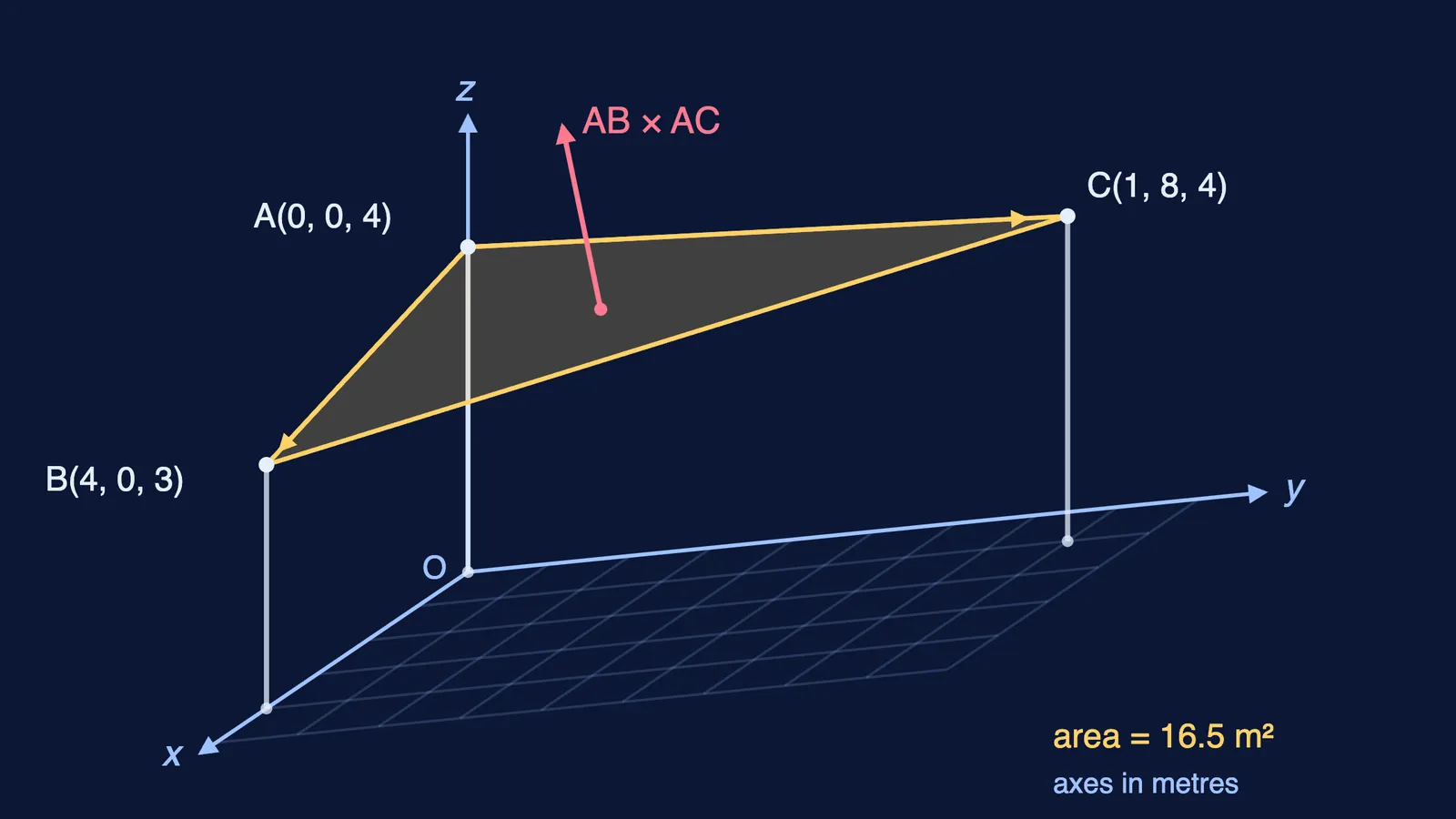
A Chennai school stretches a triangular shade sail over its courtyard. Three steel poles hold the corners at A(0, 0, 4), B(4, 0, 3) and C(1, 8, 4), in metres, with z up from the floor. Corner B is lower so rainwater drains off. The supplier needs the sail's area; the builder needs a vector perpendicular to it.
(i) For any vectors a and b, b × a equals: (a) a × b (b) −(a × b) (c) 0 (d) a · b
(ii) Write the vectors AB and AC.
(iii) Find AB × AC and hence the area of the sail.
(iv) Find the two unit vectors perpendicular to the sail. Which one points upward, and what is its direction cosine with the z-axis?
Answers.
(i) (b) Swapping the order flips the sign.
(ii) AB = 4î − k̂ and AC = î + 8ĵ.
(iii) Expanding the determinant: AB × AC = (0 + 8)î − (0 + 1)ĵ + (32 − 0)k̂ = 8î − ĵ + 32k̂. Its magnitude is √(64 + 1 + 1024) = √1089 = 33, so the area is ½ × 33 = 16.5 m².
(iv) ±(8î − ĵ + 32k̂)/33. The one with a positive k̂ component, (8î − ĵ + 32k̂)/33, points upward, and its direction cosine with the z-axis is 32/33.
How do you attack vector case-study questions?
Turn the story into vectors first: points as position vectors, paths and edges as differences, with units.
Check unit vectors and direction cosines: the squares must add to 1.
In the section formula, the ratio's first number goes with the second point: dividing PQ in m : n internally gives (mq + np)/(m + n).
Divide by the right magnitude. The projection of a on b is (a · b)/|b|.
For an area, find the cross product, then its magnitude, then halve it for a triangle.
For one-mark practice, try our vector algebra assertion-reason questions, or read how to handle case-based questions in board exams. If one step keeps going wrong, the Fermi Problem Library has worked problems with a step-by-step solver that explains the reasoning rather than printing an answer.