

On this page
Every statement stays inside the NCERT Vector Algebra chapter (Reprint 2026-27), and we checked every number with Python.
How do you answer assertion-reason questions in vector algebra?
The CBSE Class 12 Mathematics sample paper for 2026-27 has two 1-mark assertion-reason questions (Q19 and Q20), and vectors sit in Unit IV of the CBSE 2026-27 Mathematics curriculum.
Judge A, judge R, then read A, say "because", read R. If R is about a different operation or is a consequence of A, the answer is not (A). More in our assertion-reason question strategy.
Assertion-reason keys:
(A) Both A and R are true and R is the correct explanation of A.
(B) Both A and R are true but R is NOT the correct explanation of A.
(C) A is true but R is false.
(D) A is false but R is true.
Statement I / Statement II keys:
(A) Both statements are correct.
(B) Both statements are incorrect.
(C) Statement I is correct, Statement II is incorrect.
(D) Statement I is incorrect, Statement II is correct.
Vector algebra assertion-reason questions with answers
Q1 (easy). Assertion (A): The vectors î − 2ĵ + 3k̂ and −3î + 6ĵ − 9k̂ are collinear. Reason (R): Two vectors are collinear if and only if one is a nonzero scalar multiple of the other.
Answer: (A). The second vector is −3 times the first. R is NCERT's collinearity test, and it is exactly why A holds.
Trap: thinking opposite directions rule out collinearity.
Q2 (easy). Assertion (A): î + ĵ + k̂ is a unit vector. Reason (R): If l, m, n are the direction cosines of a vector, then lî + mĵ + nk̂ is a unit vector.
Answer: (D). |î + ĵ + k̂| = √3, so A is false. R is true because l² + m² + n² = 1. 1, 1, 1 are direction ratios, not cosines.
Trap: mixing up direction ratios and direction cosines.
Q3 (medium). Assertion (A): î × ĵ = k̂ and ĵ × î = −k̂. Reason (R): The scalar product is commutative.
Answer: (B). Both are true, but A is about the vector product, which is not commutative. A dot-product fact cannot explain it.
Trap: ticking (A) because both lines are true.
Q4 (medium). Assertion (A): The projection of a = 3î − ĵ + 2k̂ on b = î + 2ĵ + 2k̂ is 5/3. Reason (R): The projection of a on b is (a·b)/|a|.
Answer: (C). a·b = 5 and |b| = 3, so A is true. R divides by the wrong magnitude: the projection of a on b is (a·b)/|b|.
Trap: dividing by |a|, which gives 5/√14.
Q5 (hard). Assertion (A): For any two vectors a and b, |a × b|² + (a·b)² = |a|²|b|². Reason (R): For any two vectors a and b, |a·b| ≤ |a||b|.
Answer: (B). A follows from sin²θ + cos²θ = 1. R is the Cauchy-Schwarz inequality (NCERT Example 19): true, but it is not the reason A holds.
Trap: choosing (A) because both use the same formulas.
Q6 (hard). Assertion (A): The area of the parallelogram whose diagonals are î + 2ĵ and 2ĵ + k̂ is 3/2 square units. Reason (R): The area of a parallelogram with diagonals d₁ and d₂ is ½|d₁ × d₂|.
Answer: (A). d₁ × d₂ = 2î − ĵ + 2k̂, with magnitude 3, so the area is 3/2.
Trap: forgetting the ½ and writing 3.
Statement I and Statement II questions on vectors
Q7 (easy). Statement I: The point dividing PQ internally in the ratio 2 : 1 has position vector (a + 2b)/3 (a, b are the position vectors of P, Q). Statement II: The point dividing PQ externally in the ratio 2 : 1 has position vector (2b − a)/3.
Answer: (C). The internal formula (mb + na)/(m + n) gives (2b + a)/3, so I is correct. The external formula (mb − na)/(m − n) gives 2b − a, so II is incorrect.
Trap: keeping m + n in the denominator for external division.
Q8 (medium). Statement I: A vector can make an angle of 45° with each of the x-, y- and z-axes. Statement II: If a vector makes angles α, β, γ with the axes, then sin²α + sin²β + sin²γ = 1.
Answer: (B). At 45° each, the squared cosines add to 3/2, not 1, so I is incorrect. Squared sines add to 3 − 1 = 2, so II is incorrect.
Trap: applying the "adds to 1" rule to sines.
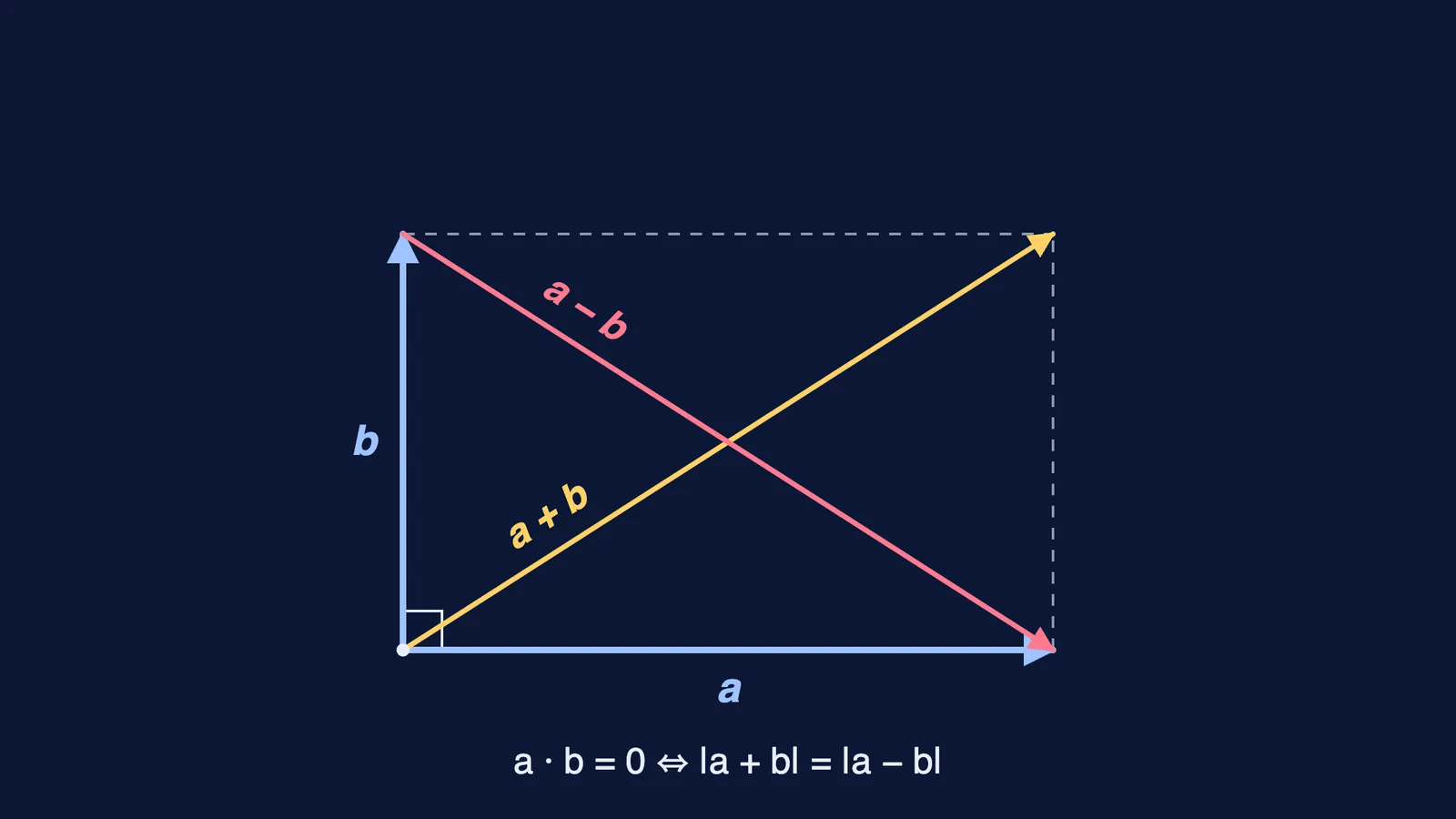
Q9 (medium). Statement I: If a and b are nonzero and |a + b| = |a − b|, then a is perpendicular to b. Statement II: For nonzero a and b, |a + b| = |a| + |b| only when a and b have the same direction.
Answer: (A). Squaring I gives 4a·b = 0, so the vectors are perpendicular. II is the equality case of the triangle inequality (NCERT Example 20), which needs the vectors to point the same way.
Trap: thinking any parallel vectors give equality in II; opposite ones do not.
Q10 (hard). Statement I: If a × b = a × c and a ≠ 0, then b = c. Statement II: If a·b = a·c and a × b = a × c with a ≠ 0, then b = c.
Answer: (D). In I, a × (b − c) = 0 only means b − c is parallel to a; a = î + ĵ, b = 2î + k̂ and c = b + 3a give the same cross product. In II, b − c is both parallel and perpendicular to a, so it is the zero vector.
Trap: "cancelling" a as if vectors could be divided.
How should you use this set?
Cover the answers and do all ten in one timed sitting.
For every miss, write the trap in your own words.
Write one new item of your own for each trap.
If one idea keeps tripping you up, the Fermi Concept Library gives every concept in mathematics its own lesson. For step marks and the formulas to revise, see our vector algebra Class 12 board exam guide, then move on to three-dimensional geometry for the board exam.


