On this page
What do 3D geometry case-study questions test?
The CBSE Class 12 Maths sample paper for 2026-27 has three case study-based questions of 4 marks each in Section E: two with parts worth 1, 1 and 2 marks, one with two 2-mark parts. Q36 is set on lines in space, and calculators are not allowed. The cases below have four parts each for practice. The CBSE 2026-27 Maths curriculum limits this chapter to direction cosines and ratios, vector and Cartesian equations of a line, skew lines, shortest distance and the angle between two lines.
Every case below is original and stays inside the NCERT Class 12 chapter on Three Dimensional Geometry (Reprint 2026-27). For marks and common errors, read our Three Dimensional Geometry Class 12 board exam guide; for a method that works across subjects, see how to answer case-based questions.
Case 1: Guy cables on a mobile tower
A telecom crew is putting up a temporary mobile tower near Nashik. They set up axes with the origin at one corner of the plot, the x- and y-axes along the boundary walls and the z-axis pointing straight up, all in metres. A steel guy cable runs from a ground anchor at A(2, 3, 0) to a clamp on the tower at B(8, 6, 6). A second cable runs from the same clamp B down to another anchor at C(14, 6, 0). The supervisor needs the cable lengths and angles.
(i) The length of cable AB is: (a) 6 m (b) 9 m (c) 81 m (d) √45 m
(ii) Write one set of direction ratios of AB.
(iii) Find the direction cosines of AB and the cosine of the angle it makes with the vertical.
(iv) Show that cable BC is perpendicular to cable AB, and use this to find the distance AC between the two anchors.
Answers.
(i) (b). AB = √(6² + 3² + 6²) = √81 = 9 m.
(ii) 6, 3, 6 (or any multiple, such as 2, 1, 2).
(iii) l, m, n = 2/3, 1/3, 2/3. The vertical is the z-axis, so the cosine is n = 2/3 (about 48.2°).
(iv) BC has direction ratios 6, 0, −6; 6(6) + 3(0) + 6(−6) = 0, so AB ⊥ BC. Then AC² = AB² + BC² = 81 + 72 = 153, so AC = 3√17 ≈ 12.4 m.
Case 2: Two ziplines from one platform
An adventure camp near Rishikesh is planning two ziplines that start from the same tower platform. With axes in metres, the origin at the foot of the tower and the z-axis vertical, the launch point is P(0, 0, 24). Zipline 1 runs in the direction 6î + 2ĵ − 3k̂ and Zipline 2 in the direction 2î + 3ĵ − 6k̂. Treat each cable as a straight line.
(i) The Cartesian equation of Zipline 1 is: (a) x/6 = y/2 = (z − 24)/(−3) (b) x/6 = y/2 = (z + 24)/(−3) (c) x/2 = y/3 = (z − 24)/(−6) (d) 6x = 2y = −3z
(ii) Write the vector equation of Zipline 1.
(iii) A rider on Zipline 1 is 9 m above ground. Find the rider's position and the length of cable already covered.
(iv) Find the angle between the two ziplines, and the point where Zipline 1 reaches ground level.
Answers.
(i) (a). Point (0, 0, 24), direction ratios 6, 2, −3.
(ii) r = 24k̂ + λ(6î + 2ĵ − 3k̂).
(iii) z = 24 − 3λ = 9 gives λ = 5, so the rider is at (30, 10, 9). The direction vector has magnitude √(36 + 4 + 9) = 7, so the rider has covered 5 × 7 = 35 m.
(iv) cos θ = (12 + 6 + 18)/(7 × 7) = 36/49, so θ = cos⁻¹(36/49) ≈ 42.7°. At ground level z = 0, so λ = 8 and the landing point is (48, 16, 0), 56 m of cable from P.
Case 3: Clearance on a pipe rack
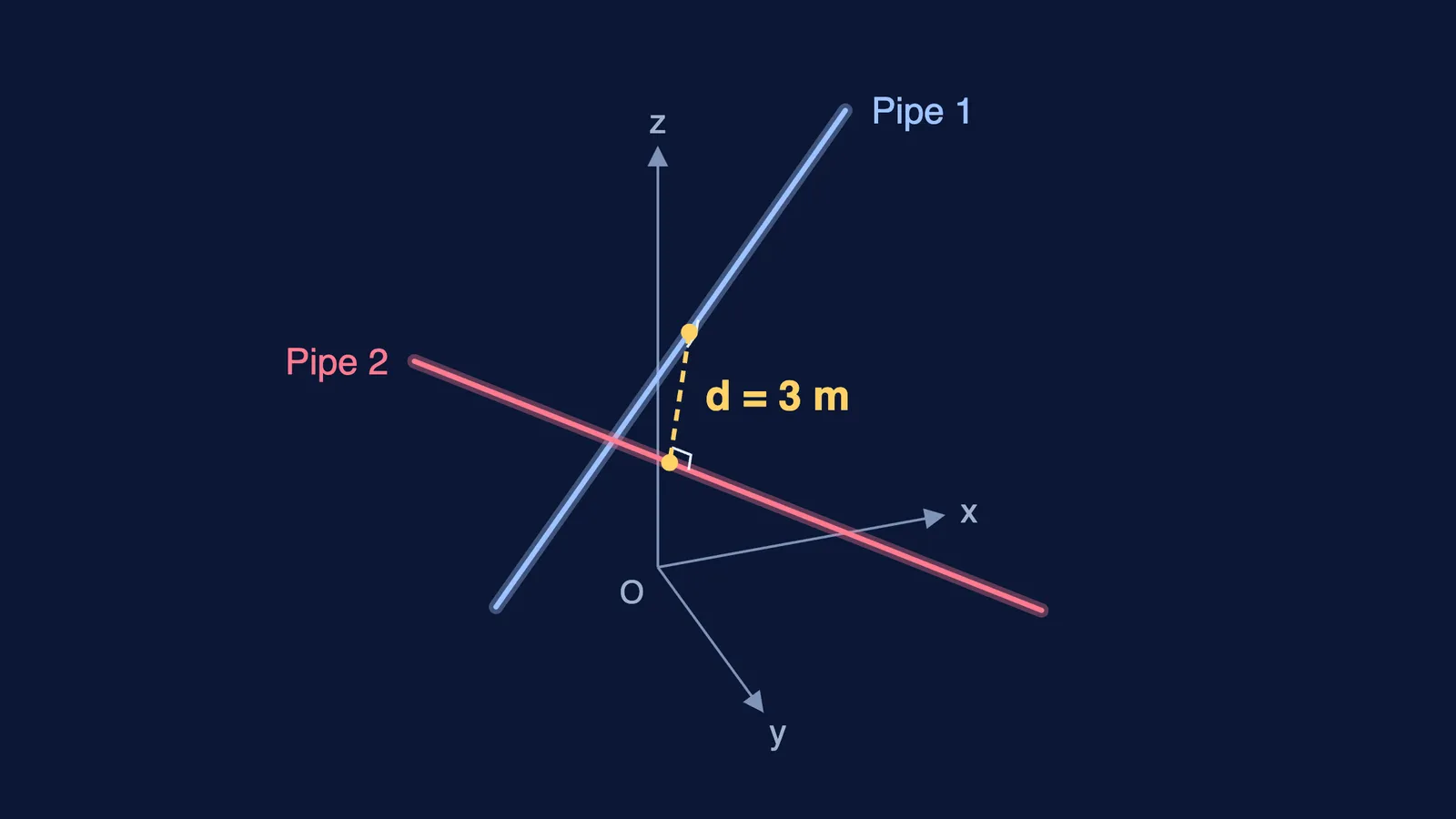
A chemical plant near Vadodara is adding pipes to a pipe rack. In the plant's survey coordinates (metres), the centreline of Pipe 1 is r = (î + 5k̂) + λ(2î + 3ĵ + 6k̂) and the centreline of Pipe 2 is r = (2î + 3ĵ + 2k̂) + μ(6î + 2ĵ − 3k̂). The site's rule for this section is that centrelines must stay at least 2.5 m apart. A third pipe, Pipe 3, is planned through the point (5, 2, 5), running parallel to Pipe 1.
(i) The angle between Pipe 1 and Pipe 2 is: (a) 0° (b) 45° (c) 60° (d) 90°
(ii) Find b₁ × b₂ for Pipes 1 and 2.
(iii) Find the shortest distance between Pipe 1 and Pipe 2. Do they meet the 2.5 m rule?
(iv) Find the distance between Pipe 1 and Pipe 3, and say why the formula from (iii) cannot be used.
Answers.
(i) (d). 2(6) + 3(2) + 6(−3) = 0.
(ii) b₁ × b₂ = −21î + 42ĵ − 14k̂, magnitude √(441 + 1764 + 196) = 49.
(iii) a₂ − a₁ = î + 3ĵ − 3k̂, and (b₁ × b₂)·(a₂ − a₁) = −21 + 126 + 42 = 147. So d = 147/49 = 3 m, which meets the rule. Not parallel and d ≠ 0, so the pipes are skew.
(iv) Here b₁ × b₁ = 0, so the skew-lines formula gives 0/0. Use d = |b × (a₃ − a₁)|/|b| with a₃ − a₁ = 4î + 2ĵ: b × (a₃ − a₁) = −12î + 24ĵ − 8k̂, magnitude 28, so d = 28/7 = 4 m.
How should you attack 3D geometry case-study questions?
Turn the story into points and direction vectors, with units, before any formula.
Reuse earlier parts: a zero dot product often sets up Pythagoras or a later step.
Check for parallel lines before any distance question.
λ is not a distance unless the direction vector is a unit vector; multiply by its magnitude, as in Case 2.
Keep surds and fractions (no calculator); use decimals only when the story needs a decision.
If you keep choosing the wrong formula, the Fermi Problem Library has a step-by-step solver that explains the reasoning rather than printing an answer. For one-mark practice, try our 3D geometry assertion-reason questions.