On this page
How do you answer assertion-reason questions in 3D geometry?
The CBSE Class 12 Maths sample paper for 2026-27 puts two assertion-reason questions, Q19 and Q20, in Section A at 1 mark each. Unit IV (Vectors and Three-dimensional Geometry) carries 14 of 80 theory marks in the CBSE 2026-27 Maths curriculum. Every statement below follows the NCERT chapter (Reprint 2026-27).
Keys for questions 1 to 6:
(A) Both true and R is the correct explanation of A.
(B) Both true but R is NOT the correct explanation of A.
(C) A is true but R is false.
(D) A is false but R is true.
Keys for questions 7 to 10:
(A) Both statements are correct.
(B) Both statements are incorrect.
(C) Statement I is correct, Statement II is incorrect.
(D) Statement I is incorrect, Statement II is correct.
Judge each statement alone first; only if both are true, ask whether R causes A. Our guide to answering assertion-reason questions has the full method.
Assertion-reason questions with answers
Q1 (easy). Assertion (A): A line equally inclined to all three coordinate axes has direction cosines 1/√3, 1/√3, 1/√3 (or all three negative). Reason (R): The direction cosines of any line satisfy l² + m² + n² = 1.
Answer: (A). Equal inclination gives l = m = n, and R turns that into 3l² = 1, so l = ±1/√3.
Trap: writing 1/3, or assuming each angle is 45°.
Q2 (easy). Assertion (A): 1/2, 1/2, 1/2 can be the direction cosines of a line. Reason (R): Any three numbers proportional to the direction cosines of a line are direction ratios of that line.
Answer: (D). The squares add to 3/4, not 1, so A is false. R is the NCERT definition: 1/2, 1/2, 1/2 are direction ratios, not direction cosines.
Trap: confusing direction ratios with direction cosines.
Q3 (medium). Assertion (A): Lines with direction ratios 1, 2, 3 and 3, −3, 1 are perpendicular. Reason (R): Two lines are perpendicular when a₁/a₂ = b₁/b₂ = c₁/c₂.
Answer: (C). A is true since 3 − 6 + 3 = 0. R is the parallel condition; perpendicular needs a₁a₂ + b₁b₂ + c₁c₂ = 0.
Trap: swapping the two conditions.
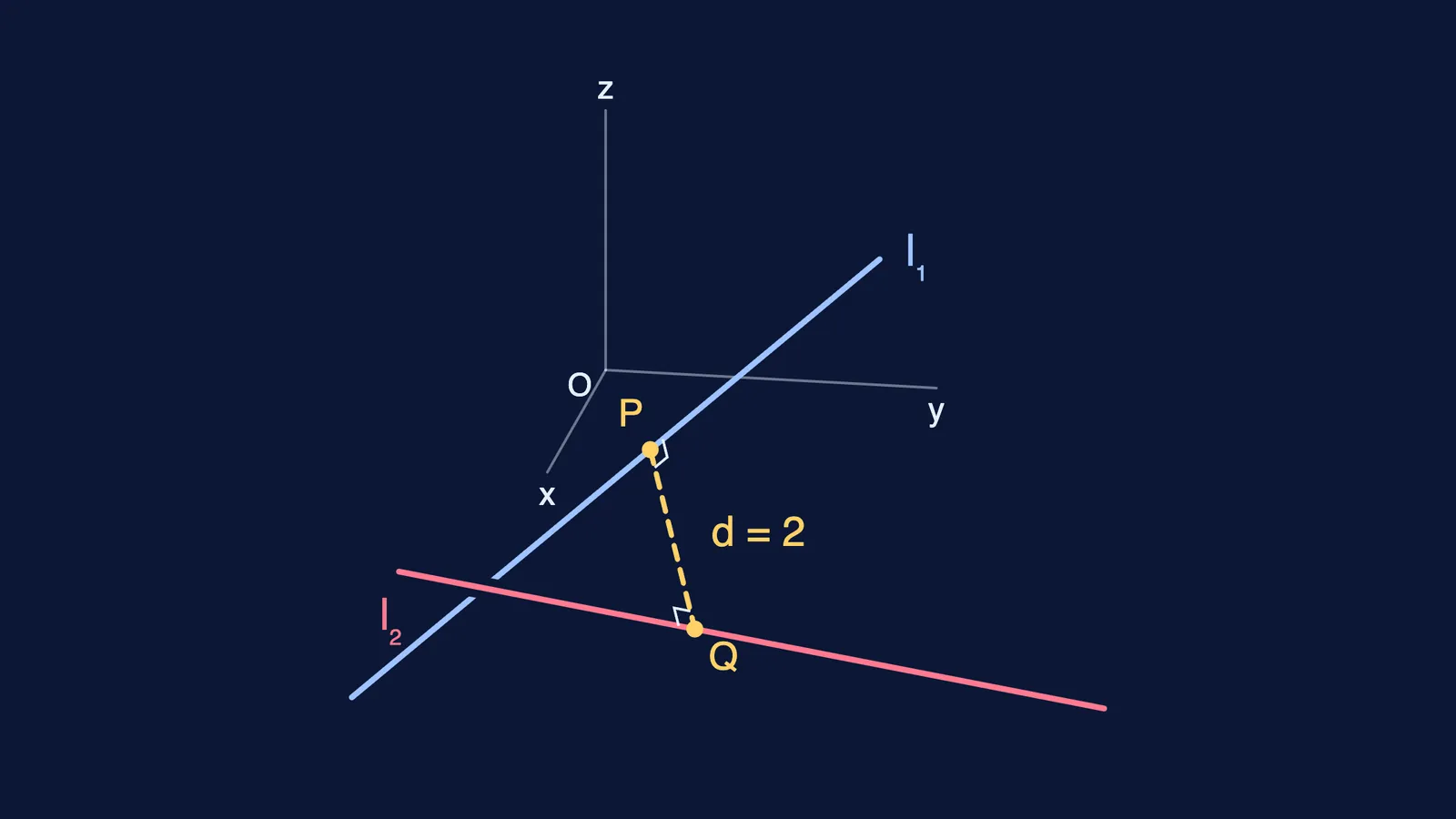
Q4 (medium). Assertion (A): The x-axis and the line through (0, 2, 0) parallel to the z-axis are skew lines. Reason (R): The shortest distance between these two lines is 2 units.
Answer: (B). Both are true: the lines are not parallel and never meet, and the common perpendicular runs from O to (0, 2, 0). But parallel lines also have a non-zero distance, so R does not explain A.
Trap: reading "non-zero distance" as "skew".
Q5 (hard). Assertion (A): The shortest distance between r = (î + ĵ) + λ(î − 2ĵ + 2k̂) and r = (2î − k̂) + μ(−2î + 4ĵ − 4k̂) can be found with d = |(b₁ × b₂)·(a₂ − a₁)| / |b₁ × b₂|. Reason (R): Here b₂ = −2b₁, so the lines are parallel and b₁ × b₂ = 0.
Answer: (D). With b₁ × b₂ = 0 the formula gives 0/0, so A is false. R is true; use d = |b × (a₂ − a₁)| / |b| = √26/3 units.
Trap: not checking for parallel lines.
Q6 (hard). Assertion (A): The shortest distance between r = (î − k̂) + λ(î + 2ĵ + 2k̂) and r = (2î + 2ĵ − 2k̂) + μ(2î − 2ĵ + k̂) is 2 units. Reason (R): The shortest-distance segment is perpendicular to both lines, so d is the length of the projection of a₂ − a₁ on b₁ × b₂.
Answer: (A). b₁ × b₂ = 6î + 3ĵ − 6k̂ (magnitude 9) and a₂ − a₁ = î + 2ĵ − k̂, so d = 18/9 = 2. R is how NCERT derives this formula.
Trap: b₁·b₂ = 0 means perpendicular directions, not that the lines meet.
Statement I and Statement II questions with answers
Q7 (easy). Statement I: The direction cosines of the positive y-axis are 0, 1, 0. Statement II: −3, 2, −2 are direction ratios of the line joining (1, 2, 3) and (4, 0, 5).
Answer: (A). The y-axis makes angles 90°, 0°, 90° with the axes. NCERT allows x₁ − x₂, y₁ − y₂, z₁ − z₂ as direction ratios.
Trap: thinking only x₂ − x₁ is allowed.
Q8 (medium). Statement I: If a line makes angles α, β, γ with the positive axes, then sin²α + sin²β + sin²γ = 1. Statement II: Reversing the direction of a directed line changes the sign of all three direction cosines.
Answer: (D). The sine squares add to 3 − 1 = 2, so I is false. II is true: the angles become their supplements.
Trap: carrying the cosine identity over to sines.
Q9 (hard). Statement I: The lines (x − 1)/1 = y/1 = (z − 2)/(−1) and (x − 1)/2 = (y − 4)/(−2) = (z + 1)/1 intersect at (3, 2, 0). Statement II: Two lines in space that are not parallel must intersect.
Answer: (C). Parameters 2 and 1 on the two lines give (3, 2, 0), so I is true. II is false: non-parallel lines that never meet are skew.
Trap: using the 2D rule in space.
Q10 (hard). Statement I: The distance between parallel lines r = a₁ + λb and r = a₂ + μb is |(a₂ − a₁)·b| / |b|. Statement II: The shortest distance between two distinct parallel lines is zero because they are coplanar.
Answer: (B). The dot product measures along the lines, not across; the formula is |b × (a₂ − a₁)| / |b|. Coplanar lines need not meet.
Trap: treating coplanar as intersecting.
How should you use this set before the board exam?
Do all ten in 12 minutes without notes.
Sort each miss: wrong formula, wrong condition, or wrong cause-and-effect call.
Redo Q5, Q6 and Q9 in full, as 3-mark answers.
If most misses are wrong-method errors, the Fermi Problem Library has worked problems with a step-by-step solver that explains the reasoning rather than printing an answer.
For marks, answer layouts and common errors, read our Three Dimensional Geometry Class 12 board exam guide. Planes are out of the 2026-27 syllabus; for JEE, see 3D geometry for JEE.