On this page
What do thermal properties case studies test?
The CBSE Class XI Physics curriculum for 2026-27 covers thermal expansion, specific heat, calorimetry, latent heat, conduction, convection, radiation and qualitative ideas of Wien's and Stefan's laws. Every case stays inside that list and NCERT Class 11 Physics Chapter 10 (Reprint 2026-27), using NCERT's table values.
This is practice in the case-based style; ask your teacher how your school paper uses it. For formulas, see our Thermal Properties of Matter Class 11 guide.
Case 1: The footbridge in a Lucknow summer
Lucknow is building a 40 m steel footbridge over a road. The deck can drop to 6 °C on a January night and reach 46 °C on a June afternoon. One end is fixed; the other rests on rollers beside an expansion gap. For steel, NCERT Chapter 10 gives αl = 1.2 × 10⁻⁵ K⁻¹ and Y = 2 × 10¹¹ N m⁻².
(i) The SI unit of the coefficient of linear expansion is: (a) m K⁻¹ (b) K⁻¹ (c) m⁻¹ K (d) J K⁻¹
(ii) By how much does the deck lengthen between the coldest night and the hottest afternoon?
(iii) Aluminium has αl = 2.5 × 10⁻⁵ K⁻¹. How wide a gap would an aluminium deck of the same length need over the same temperature range?
(iv) Debris jams the gap shut at 30 °C. Find the thermal stress in the deck at 46 °C.
Answers.
(i) (b) K⁻¹, since Δl/l has no unit.
(ii) Δl = αl l ΔT = 1.2 × 10⁻⁵ × 40 × (46 − 6) = 0.0192 m, about 19 mm.
(iii) Δl is proportional to αl, so the gap grows 2.5/1.2 times: 19.2 × 2.5/1.2 = 40 mm.
(iv) The blocked strain is αl ΔT = 1.2 × 10⁻⁵ × 16 = 1.92 × 10⁻⁴. Stress = Y × strain = 2 × 10¹¹ × 1.92 × 10⁻⁴ ≈ 3.8 × 10⁷ N m⁻², compressive.
Case 2: Cooling nimbu pani in Chennai
Ananya makes 1.2 kg of nimbu pani at 34 °C in Chennai and drops in 0.15 kg of ice cubes at −8 °C. Treat the drink as water, ignore the jug and the air, and use NCERT Tables 10.3 and 10.5: s(water) = 4186 J kg⁻¹ K⁻¹, s(ice) = 2060 J kg⁻¹ K⁻¹ and Lf = 3.33 × 10⁵ J kg⁻¹. Her cousin says 0.15 kg of water at 0 °C would cool it just as well.
(i) While the ice is melting at 0 °C, its temperature: (a) rises steadily (b) stays constant (c) falls (d) first falls, then rises
(ii) How much heat does the ice take to warm from −8 °C to 0 °C, and how much to melt?
(iii) Find the final temperature of the drink.
(iv) Find the final temperature with the cousin's 0 °C water, and explain the difference.
Answers.
(i) (b). The heat changes the state, not the temperature.
(ii) Warming: 0.15 × 2060 × 8 = 2472 J. Melting: 0.15 × 3.33 × 10⁵ = 49 950 J. Total 52 422 J.
(iii) Cooling the drink to 0 °C would release 1.2 × 4186 × 34 ≈ 1.71 × 10⁵ J, more than 52 422 J, so all the ice melts. Heat lost = heat gained: 1.2 × 4186 × (34 − T) = 52 422 + 0.15 × 4186 × T, so 5651T ≈ 118 367 and T ≈ 20.9 °C.
(iv) With water at 0 °C: 1.2 × 4186 × (34 − T) = 0.15 × 4186 × T, so T = 1.2 × 34/1.35 ≈ 30.2 °C. Ice wins by about 9 °C because melting absorbs 49 950 J of latent heat before the meltwater starts warming.
Case 3: A hot concrete roof in Nagpur
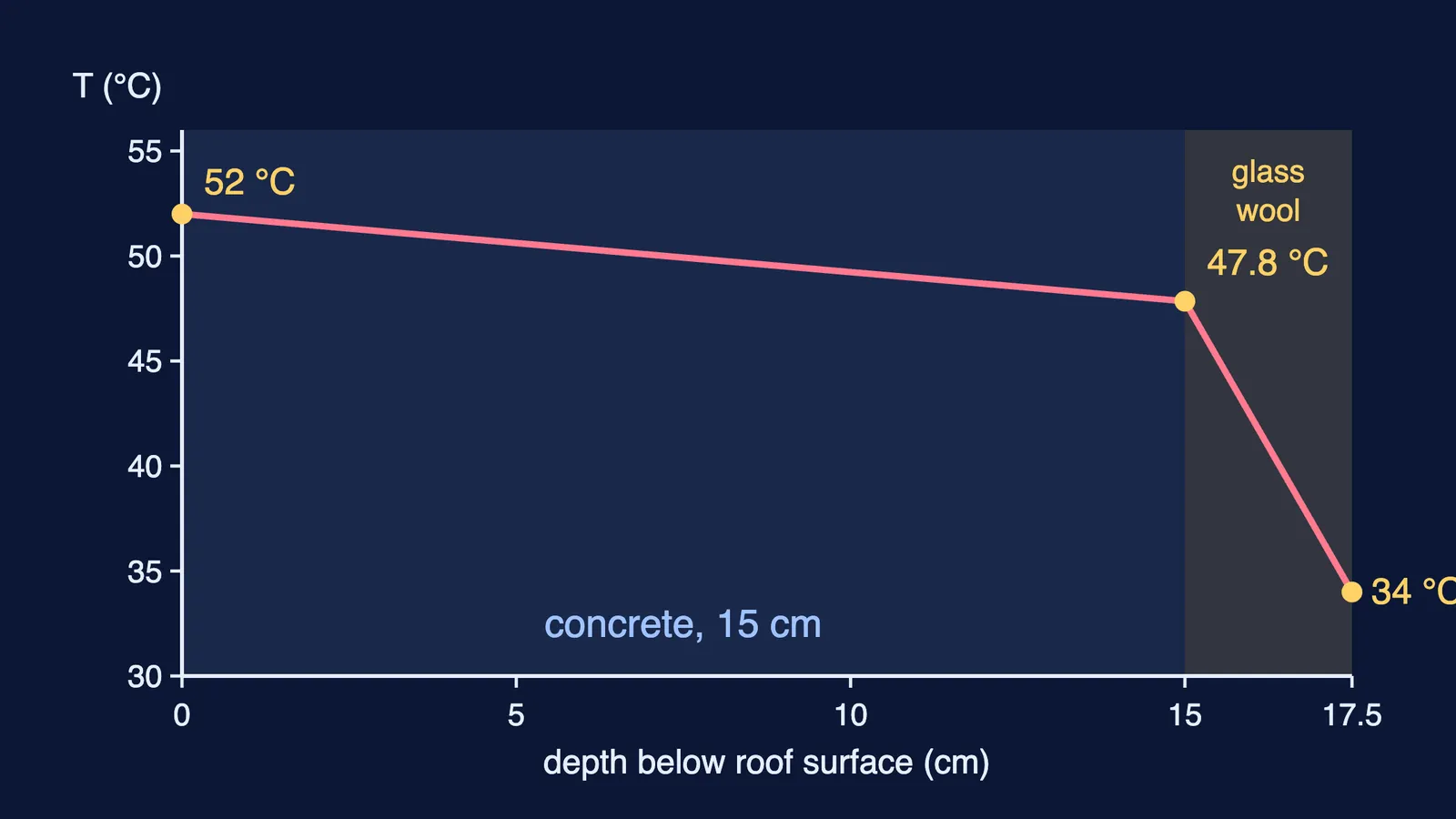
On a May afternoon in Nagpur, the sun heats the top of a 20 m² concrete roof, 15 cm thick, to 52 °C; its underside is at 34 °C. A contractor suggests a 2.5 cm glass wool layer under the slab; a neighbour suggests white paint. From NCERT Table 10.6, K is 0.8 W m⁻¹ K⁻¹ for concrete and 0.04 W m⁻¹ K⁻¹ for glass wool. Assume steady state, with the outer surfaces held at 52 °C and 34 °C.
(i) Heat travels from the top of the slab to its underside mainly by: (a) convection (b) radiation (c) conduction (d) evaporation
(ii) Find the heat current through the bare slab.
(iii) Treating the roof top as a blackbody and using Wien's law (constant 2.9 × 10⁻³ m K), find the wavelength at which it radiates most. Why does white paint help?
(iv) With glass wool fitted, find the heat current, the junction temperature and the factor by which heat flow falls.
Answers.
(i) (c) conduction.
(ii) H = KA(TC − TD)/L = 0.8 × 20 × 18/0.15 = 1920 W.
(iii) T = 52 + 273 = 325 K, so λm = 2.9 × 10⁻³/325 ≈ 8.9 × 10⁻⁶ m, about 8.9 μm, in the infrared. White surfaces absorb less sunlight than dark ones, so the roof heats up less.
(iv) The same heat current H flows through both layers, so 18 = H × (0.15/0.8 + 0.025/0.04)/20 = H × 0.8125/20, giving H ≈ 443 W. The concrete drop is 443 × 0.1875/20 ≈ 4.2 °C, so the junction is at about 47.8 °C. The flow falls 1920/443 ≈ 4.3 times.
How do you attack case-study questions on this chapter?
Use kelvin only where the law needs it. ΔT is the same in °C and K; Wien's and Stefan's laws need absolute T.
Check that all the ice melts before writing one balance. If not, the mix stays at 0 °C.
List heat terms in order: warm the ice, melt it, warm the meltwater.
For layers, add L/K. The same heat current crosses each layer, so the largest L/K takes most of the drop.
Sense-check against the story. A 40 m deck moves millimetres; an iced drink ends between 0 °C and 34 °C.
For the general method, read our guide to case-based questions in board exams, then try the next chapter, Thermodynamics Class 11 physics. If you keep choosing the wrong method, the Fermi Problem Library has worked problems with a step-by-step solver that explains the reasoning rather than printing an answer.