On this page
Respiration in Plants is Chapter 12 of the CBSE Class XI Biology curriculum for 2026-27, in Unit IV, Plant Physiology. Class 11 exams are set by schools, so treat these three original cases, easy to hard, as practice in the case-based style. Every fact is checked against the NCERT Respiration in Plants chapter (Reprint 2026-27); the scenarios and readings are invented. For chapter notes, read our Respiration in Plants Class 11 guide.
Case 1: Why is the potted neem sapling struggling?
Students in Jaipur notice small raised pores on the bark of their school's old neem tree. Nearby, a potted neem sapling has stood in a tray of water for six days. A probe reads 0.4 mg of dissolved oxygen per litre in its waterlogged soil, against 7.8 mg in a well-drained pot beside it. Its lower leaves have yellowed.
(i) The raised pores on the bark are: (a) stomata (b) lenticels (c) hydathodes (d) root hairs.
(ii) Give one reason the thick neem trunk needs no special respiratory organ.
(iii) Which stage of respiration needs no oxygen, so the waterlogged root cells can still run it, and where in the cell does it happen?
(iv) Using the role of oxygen, explain why the roots' ATP supply falls so sharply.
Answers.
(i) (b) Lenticels, which with stomata are the plant's openings for gas exchange.
(ii) A stem's living cells lie in thin layers beneath the bark, close to the surface and its lenticels; the interior cells are dead and only give support.
(iii) Glycolysis, in the cytoplasm.
(iv) Oxygen is the final hydrogen acceptor of the electron transport system on the inner mitochondrial membrane. With too little of it, NADH and FADH2 are not reoxidised, so the ETS and Krebs' cycle slow and stall. The roots fall back on glycolysis plus fermentation: a net 2 ATP for each glucose fermented instead of a theoretical 38, only one-nineteenth as much.
Case 2: Why does the wine tank stop at 13%?
A small winery near Nashik ferments crushed grapes in sealed steel tanks. The log for one tank reads 0% alcohol on day 0, 4% on day 3, 9% on day 7, 12.5% on day 11, 13% on day 14 and still 13% on day 20, though sugar is left. The tank is never opened to air. A trainee's worksheet follows 1,200 glucose molecules through the yeast's pathway in that tank.
(i) Which pair of enzymes converts pyruvic acid to ethanol and CO2? (a) hexokinase and invertase (b) pyruvic acid decarboxylase and alcohol dehydrogenase (c) lactate dehydrogenase and citrate synthase (d) pyruvate dehydrogenase and ATP synthase
(ii) Why does the alcohol level stop rising even though sugar remains?
(iii) For the 1,200 glucose molecules, how many ATP are made, used and gained net in glycolysis?
(iv) How many NADH + H+ form, what happens to them, and how many times more ATP would the same glucose give aerobically?
Answers.
(i) (b) Pyruvic acid decarboxylase and alcohol dehydrogenase.
(ii) As the NCERT chapter notes, yeast cells are killed by their own alcohol once it reaches about 13 per cent, so fermentation stops while sugar is still left.
(iii) Glycolysis makes 4 ATP and uses 2 per glucose. Made: 4 × 1,200 = 4,800. Used: 2 × 1,200 = 2,400. Net: 2,400 ATP.
(iv) One NADH + H+ forms each time PGAL becomes BPGA, so 2 per glucose: 2 × 1,200 = 2,400. They are reoxidised to NAD+ as pyruvic acid becomes ethanol, which keeps glycolysis running but yields no ATP. Aerobically: 38 × 1,200 = 45,600 ATP, which is 45,600 ÷ 2,400 = 19 times more.
Case 3: What are the seeds respiring?
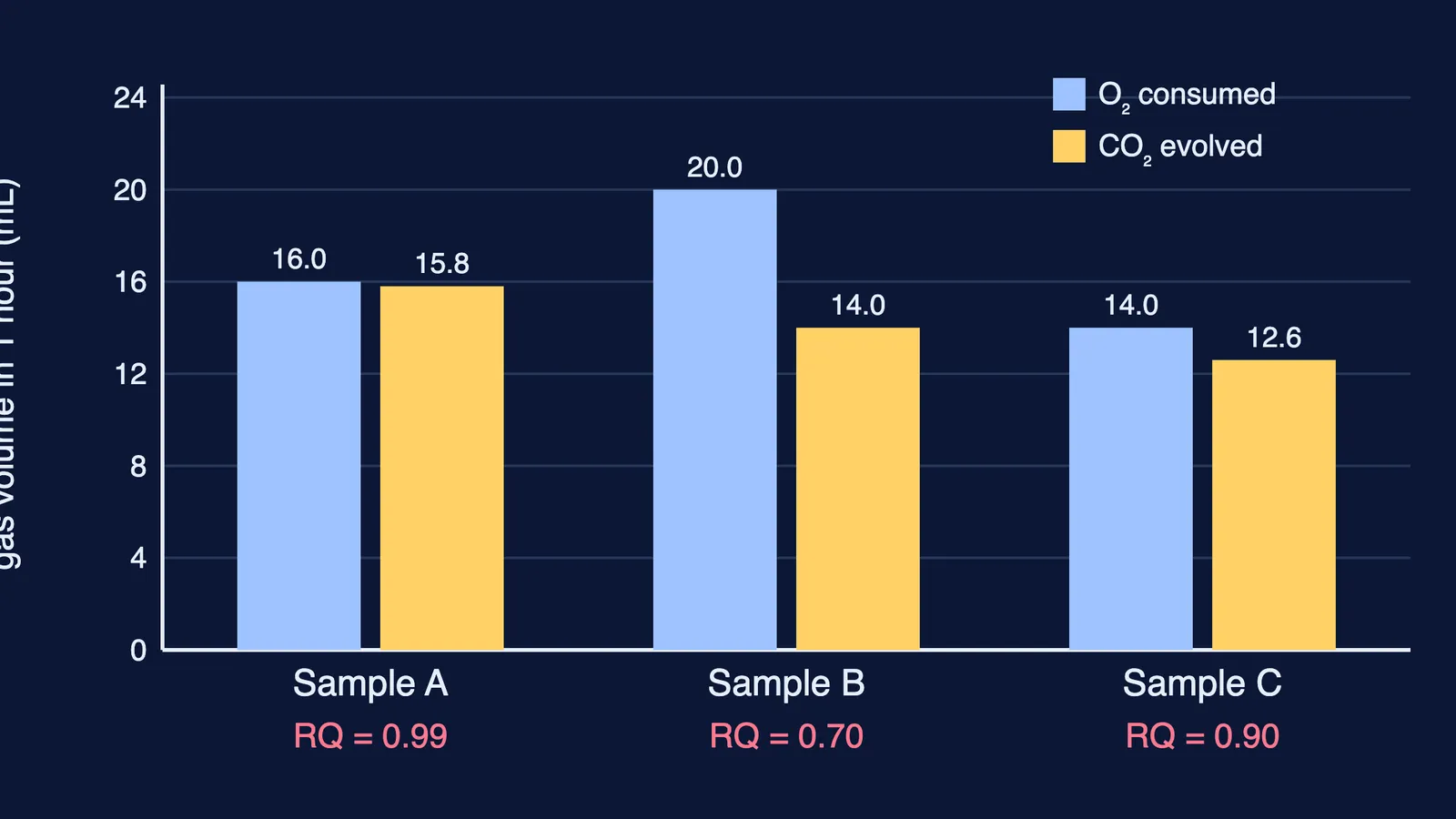
A Bengaluru college lab runs a respirometer on three germinating seed samples for one hour at 25 °C. Sample A, soaked wheat grains, takes up 16.0 mL of O2 and gives out 15.8 mL of CO2. Sample B, an oil-rich seed, takes up 20.0 mL of O2 and gives out 14.0 mL of CO2. Sample C, from an unlabelled packet, takes up 14.0 mL of O2 and gives out 12.6 mL of CO2. A student writes: "Sample C is respiring only protein."
(i) Define respiratory quotient. What is its value when carbohydrate is fully oxidised?
(ii) Calculate the RQ of samples A, B and C.
(iii) Which substrate is sample B mainly respiring, and where do its two breakdown products enter the respiratory pathway?
(iv) Why is the student's conclusion about sample C unsafe? Support your answer with a calculation.
Answers.
(i) RQ is the volume of CO2 evolved divided by the volume of O2 consumed. For fully oxidised carbohydrate it is 1, since 6 CO2 are released for 6 O2 used.
(ii) A: 15.8 ÷ 16.0 = 0.99. B: 14.0 ÷ 20.0 = 0.70. C: 12.6 ÷ 14.0 = 0.90.
(iii) Fat. NCERT's tripalmitin example gives 102 CO2 ÷ 145 O2 = 0.70. Fats are first split into glycerol and fatty acids: fatty acids enter as acetyl CoA and glycerol enters after conversion to PGAL.
(iv) NCERT notes that organisms often respire more than one substrate and never pure proteins or fats. A mix in which carbohydrate takes two-thirds of the O2 and fat one-third also gives 0.90: (2/3 × 1.0) + (1/3 × 0.70) = 0.90. So 0.90 alone cannot prove protein.
How to attack case-study questions
Find the oxygen clue first. With oxygen, count glycolysis, Krebs' cycle and ETS (38 ATP); without it, glycolysis plus fermentation (net 2).
Name the place with every stage. Glycolysis in the cytoplasm, Krebs' cycle in the matrix, ETS on the inner mitochondrial membrane.
Count per glucose, then multiply. Write the per-glucose figure (4 made, 2 used, 2 NADH) before scaling up.
Keep CO2 on top for RQ. Fat sits near 0.7, carbohydrate at 1; a value between can mean a mix.
Call 38 theoretical. NCERT's count assumes no intermediate is drawn off.
If the ATP bookkeeping keeps slipping, the Fermi Problem Library has worked problems with a step-by-step solver that explains the reasoning rather than printing an answer. For more practice in this format, see our guide to answering case-based questions in board exams and the assertion-reason questions on photosynthesis and respiration.