On this page
Three original case studies on Class 12 Probability, from a two-way table to Bayes' theorem, with every answer worked out. For the full chapter, read our Probability Class 12 board exam guide.
What do Probability case-study questions test?
The CBSE Mathematics curriculum for 2026-27 lists five topics in Unit VI, Probability: conditional probability, the multiplication theorem, independent events, total probability and Bayes' theorem. The last section of the NCERT Probability chapter (Reprint 2026-27) is 13.5, Bayes' theorem, and probability distributions are not on the 2026-27 syllabus, so these cases leave them out.
The CBSE 2026-27 sample paper has 3 case-study questions of 4 marks each in Section E. Its case studies are on other units, but a Probability passage fits the format well. For the format in general, see our guide to case-based questions in board exams.
Case 1: Bus riders and the robotics club
A school in Lucknow has 120 students in Class 12. Of these, 70 come to school on the school bus and the other 50 walk, cycle or are dropped off. The robotics club has 48 Class 12 members: 28 of them ride the bus and 20 do not. The club coordinator picks Class 12 students at random from all 120 for a survey. Let B be the event "the student rides the bus" and R the event "the student is in the robotics club".
(i) P(R) equals: (A) 1/3 (B) 2/5 (C) 7/12 (D) 1/4
(ii) Find P(R|B).
(iii) Are the events B and R independent? Justify.
(iv) Two students are chosen one after the other without replacement. Find the probability that both are in the robotics club.
Answers.
(i) (B). P(R) = 48/120 = 2/5.
(ii) Among the 70 bus riders, 28 are in the club, so P(R|B) = 28/70 = 2/5. Equivalently, P(B ∩ R)/P(B) = (28/120)/(70/120).
(iii) Yes. P(B ∩ R) = 28/120 = 7/30, and P(B) P(R) = (7/12)(2/5) = 7/30. They are equal, which matches P(R|B) = P(R) from (ii).
(iv) By the multiplication theorem, P = (48/120) × (47/119) = 94/595, about 0.158. The second factor is a conditional probability: one club member is already gone.
Case 2: Two solar pumps for one village
A village in Rajasthan gets drinking water from two solar pumps, A and B, on separate wells. On any day, pump A works with probability 0.9 and pump B with probability 0.8, and the two work or fail independently of each other. The village has water on a day if at least one pump works.
(i) The probability that both pumps work on a given day is: (A) 0.98 (B) 0.85 (C) 0.72 (D) 0.08
(ii) Find the probability that the village has no water on a given day.
(iii) Find the probability that exactly one pump works.
(iv) On a certain day the village has water. Find the probability that pump A had failed that day.
Answers.
(i) (C). By independence, P(A ∩ B) = 0.9 × 0.8 = 0.72.
(ii) If A and B are independent, so are A′ and B′ (an NCERT result). P(A′ ∩ B′) = 0.1 × 0.2 = 0.02.
(iii) P(A ∩ B′) + P(A′ ∩ B) = 0.9 × 0.2 + 0.1 × 0.8 = 0.18 + 0.08 = 0.26. Check: 0.72 + 0.26 + 0.02 = 1.
(iv) Let W = "water available", so P(W) = 1 − 0.02 = 0.98. If water is available and A failed, then B worked: P(A′ ∩ W) = 0.08. So P(A′|W) = 0.08/0.98 = 4/49, about 0.082.
Case 3: Which courier made the parcel late?
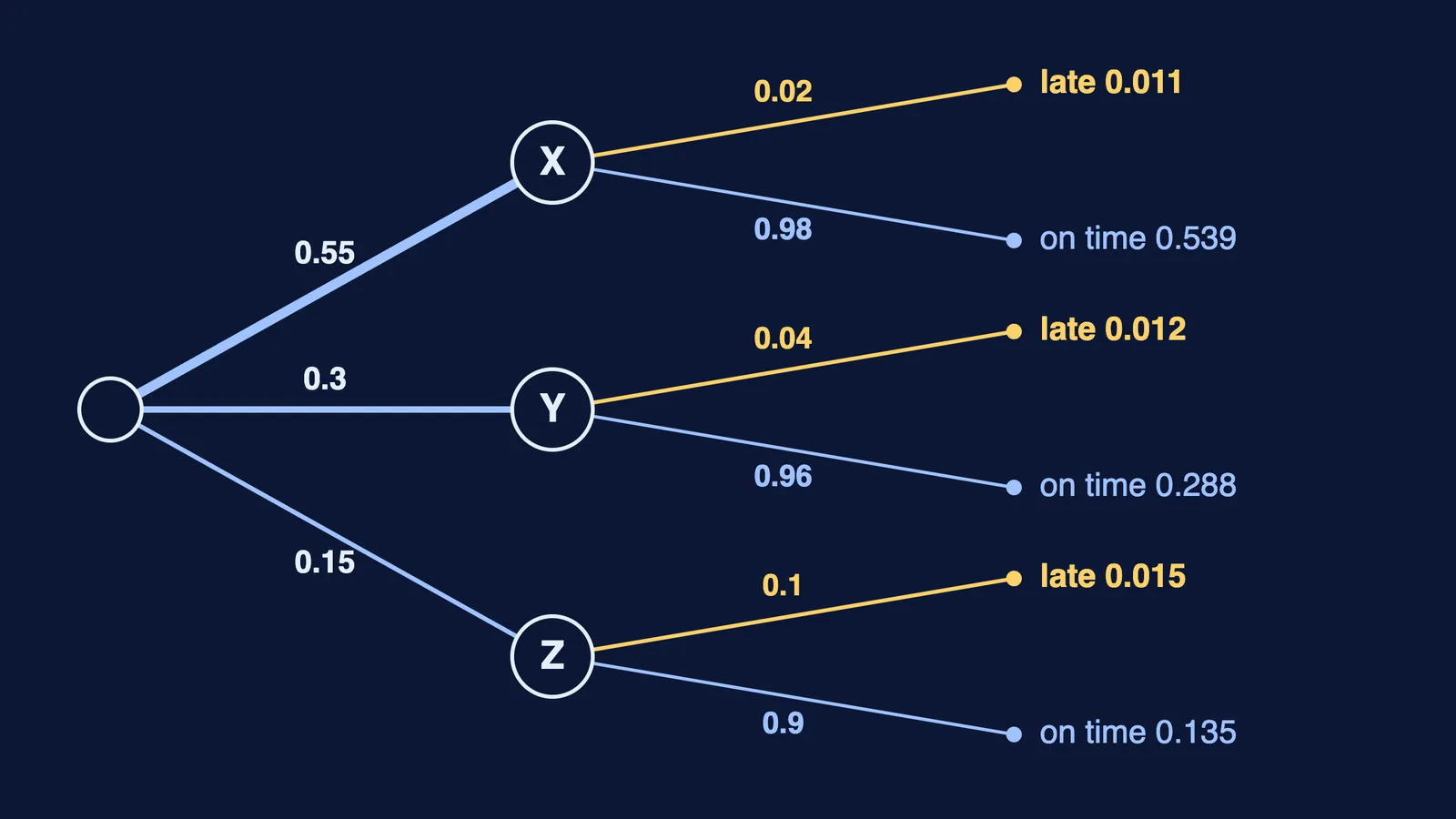
An online bookshop in Bengaluru sends its orders through three courier companies. Courier X carries 55% of parcels, Y carries 30% and Z carries 15%. From its delivery records, the shop finds that 2% of X's parcels, 4% of Y's and 10% of Z's arrive after the promised date. A customer's parcel is picked at random from one month's orders. Let E1, E2, E3 be "sent by X, Y, Z" and L be "arrives late".
(i) The probability that a parcel is sent by Z and arrives late is: (A) 0.10 (B) 0.15 (C) 0.015 (D) 0.25
(ii) Why do E1, E2 and E3 form a partition of the sample space?
(iii) Find the probability that a randomly chosen parcel arrives late.
(iv) A parcel arrives late. Which courier most likely carried it, and with what probability?
Answers.
(i) (C). By the multiplication theorem, P(E3 ∩ L) = P(E3) P(L|E3) = 0.15 × 0.10 = 0.015.
(ii) Each parcel goes by exactly one courier, so the events are pairwise disjoint and together cover every parcel; each also has non-zero probability.
(iii) By total probability, P(L) = 0.55 × 0.02 + 0.30 × 0.04 + 0.15 × 0.10 = 0.011 + 0.012 + 0.015 = 0.038.
(iv) By Bayes' theorem, P(E1|L) = 0.011/0.038 = 11/38, P(E2|L) = 0.012/0.038 = 12/38 = 6/19 and P(E3|L) = 0.015/0.038 = 15/38, about 0.39. Courier Z is the most likely, although it carries the fewest parcels: its high late rate outweighs its small share.
How to attack case-study questions on Probability
Name the events in words before writing any number, as in Case 3. The later parts reuse them.
Turn each percentage into a probability and check that the shares of a partition add to 1.
When the passage says "given", "if it is known" or "found to be", the answer is conditional. Decide which event is known before dividing.
Draw a tree for two-stage passages. The products at the ends of branches give total probability in one line and Bayes' theorem in the next.
Keep fractions until the last step and check that complementary answers add to 1, as in Case 2.
If a step still goes wrong, the Fermi Problem Library has worked problems with a step-by-step solver that explains the reasoning rather than printing an answer. For one-mark practice on the same ideas, try our assertion-reason questions on Class 12 Probability.