On this page
Ten original questions on Class 12 Probability, aimed at three weak spots: conditioning, independence and Bayes' weighting.
How do you answer assertion-reason questions in probability?
The CBSE Class 12 Mathematics sample paper for 2026-27 has two assertion-reason questions, Q19 and Q20, of 1 mark each. Every item here stays inside the CBSE 2026-27 Mathematics syllabus and the NCERT Probability chapter (Reprint 2026-27).
Keys for Q1 to Q6:
(A) Both A and R are true and R is the correct explanation of A.
(B) Both A and R are true but R is NOT the correct explanation of A.
(C) A is true but R is false.
(D) A is false but R is true.
Keys for Q7 to Q10:
(A) Both statements are correct.
(B) Both statements are incorrect.
(C) Statement I is correct, Statement II is incorrect.
(D) Statement I is incorrect, Statement II is correct.
Judge each statement alone first; only then ask whether R makes A hold. More in our assertion-reason strategy guide.
Assertion-reason questions with answers
Q1 (easy). Assertion (A): If P(F) = 0.5 and P(E ∩ F) = 0.2, then P(E|F) = 0.4. Reason (R): P(E|F) = P(E ∩ F)/P(F), provided P(F) ≠ 0.
Answer: (A). R is NCERT's definition of conditional probability, and 0.2/0.5 = 0.4.
Trap: dividing by P(E) instead of P(F).
Q2 (easy). Assertion (A): For events E and F with P(F) ≠ 0, P(E′|F) = 1 − P(E|F). Reason (R): For events E and F with P(F) and P(F′) non-zero, P(E|F′) = 1 − P(E|F).
Answer: (C). A is an NCERT property. R complements the wrong event. Take E as the whole sample space: P(E|F) = P(E|F′) = 1, not 1 − 1.
Trap: putting the dash on the condition instead of the event.
Q3 (medium). Assertion (A): If E and F are mutually exclusive with P(E) = 0.3 and P(F) = 0.4, then E and F are not independent. Reason (R): Two mutually exclusive events with non-zero probabilities cannot be independent.
Answer: (A). P(E ∩ F) = 0 but P(E) P(F) = 0.12, so the product rule fails. R is the NCERT remark that settles A directly.
Trap: treating "mutually exclusive" and "independent" as the same idea.
Q4 (medium). A fair die is thrown; E = {2, 4, 6}, F = {1, 2}. Assertion (A): E and F are independent. Reason (R): E and F have an outcome in common.
Answer: (B). P(E ∩ F) = P({2}) = 1/6 = (1/2)(1/3), so A is true, and R is true too. But sharing an outcome does not cause independence: E and {2, 3} also share 2, yet 1/6 ≠ (1/2)(1/3).
Trap: thinking shared outcomes prove independence.
Q5 (medium). A and B are independent, P(A) = 0.6 and P(B) = 0.5. Assertion (A): P(A′ ∩ B′) = 0.7. Reason (R): If A and B are independent, so are A′ and B′.
Answer: (D). R is an NCERT result. So P(A′ ∩ B′) = 0.4 × 0.5 = 0.2, so A is false. The 0.7 is 1 − P(A ∩ B) = P(A′ ∪ B′).
Trap: mixing up (A ∩ B)′ with A′ ∩ B′.
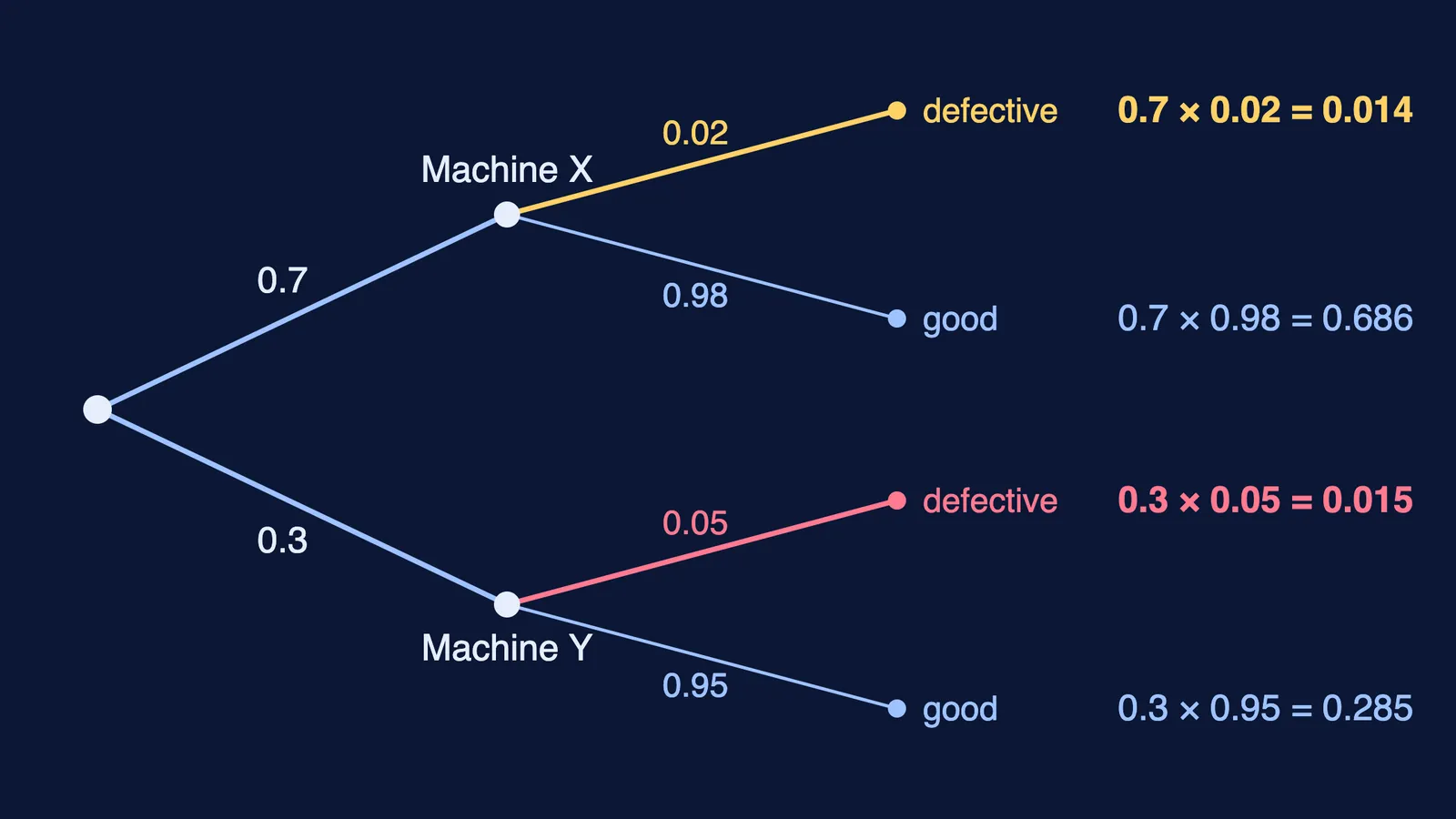
Q6 (hard). Machine X makes 70% of a factory's bolts and machine Y makes 30%. Of X's bolts 2% are defective; of Y's, 5%. Assertion (A): A bolt picked at random is found defective; it is more likely to have come from Y than from X. Reason (R): Given a defective bolt, the machine with the higher defect rate is always the more likely source.
Answer: (C). By Bayes' theorem the posteriors compare 0.7 × 0.02 = 0.014 with 0.3 × 0.05 = 0.015, so P(Y|defective) = 15/29, just over half: A is true. R is false: at a 25% share, Y's product drops to 0.0125 and X wins.
Trap: ignoring the priors.
Statement I and Statement II questions with answers
Q7 (medium). E and F have non-zero probabilities. Statement I: P(E|F) = P(F|E) for any such E and F. Statement II: P(F) P(E|F) = P(E) P(F|E).
Answer: (D). Both sides of Statement II equal P(E ∩ F). Statement I fails on a die with E = {1}, F = {1, 2}: P(E|F) = 1/2 but P(F|E) = 1.
Trap: swapping the condition.
Q8 (medium). P(A) = 0.5, P(B) = 0.4 and P(A ∪ B) = 0.7. Statement I: A and B are independent. Statement II: P(A|B) = 0.2.
Answer: (C). P(A ∩ B) = 0.5 + 0.4 − 0.7 = 0.2 = 0.5 × 0.4, so Statement I holds. But P(A|B) = 0.2/0.4 = 0.5, which equals P(A).
Trap: confusing P(A ∩ B) with P(A|B).
Q9 (hard). A slip is drawn at random from four slips numbered 1, 2, 3 and 4. E = {1, 2}, F = {1, 3}, G = {1, 4}. Statement I: E, F and G are pairwise independent. Statement II: P(E ∩ F ∩ G) = 1/4.
Answer: (A). Each event has probability 1/2 and every intersection is just slip 1, so each pair gives 1/4 = (1/2)(1/2) and Statement II holds. Since 1/4 ≠ 1/8, the three are not mutually independent under NCERT's definition.
Trap: assuming pairwise independence gives mutual independence.
Q10 (hard). Bag I has 3 red and 2 black balls; Bag II has 1 red and 4 black. A die is thrown: on 1 or 2 a ball is drawn from Bag I, otherwise from Bag II. Statement I: P(red) = 2/5. Statement II: Given the ball is red, the probability it came from Bag I is 3/4.
Answer: (B). By total probability, P(red) = (1/3)(3/5) + (2/3)(1/5) = 1/3. By Bayes' theorem, P(Bag I|red) = (1/5)/(1/3) = 3/5.
Trap: pooling all 10 balls (giving 4/10 and 3/4), which ignores the die.
How should you use this set?
Cover the answers; mark each statement true or false first.
For every (A) or (B), write the rule that links R to A, or "no rule".
For every false statement, write the counter-example or the corrected number.
Redo misses two days later.
For the 5-mark Bayes layout and step marks, read our Probability Class 12 board exam guide. If you got a key right but cannot say why, the Fermi Concept Library has a lesson for every concept in mathematics, each with its place in the map.