

On this page
Three original cases, each with four graded parts and worked answers. For chapter notes, read our Neural control and coordination Class 11 guide.
What do these case study questions cover?
Class 11 exams are set by your school, so the pattern varies. Treat these as practice in the case-based style.
Every fact follows Chapter 18 of NCERT Class 11 Biology (Reprint 2026-27) and the CBSE 2026-27 Class XI Biology syllabus, which lists neurons and nerves, the human nervous system and the conduction of nerve impulse. The NCERT chapter states that the sodium-potassium pump moves 3 Na⁺ out of the cell for every 2 K⁺ it brings in.
Case 1: A brain model for the school exhibition
Mehak's group in Lucknow builds a clay model of a brain cut down the middle for their science exhibition. They colour the forebrain blue, the midbrain green and the hindbrain orange. A thin canal runs through the green part, and four round swellings sit on its upper (dorsal) side. Three cloth layers stand for the brain's coverings. A chart beside it traces three fibres: fibre P carries a message from the skin of the hand to the spinal cord, fibre Q carries a command from the spinal cord to a thigh muscle, and fibre R carries a command from the CNS to the smooth muscle of the stomach wall.
(i) The canal through the green part is the: (a) central canal (b) cerebral aqueduct (c) synaptic cleft (d) corpus callosum
(ii) Name the three cloth layers in order, from the outside in.
(iii) Which parts of the model together form the brain stem, and which colours do they carry?
(iv) Classify fibres P, Q and R as afferent or efferent, and say which division of the PNS carries Q and which carries R.
Answers.
(i) (b) The cerebral aqueduct passes through the midbrain.
(ii) Dura mater (outer), arachnoid (middle), pia mater (inner, touching brain tissue).
(iii) Midbrain (green), pons and medulla oblongata (both orange). The orange cerebellum is not part of it.
(iv) P is afferent: it carries impulses from a tissue to the CNS. Q and R are efferent. Q reaches a skeletal muscle, so it belongs to the somatic neural system; R reaches smooth muscle of an involuntary organ, so it belongs to the autonomic neural system.
Case 2: An axon on the computer screen
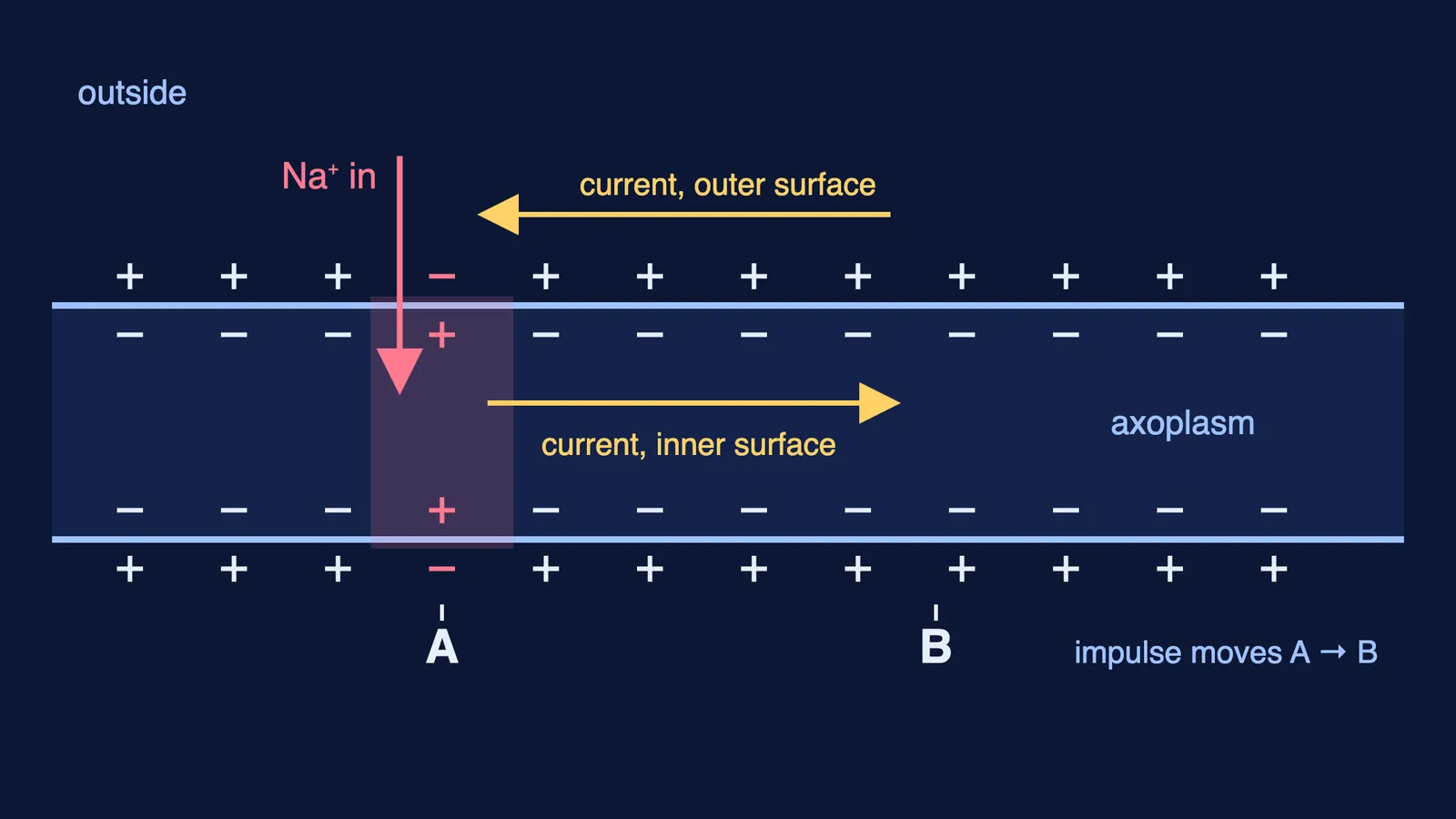
In a Chennai school lab, students run a computer model of a single resting axon to see how a nerve impulse starts and spreads. The screen shows high K⁺ and negatively charged proteins inside, and high Na⁺ outside. A counter shows the sodium-potassium pump completing 400 cycles in one time step. The students then click a stimulus at point A on the membrane. Point A turns red, then point B just ahead turns red, and A soon returns to its resting colour.
(i) At rest, the axonal membrane is comparatively more permeable to: (a) Na⁺ (b) K⁺ (c) negatively charged proteins (d) all three equally
(ii) In the 400 cycles, how many Na⁺ and K⁺ ions does the pump move, and what is the net movement of positive charge?
(iii) What happens at point A when it turns red, and what is the potential there called?
(iv) Explain why point B turns red next, and why A returns to rest.
Answers.
(i) (b) K⁺. It is nearly impermeable to Na⁺.
(ii) Na⁺ out = 3 × 400 = 1,200; K⁺ in = 2 × 400 = 800. Net: 1,200 − 800 = 400 positive charges leave, keeping the outer surface positive.
(iii) The membrane at A becomes freely permeable to Na⁺, Na⁺ rushes in and polarity reverses (inside positive). This is the action potential, or nerve impulse.
(iv) Current flows from A to B on the inner surface and from B to A on the outer surface, reversing the polarity at B. At A, Na⁺ permeability falls quickly, K⁺ diffuses out and the resting potential returns.
Case 3: Testing compound Z on two synapses
A research team in Hyderabad grows two pairs of connected neurons in dishes. Pair 1 is joined by a chemical synapse, pair 2 by an electrical synapse. They stimulate each pre-synaptic neuron 50 times and count new potentials in the post-synaptic neuron. Before treatment, pair 1 responds 46 times and pair 2 responds 50 times. They then add compound Z, which binds to the receptors on post-synaptic membranes without opening ion channels. Pair 1 then responds 0 times and pair 2 still responds 50 times. A test of the fluid in the synaptic cleft of pair 1 still finds neurotransmitter after each stimulus.
(i) The fluid-filled space in pair 1 is the: (a) node of Ranvier (b) synaptic knob (c) synaptic cleft (d) cerebral aqueduct
(ii) Find the response rate of pair 1 before and after compound Z.
(iii) Why does compound Z have no effect on pair 2?
(iv) A student says compound Z stops vesicles releasing neurotransmitter. Use the data to judge this claim.
Answers.
(i) (c) Synaptic cleft.
(ii) Before: 46 ÷ 50 × 100 = 92%. After: 0 ÷ 50 × 100 = 0%.
(iii) At an electrical synapse the membranes are very close and current flows directly from one neuron into the other. No receptor is involved, so Z has nothing to block.
(iv) The claim is wrong. Neurotransmitter still appears in the cleft, so vesicles still fuse and release it. Z acts one step later: neurotransmitter binding to receptors normally opens ion channels, letting ions in to make a new potential. With receptors occupied, the channels stay shut.
How do you answer neural control case study questions?
Sort each fibre as afferent or efferent, then somatic or autonomic; Case 1 (iv) turns on this.
For the impulse, name the ion, its direction and the surface it changes.
In pump questions, multiply cycles by 3 and by 2; net charge is the difference.
For a synapse, write the chain: impulse arrives, vesicles fuse, neurotransmitter is released, binds receptors, channels open. Then find the broken link.
Use only brain functions NCERT states, such as the medulla controlling respiration.
For one-mark practice, try our assertion-reason questions on neural control and coordination, or read how to handle case-based questions. If the moving impulse is hard to picture, the Fermi Simulation Lab has interactive simulations for the ideas that are easier to see than to read.


