On this page
What do matrices and determinants case studies test?
The CBSE Mathematics Sample Question Paper 2026-27 has three case study-based questions of 4 marks each in Section E; calculators are not allowed. Its matrix case, Q38, asks for AX = B, the adjoint and the solution by the inverse.
The CBSE 2026-27 Mathematics curriculum lists matrix operations, determinants up to 3×3, cofactors, area of a triangle, adjoint, inverse, and solving systems with a unique solution by the inverse. Every case follows NCERT Class 12 Chapter 3, Matrices and Chapter 4, Determinants (Reprint 2026-27). Scenarios and numbers are ours. For step marks, see our matrices and determinants board exam guide.
Case 1: Two stalls at a Diwali mela
Ananya's family runs two stalls, P and Q, at a Diwali mela in Lucknow. Both sell diya packs, candle boxes and rangoli kits. On the first evening, P sells 40 diya packs, 25 candle boxes and 10 rangoli kits; Q sells 30, 35 and 15. The profit is ₹12 per diya pack, ₹20 per candle box and ₹35 per rangoli kit. Ananya writes the sales as matrix S (one row per stall, one column per item) and the profits as a column matrix P. Second-evening sales are 50, 20, 12 at P and 45, 30, 20 at Q (matrix T).
(i) The order of S is: (a) 3×2 (b) 2×3 (c) 2×2 (d) 3×3
(ii) Which product is defined? (a) both SP and PS (b) only SP (c) only PS (d) neither
(iii) Find SP and interpret it.
(iv) Using one product, find each stall's two-evening profit. Which earned more?
Answers.
(i) (b) 2×3: two stalls, three items.
(ii) (b). S is 2×3 and P is 3×1, so SP is 2×1. PS fails: P has 1 column, S has 2 rows.
(iii) SP = [40(12) + 25(20) + 10(35); 30(12) + 35(20) + 15(35)] = [1330; 1585]. First-evening profit: ₹1330 at P, ₹1585 at Q.
(iv) S + T = [90 45 22; 75 65 35]. (S + T)P = [2750; 3425]. Stall Q earned more. This equals SP + TP.
Case 2: A drip line across a vineyard
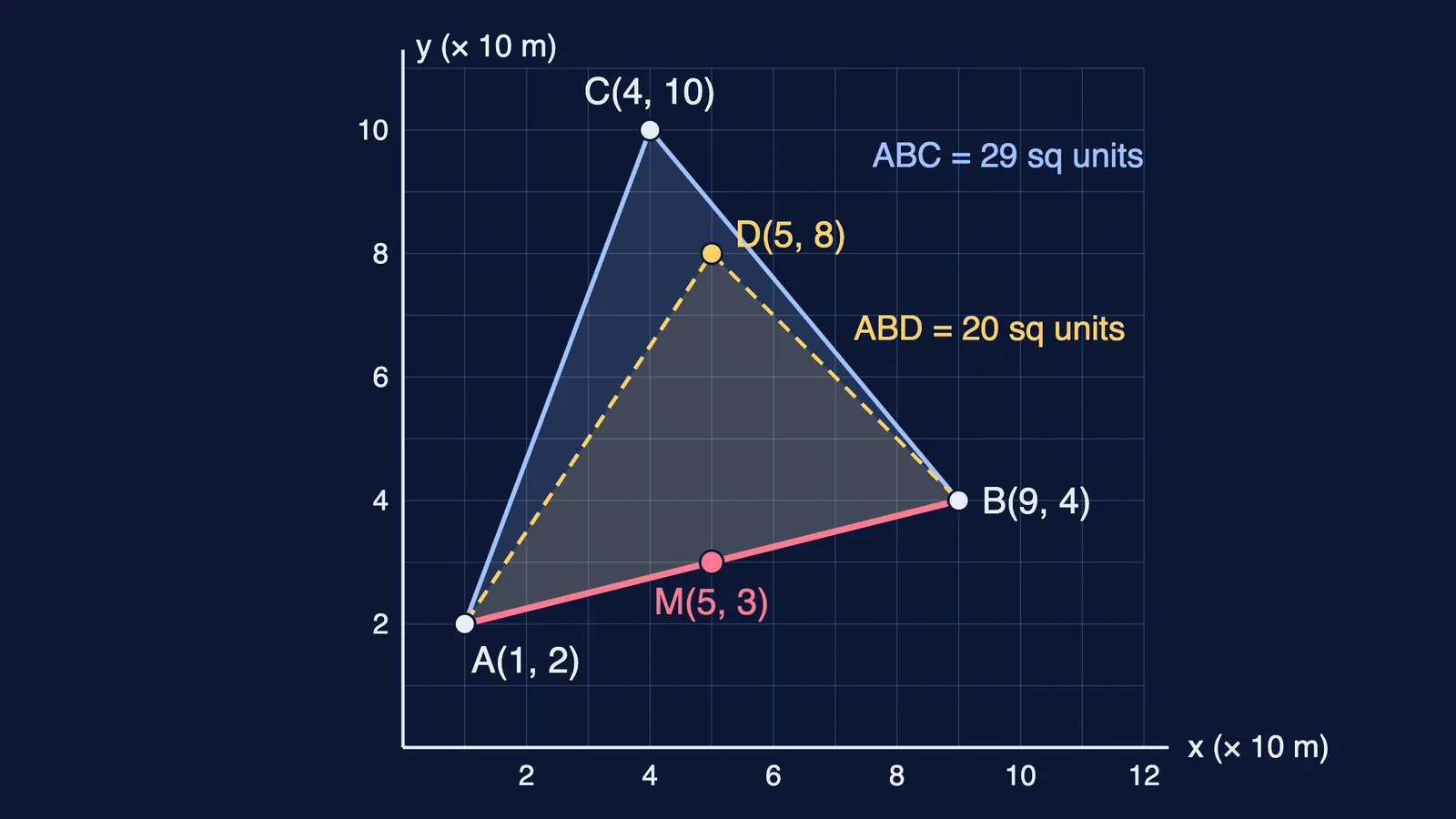
A Nashik grape farmer maps her triangular plot on a grid where 1 unit is 10 m. The corner posts stand at A(1, 2), B(9, 4) and C(4, 10). A straight drip pipe runs from A to B, and a sprinkler is to be fixed at M(5, 3); it must sit exactly on the pipe, or the joint will leak. She also wants a nursery bed ABD with D(k, 8) and area 20 square units. Her farm lies between x = 0 and x = 12.
(i) If the area determinant for points P, Q, R is zero, then: (a) the triangle is right-angled (b) P, Q, R are collinear (c) P, Q, R coincide (d) the area is negative
(ii) Find the area of the plot in square units and in square metres.
(iii) Use a determinant to show that M lies on the pipe AB.
(iv) Find the possible values of k, and the one she can use.
Answers.
(i) (b). Collinear points give area zero.
(ii) Δ = ½|1(4 − 10) + 9(10 − 2) + 4(2 − 4)| = ½|−6 + 72 − 8| = 29 square units. One square unit is 100 m², so the plot is 2900 m².
(iii) The determinant with rows (1, 2, 1), (9, 4, 1), (5, 3, 1) is 1(4 − 3) + 9(3 − 2) + 5(2 − 4) = 1 + 9 − 10 = 0. Area zero, so M is collinear with A and B, and 1 < 5 < 9 puts it between them, on the pipe.
(iv) Δ = ½[1(4 − 8) + 9(8 − 2) + k(2 − 4)] = ½(50 − 2k) = 25 − k. The area is given, so use both signs: 25 − k = 20 gives k = 5, and 25 − k = −20 gives k = 45. Only k = 5 lies inside the farm, so D is (5, 8).
Case 3: Ticket sales at a science museum
A science museum in Kolkata sells three kinds of ticket: student at ₹x, adult at ₹y and senior citizen at ₹z. The price board is being repainted, so a new cashier must work out the prices from three bills in the register. One group of 2 students, 3 adults and 1 senior paid ₹280. A second group of 4 students, 1 adult and 2 seniors paid ₹260. A third group of 1 student, 2 adults and 3 seniors paid ₹270.
(i) The system AX = B has a unique solution when: (a) |A| = 0 (b) |A| ≠ 0 (c) A is symmetric (d) B = O
(ii) Write A and find |A|.
(iii) Find adj A.
(iv) Find the three prices using X = A⁻¹B.
Answers.
(i) (b). Then X = A⁻¹B is the only solution.
(ii) A = [2 3 1; 4 1 2; 1 2 3], B = [280; 260; 270]. |A| = 2(3 − 4) − 3(12 − 2) + 1(8 − 1) = −2 − 30 + 7 = −25.
(iii) Cofactors: A₁₁ = −1, A₁₂ = −10, A₁₃ = 7; A₂₁ = −7, A₂₂ = 5, A₂₃ = −1; A₃₁ = 5, A₃₂ = 0, A₃₃ = −10. Transposing gives adj A = [−1 −7 5; −10 5 0; 7 −1 −10]. Check: A(adj A) = −25I.
(iv) (adj A)B = [−280 − 1820 + 1350; −2800 + 1300 + 0; 1960 − 260 − 2700] = [−750; −1500; −1000]. X = (1/−25)(adj A)B = [30; 60; 40]: a student ticket is ₹30, an adult ₹60 and a senior ₹40.
How do you attack case-study questions on matrices and determinants?
Write orders before multiplying. (m×n)(n×p) gives m×p.
Label rows and columns from the story. "Rows are stalls" stops you writing S as 3×2.
Mind the sign in area. Use both signs when the area is given.
Check adj A before solving with A(adj A) = |A|I.
Read the answer back into the story. Prices must be positive.
For the general method, see our guide to case-based questions in board exams, then our matrices and determinants assertion-reason questions. If cofactor signs slip, the Fermi Problem Library has worked problems with a step-by-step solver that explains the reasoning rather than printing an answer.