On this page
Each question below hides a misconception or a "true, but not the reason" link. Every statement was checked against the NCERT Class 12 chapters on Matrices and Determinants (Reprint 2026-27), and every number recomputed.
How do you answer assertion-reason questions?
The CBSE Class 12 Maths sample question paper for 2026-27 puts two assertion-reason questions, Q19 and Q20, in Section A at 1 mark each. Judge each statement alone, then ask whether R directly causes A. Keys for the six assertion-reason items:
(A) Both A and R are true and R is the correct explanation of A.
(B) Both A and R are true but R is NOT the correct explanation of A.
(C) A is true but R is false.
(D) A is false but R is true.
Keys for the four statement pairs:
(A) Both statements are correct.
(B) Both statements are incorrect.
(C) Statement I is correct, Statement II is incorrect.
(D) Statement I is incorrect, Statement II is correct.
All items stay inside the CBSE 2026-27 Class 12 Maths syllabus.
Assertion-reason questions on matrices and determinants
Q1 (easy). Assertion (A): If A is a 2 x 3 matrix and B is a 3 x 2 matrix, both AB and BA are defined. Reason (R): The product AB is defined when the number of columns of A equals the number of rows of B.
Answer: (A). Columns of A (3) match rows of B (3), so AB is 2 x 2; columns of B (2) match rows of A (2), so BA is 3 x 3. R is the rule that decides both.
Trap: assuming AB and BA have the same order.
Q2 (easy). Assertion (A): If A is a 3 x 3 matrix with |A| = 3, then |2A| = 6. Reason (R): If A is a square matrix of order n, then |kA| = kⁿ|A|.
Answer: (D). By R, |2A| = 2³ x 3 = 24, so A is false.
Trap: scaling only one row.
Q3 (medium). Assertion (A): For A = [[0, 1], [0, 0]], A² = O. Reason (R): If A² = O for a square matrix A, then A = O.
Answer: (C). A is true by direct multiplication. R is false, and A itself is the counterexample.
Trap: assuming xy = 0 forces x = 0 or y = 0.
Q4 (medium). Assertion (A): For every square matrix P, P + P′ equals its own transpose. Reason (R): Every square matrix splits into a symmetric part plus a skew-symmetric part.
Answer: (B). Both are NCERT theorems. A holds because (P + P′)′ = P′ + P. R is proved using A, so R does not explain A.
Trap: picking (A) because the facts sit together in NCERT.
Q5 (hard). Assertion (A): The system x + 2y = 3, 2x + 4y = 7 has no solution. Reason (R): If the coefficient matrix A of a system AX = B is singular, the system has no solution.
Answer: (C). |A| = 0 and (adj A)B = [-2, 1]ᵀ ≠ O, so the system is inconsistent. R is false: x + 2y = 3, 2x + 4y = 6 has |A| = 0 and infinitely many solutions.
Trap: stopping at |A| = 0 instead of computing (adj A)B.
Q6 (hard). Assertion (A): If A is a 3 x 3 matrix with |A| = 5, then |adj A| = 25. Reason (R): For a square matrix A of order n, |adj A| = |A|ⁿ⁻¹.
Answer: (A). With n = 3, |adj A| = 5² = 25, straight from R.
Trap: using |A|ⁿ and writing 125.
Statement I and Statement II questions with answers
Q7 (easy). Statement I: Every scalar matrix is a diagonal matrix. Statement II: Every diagonal matrix is a scalar matrix.
Answer: (C). A scalar matrix is a diagonal matrix with equal diagonal entries, so I is true. diag(1, 2) is diagonal but not scalar, so II is false.
Trap: reading the definition backwards.
Q8 (medium). Statement I: If A and B are invertible matrices of the same order, then (AB)⁻¹ = A⁻¹B⁻¹. Statement II: A square matrix has an inverse exactly when its determinant is non-zero.
Answer: (D). NCERT gives (AB)⁻¹ = B⁻¹A⁻¹. For A = [[1, 2], [0, 1]] and B = [[1, 0], [3, 1]], A⁻¹B⁻¹ = [[7, -2], [-3, 1]] but (AB)⁻¹ = [[1, -2], [-3, 7]]. II is an NCERT theorem.
Trap: forgetting the order reversal.
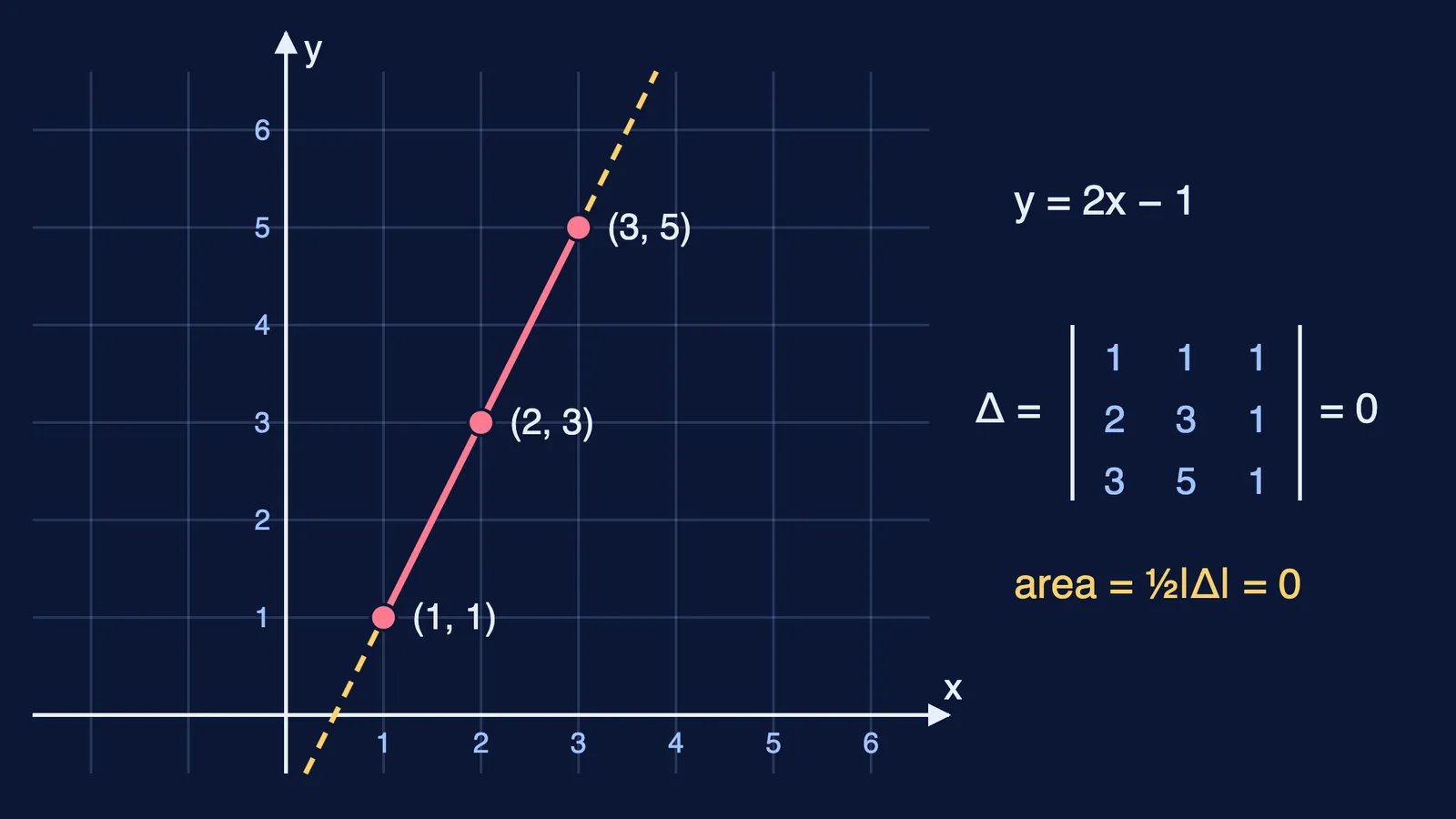
Q9 (hard). Statement I: For all square matrices A and B of order 2, (A + B)² = A² + 2AB + B². Statement II: The area of the triangle with vertices (1, 1), (2, 3) and (3, 5) is 1 square unit.
Answer: (B). I fails because AB ≠ BA in general; Q8's A and B give (A + B)² = [[10, 8], [12, 10]] but A² + 2AB + B² = [[16, 8], [12, 4]]. II fails: the points lie on y = 2x − 1, so the area is 0.
Trap: expanding as with numbers.
Q10 (hard). Statement I: A 3 x 3 determinant gives the same value whether it is expanded along any row or any column. Statement II: If the elements of row 1 are multiplied by the cofactors of row 2 and added, the sum is zero.
Answer: (A). Both are in NCERT; II's sum equals a determinant with two identical rows. For [[2, 1, 3], [0, 4, -1], [5, 2, 1]], row 1 with its own cofactors gives -53 and with row 2's gives 0.
Trap: expecting |A| from any row-cofactor pairing.
How should you use this set?
Attempt all ten in 12 minutes, marking T or F on each statement before choosing a key.
For each miss, note what you misjudged: A, R, or the link.
Redo Q2, Q5, Q6 and Q9 by hand.
Write one new pair from a theorem you got wrong.
If a calculation like Q5 still feels unclear, the Fermi Problem Library has worked problems with a step-by-step solver that explains the reasoning rather than printing an answer.
For the whole chapter with step marks, read our guide to matrices and determinants for the Class 12 board exam. For the method across subjects, see our assertion-reason strategy guide.