On this page
Human Reproduction sits in Unit VI, Reproduction, of the CBSE Class 12 Biology syllabus for 2026-27. The CBSE 2026-27 Biology sample paper has two case-based questions of 4 marks each in Section D. Each case there has a 1-mark part, a 2-mark part, and then a choice of two 1-mark parts. The three original cases below, easy to hard, follow that pattern and are built only on the NCERT chapter on Human Reproduction (Reprint 2026-27).
In each case, (i) carries 1 mark and (ii) carries 2; attempt either (iii) or (iv), 1 mark. For the full chapter, read our Human Reproduction Class 12 board guide.
Case 1: Does this semen sample meet the NCERT benchmarks?
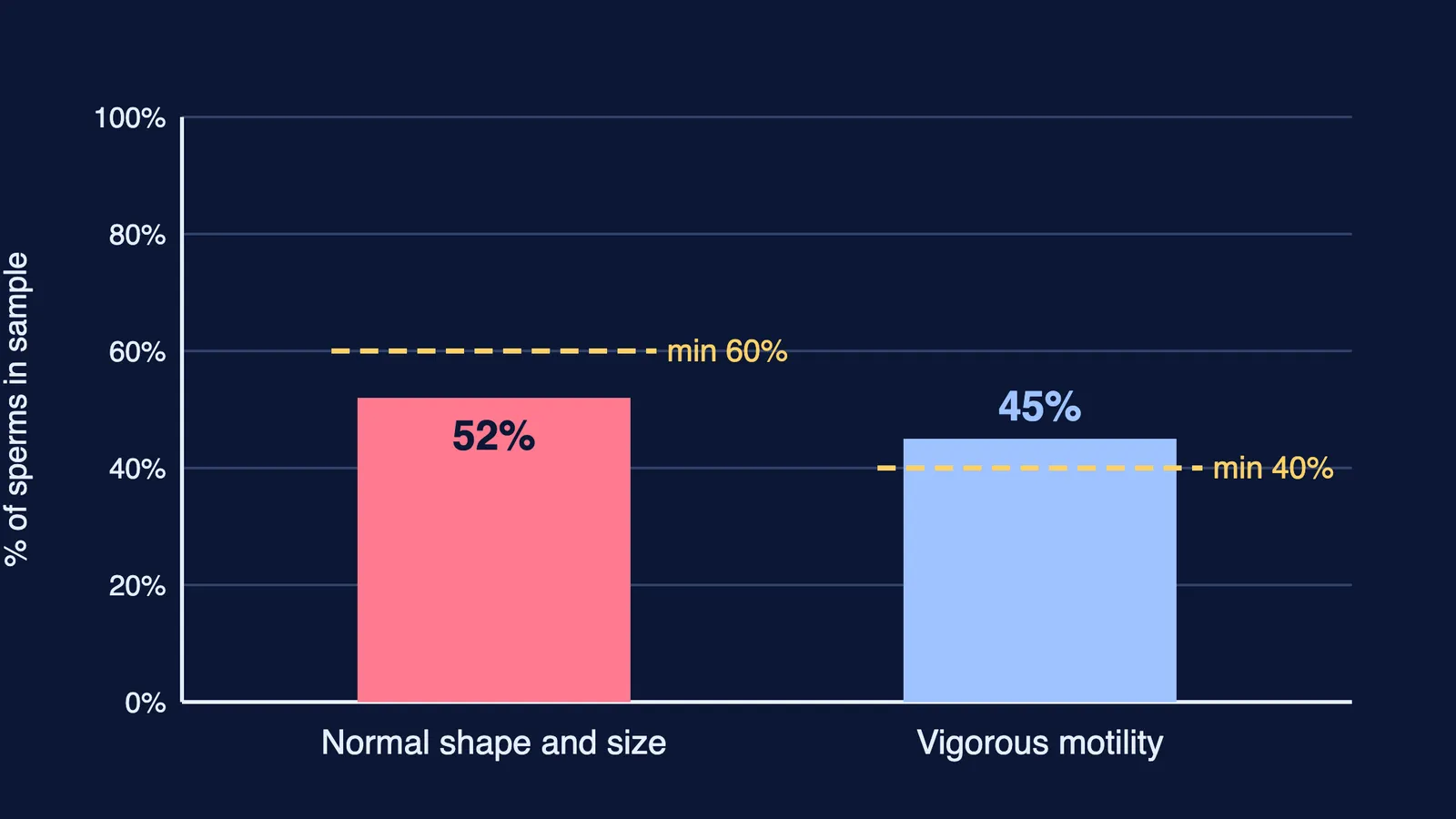
Ritesh, a trainee at a pathology lab in Nagpur, is practising with an anonymised sample report. The sample contains 240 million sperms. The report notes that 52% of the sperms have normal shape and size, 45% show vigorous motility, and the seminal plasma tests positive for fructose. His supervisor asks him to compare these figures with the textbook benchmarks for normal fertility. This is a training exercise, not a diagnosis.
(i) Which part of the sperm contains numerous mitochondria? (a) Head (b) Neck (c) Middle piece (d) Tail
(ii) Which NCERT benchmark does the sample fail, and by how many normally shaped sperms does it fall short?
(iii) Name the glands whose secretions make up the seminal plasma.
OR (iv) How many sperms in this sample show vigorous motility?
Answers.
(i) (c) Middle piece. Its mitochondria produce the energy for the tail's movement.
(ii) The NCERT chapter says at least 60 per cent of sperms must have normal shape and size and at least 40 per cent must show vigorous motility. Motility passes (45% is above 40%), but shape fails. Normal sperms present: 52% of 240 million = 124.8 million. Needed: 60% of 240 million = 144 million. Shortfall: 144 − 124.8 = 19.2 million.
(iii) The paired seminal vesicles, the prostate and the paired bulbourethral glands. Seminal plasma is rich in fructose, calcium and certain enzymes.
(iv) 45% of 240 million = 0.45 × 240 = 108 million sperms.
Case 2: Why does only one sperm fertilise the ovum?
For a science exhibition in Bhopal, Ananya builds an eight-step model. Step 1 shows an ovum surrounded by many sperms at its zona pellucida. In step 2, a single sperm has entered. Steps 3 to 6 show the embryo moving down the oviduct with 2, 4, 8 and 16 cells. Step 7 is a ball of cells with an outer layer and an inner group of cells, and step 8 shows it embedded in the uterine lining. A visitor asks why only one sperm got in, and whether the baby's sex has already been decided by step 8.
(i) In which part of the fallopian tube does step 1 take place?
(ii) Answer the visitor's second question, and give the sex chromosomes and total chromosome number of the zygote if a Y-bearing sperm entered at step 2.
(iii) What stops a second sperm from entering once the first sperm contacts the zona pellucida?
OR (iv) Which steps of the model show a morula?
Answers.
(i) The ampullary region (ampulla), where the NCERT chapter says fertilisation takes place.
(ii) Yes. The sex is decided at fertilisation (step 2): every ovum carries an X, while 50 per cent of sperms carry X and 50 per cent carry Y. A Y-bearing sperm gives an XY zygote with 46 chromosomes (44 + XY), which develops into a male.
(iii) The sperm's contact with the zona pellucida induces changes in the membrane that block the entry of additional sperms.
(iv) Steps 5 and 6 (8 and 16 cells), because a morula is the embryo with 8 to 16 blastomeres.
Case 3: Do most ovarian follicles ever release an ovum?
At a health-education class in a Chennai school, a teacher writes two lines from the textbook on the board: each ovary has only 60,000 to 80,000 primary follicles left at puberty, and one ovum is released in each menstrual cycle. She then describes Meena, a hypothetical woman whose cycles begin at menarche at age 13 and repeat every 28 days until menopause at 50, with two pregnancies of about 270 days each in between. A student says, "So almost all those follicles must turn into eggs." Test this, taking a year as 365 days.
(i) At which stage of meiosis are primary oocytes arrested, and when does the arrest begin?
(ii) About how many ovulations does Meena have in her life? Use the answer to test the student's claim.
(iii) Why are no cycles counted during Meena's two pregnancies?
OR (iv) How many primary follicles do both of Meena's ovaries hold together at puberty?
Answers.
(i) Prophase I. Oogonia in the fetal ovary enter prophase I and are arrested there as primary oocytes, so the arrest begins before birth.
(ii) 37 years × 365 = 13,505 days; minus 2 × 270 = 540 days of pregnancy leaves 12,965 days; 12,965 ÷ 28 ≈ 463 ovulations. Both ovaries hold 120,000 to 160,000 primary follicles, so 463 is only about 0.29% to 0.39% of them: fewer than 1 follicle in 250 ever releases an ovum. The claim is wrong.
(iii) The NCERT chapter says that during pregnancy all events of the menstrual cycle stop and there is no menstruation, so there is no ovulation to count.
(iv) 2 × 60,000 to 2 × 80,000 = 120,000 to 160,000 primary follicles.
How to attack case-study questions on Human Reproduction?
Underline every number in the passage and link it to a line in the NCERT chapter: 60 and 40 per cent for sperm quality, 8 to 16 blastomeres for a morula.
Name the exact place and cell: ampulla, not "fallopian tube"; primary oocyte, not "egg".
For timeline cases, write the sequence in the margin first: fertilisation, cleavage, morula, blastocyst, implantation.
In the 2-mark part, give the fact and the reason in separate sentences.
For more practice, our guide to case-based questions in board exams covers the method, and the Human Reproduction assertion-reason set drills this chapter.
If gametogenesis still feels like a list of names, the Fermi Concept Library has a lesson for every biology concept, each with its place in the map of ideas around it.