

On this page
These three case studies on Chapter 7, Human Health and Disease, run from easy to hard. Every fact in the answers matches the NCERT Class 12 Biology chapter (reprint 2026-27); the people, places and numbers in the passages are invented for practice. For the whole chapter with model answers, use our Human health and disease Class 12 board exam guide.
What do case-based questions on human health and disease test?
The CBSE Biology sample paper for 2026-27 has 2 case-based questions of 4 marks each, in Section D. They test whether you can spot the chapter idea inside a real situation. Our guide to case-based questions in board exams covers the general method.
Case 1: Larvae in the coolers
In August, six residents of a housing society in Nagpur report chills and high fever that return every few days. Blood tests show *Plasmodium vivax*. Volunteers check all 48 desert coolers in the society and find mosquito larvae in 18. The committee then drains and cleans every cooler weekly and releases *Gambusia* fish into the garden pond. Three weeks later, a recheck finds larvae in only 3 coolers. The secretary asks Class 12 students in the society to explain the data.
(i) The insect that carries *Plasmodium* to the residents is: (a) female *Aedes* (b) female *Anopheles* (c) male *Anopheles* (d) housefly.
(ii) In what form does *Plasmodium* enter the human body, and where does it first multiply?
(iii) Calculate the percentage of coolers with larvae before and after the drive, and the percentage fall in larva-positive coolers.
(iv) A resident says treating the six patients is enough and the cooler drive is wasted effort. Give two reasons from the parasite's life cycle why he is wrong. (2 marks)
Answers.
(i) (b) female *Anopheles*, which NCERT calls both a host and the vector.
(ii) As sporozoites, the infectious form; they first multiply in liver cells and then attack red blood cells.
(iii) Before: 18 ÷ 48 × 100 = 37.5%. After: 3 ÷ 48 × 100 = 6.25%. Fall: (18 − 3) ÷ 18 × 100 = 83.3% (a fall of 31.25 percentage points).
(iv) First, mosquitoes that bit the patients take up the parasite, which develops into sporozoites stored in their salivary glands, and infect new people after the six are treated. Second, the parasite needs two hosts, human and female *Anopheles*; removing breeding places with drained coolers and larva-eating *Gambusia* breaks the cycle. NCERT calls vector control the most important measure for vector-borne diseases.
Case 2: Two doses, two curves
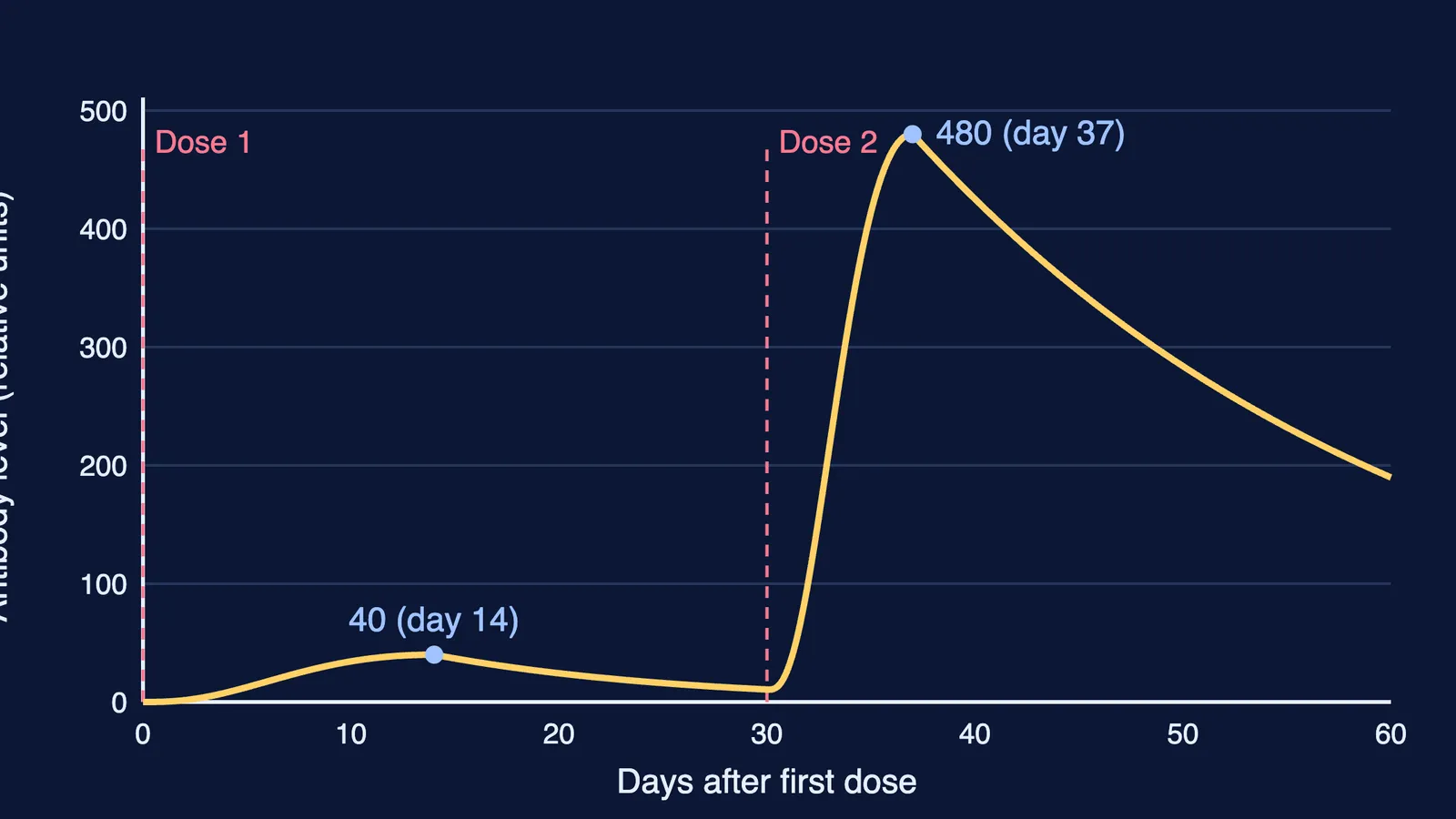
Meera, a first-year nursing student in Lucknow, receives a hepatitis B vaccine. A lab tracks her antibody level in relative units: after the first dose it rises slowly and peaks at 40 units on day 14. A second dose is given on day 30, and this time the level peaks at 480 units on day 37. The same week, her cousin gets a deep cut from a rusty sickle on the farm. The doctor injects him with tetanus antitoxin at once.
(i) The hepatitis B vaccine Meera received is made: (a) from killed virus grown in eggs (b) by recombinant DNA technology in yeast (c) from horse serum (d) from weakened bacteria.
(ii) Name the response after the second dose and the cells that make it possible.
(iii) How many times higher was the second peak, and how many days sooner after the dose did it come?
(iv) Classify Meera's and her cousin's immunity as active or passive, and explain why the cousin was not simply given a vaccine. (2 marks)
Answers.
(i) (b). NCERT's example of a recombinant vaccine is hepatitis B vaccine produced from yeast.
(ii) The secondary, or anamnestic, response, made possible by memory B and T cells formed after the first dose.
(iii) 480 ÷ 40 = 12 times higher. The first peak came 14 days after dose 1; the second came 37 − 30 = 7 days after dose 2, so 7 days sooner.
(iv) Meera's is active immunity: her own body made the antibodies, slowly, and kept memory. Her cousin's is passive: antitoxin contains preformed antibodies, and tetanus needs a quick response that active immunity is too slow to give.
Case 3: The driver's blood test
Ravi, a 31-year-old truck driver, has had bouts of fever, diarrhoea and weight loss for months. An ELISA on his blood is positive for HIV, and his doctor thinks he was infected about seven years earlier. Over the next two years his helper T-cell count falls from 600 to 240 cells per microlitre of blood, and he develops tuberculosis. His employer wants him to stop eating with the other drivers. His wife, three months pregnant, is advised to get tested.
(i) The enzyme that lets HIV make DNA from its RNA genome is: (a) DNA ligase (b) RNA polymerase (c) reverse transcriptase (d) restriction endonuclease.
(ii) Why is a gap of seven years between infection and symptoms not surprising?
(iii) Find the percentage fall in Ravi's helper T-cell count and the average fall per year.
(iv) Is the employer right? Why is testing his wife important? (2 marks)
Answers.
(i) (c) reverse transcriptase. The viral DNA then joins the host cell's DNA.
(ii) NCERT says the time lag between infection and AIDS symptoms ranges from a few months to many years, usually 5-10 years.
(iii) (600 − 240) ÷ 600 × 100 = 60%. Average fall: 360 ÷ 2 = 180 cells per microlitre per year.
(iv) No. HIV is not spread by touch or physical contact, only through body fluids, and NCERT says infected people should not be isolated from family and society. His wife should be tested because HIV spreads by sexual contact and from an infected mother to her child through the placenta.
How do you attack case-study questions on this chapter?
Name the disease or process in the first line of every answer; the passage rarely says "this is passive immunity".
For pathogens, link organism, group, route of entry and one symptom.
Show the arithmetic in full, with units.
For HIV and drug-abuse cases, answer social questions with the NCERT reason (body fluids only, no isolation), not opinion.
If one term keeps tripping you up, look it up in the Fermi Concept Library, which has a lesson for every biology concept, then retry the case.
For quicker drills on the same chapter, try our human health and disease assertion-reason set.


