

On this page
Three original case studies, easiest first, each with four parts and worked answers.
What do these case-study questions cover?
The CBSE Class 10 Science syllabus for 2026-27 covers the lens of the human eye, defects of vision and their correction, refraction through a prism, dispersion and scattering of light, excluding the colour of the Sun at sunrise and sunset. Every answer below follows the NCERT chapter, Reprint 2026-27, with the lens formula and Snell's law from Light: Reflection and Refraction. For the whole chapter, see our guide to The Human Eye and the Colourful World for Class 10; for one-mark practice, try our human eye assertion-reason questions.
Case 1: Why is the danger lamp red?
A Class 10 group from Bhopal is camping in a hill forest. At 7 a.m., sunlight comes through the misty canopy as bright, visible shafts. Through a gap above, Aarav sees a clear blue sky, while the mist around him looks white. At a foggy level crossing, the guard's red lamp is the first thing everyone picks out. That night, Meher points at the sky: the stars flicker, but one bright planet low in the east shines steadily.
(i) The visible shafts of sunlight between the trees are an example of: (a) dispersion (b) the Tyndall effect (c) atmospheric refraction (d) reflection by a mirror.
(ii) Why is a red lamp used as the danger signal at the level crossing?
(iii) Why do the stars flicker while the planet does not?
(iv) The blue sky and the white mist are both made by scattering. Why are their colours different?
Answers.
(i) (b). Mist droplets scatter light, making the beam visible.
(ii) Red is scattered least by fog or smoke, so it is seen in the same colour at a distance. Red light has a wavelength about 1.8 times that of blue light, according to the NCERT chapter.
(iii) Distant stars act as point sources; atmospheric refraction keeps shifting their apparent position, so their light flickers. A planet is much closer and acts as an extended source, a collection of point sources whose variations average out to zero.
(iv) The colour of scattered light depends on the size of the scattering particles. Air molecules are smaller than the wavelength of visible light and scatter blue most strongly; mist droplets are much larger, scatter longer wavelengths too, and the scattered light looks white.
Case 2: Which lens does each patient need?
A school in Kochi holds a free eye-check camp. Riya, 14, has been squinting in class and can read the board only from the front bench. The optometrist finds that she sees clearly only up to 2.5 m, so her far point is 2.5 m. Her grandfather, 66, reads distant bus numbers easily but holds the newspaper about 50 cm from his eyes. The optometrist wants Riya to see distant objects clearly and her grandfather to read at 25 cm, the normal near point.
(i) Riya has: (a) myopia, corrected by a concave lens (b) myopia, corrected by a convex lens (c) hypermetropia, corrected by a concave lens (d) presbyopia, corrected by a convex lens.
(ii) What happens to Riya's eye lens when she looks down from the board to her notebook?
(iii) Find the focal length and power of Riya's corrective lens.
(iv) Find the power of the grandfather's reading lens, and name his defect and its cause.
Answers.
(i) (a). Distant images form in front of her retina.
(ii) Her ciliary muscles contract, the lens becomes thicker and its focal length decreases.
(iii) The lens must make parallel rays appear to come from her far point, so f = −2.5 m. P = 1/f = 1/(−2.5 m) = −0.4 D, a concave lens.
(iv) The lens must form a virtual image of a page at u = −25 cm at his near point, v = −50 cm. 1/f = 1/v − 1/u = −1/50 + 1/25 = 1/50, so f = +50 cm = +0.5 m and P = +2.0 D, a convex lens. His defect is presbyopia: with age, the ciliary muscles weaken and the eye lens becomes less flexible.
Case 3: Which colour bends most in the prism?
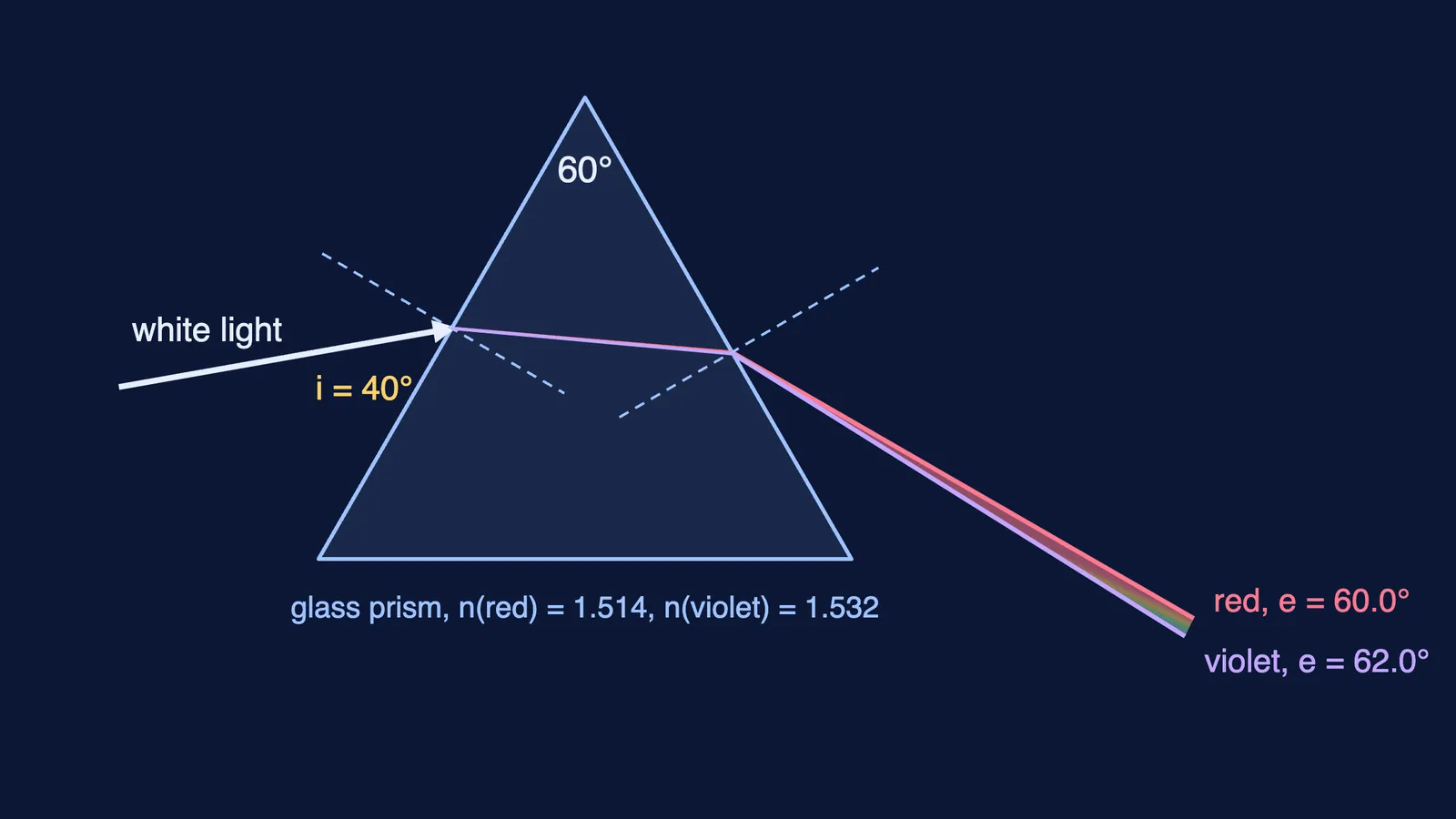
At a science fair in Jaipur, Kabir's stall shows a glass prism with an angle of 60°. A narrow beam of white light falls on one face at an angle of incidence of 40°, and a band of colours appears on a white screen a metre away. His label gives the refractive index of this glass as 1.514 for red light and 1.532 for violet light. A visitor asks what an identical second prism, placed upside down behind the first, would do.
(i) Which colour is deviated least by the prism? (a) violet (b) blue (c) green (d) red
(ii) What is the band of colours called, and what is the splitting of white light into it called?
(iii) Answer the visitor: what comes out of the second, inverted prism, and what does it show?
(iv) Use Snell's law to find the angle of refraction at the first face for red and for violet light. Which bends more?
Answers.
(i) (d). Red bends the least and violet the most.
(ii) The band is a spectrum; the splitting is dispersion.
(iii) White light emerges: the inverted prism recombines the colours, which showed Newton that sunlight is made up of them.
(iv) sin r = sin i / n, with sin 40° = 0.643. Red: sin r = 0.643/1.514 = 0.425, so r = 25.1°. Violet: sin r = 0.643/1.532 = 0.420, so r = 24.8°. Violet bends closer to the normal, so it bends more.
How to attack case-study questions on this chapter
Translate the story into NCERT terms: "reads only from the front bench" is myopia, "holds the paper far away" is hypermetropia or presbyopia, "visible beam" is the Tyndall effect.
Convert f to metres before P = 1/f; concave lenses have negative power.
For a reading lens, take u = −25 cm and v = the person's near point, also negative.
In "why" parts, give NCERT's exact cause, such as stars being point sources.
For prisms, mark red on the less-bent side.
If lens-formula signs trip you up, the Fermi Problem Library has worked problems with a step-by-step solver that explains the reasoning rather than printing an answer. More on the format: our guide to case-based questions in board exams.


