On this page
A common way to lose marks here is pairing a true fact with an effect it does not cause. These 10 original questions target that slip.
What do these questions cover?
The CBSE Class 10 Science sample paper for 2026-27 has four assertion-reason questions (Q8, Q9, Q24 and Q32), each worth 1 mark. Every item here stays inside the CBSE 2026-27 Science syllabus: the eye, defects of vision, the prism, dispersion and scattering, excluding the colour of the Sun at sunrise and sunset. Q5 uses atmospheric refraction from NCERT section 10.5. Each statement was checked against the NCERT chapter, Reprint 2026-27. For the whole chapter, read our guide to The Human Eye and the Colourful World for Class 10.
How do you answer assertion-reason questions?
Judge each statement alone first. If both are true, ask whether R is the cause NCERT gives for A. See our assertion-reason strategy guide.
Keys for Q1 to Q6:
(A) Both A and R are true and R is the correct explanation of A.
(B) Both A and R are true but R is NOT the correct explanation of A.
(C) A is true but R is false.
(D) A is false but R is true.
Keys for Q7 to Q10:
(A) Both statements are correct.
(B) Both statements are incorrect.
(C) Statement I is correct, Statement II is incorrect.
(D) Statement I is incorrect, Statement II is correct.
Assertion-reason questions with answers
Q1 (easy). Assertion (A): Most of the bending of light that enters the eye happens at the outer surface of the cornea. Reason (R): The iris adjusts the size of the pupil.
Answer: (B). Both are true. The iris controls how much light enters, not how much it bends.
Trap: picking (A) because both sentences are about the front of the eye.
Q2 (easy). Assertion (A): Someone who can read a bus number only when the bus is a few metres away is helped by spectacles with a concave lens. Reason (R): In a myopic eye, light from a distant object comes to a focus in front of the retina.
Answer: (A). This is myopia. The image forms in front of the retina, so a concave lens is needed to move it back onto the retina.
Trap: choosing a convex lens because "the image needs help".
Q3 (medium). Assertion (A): When you look up from a distant hill to the book in your hands, your eye lens becomes thinner. Reason (R): The ciliary muscles contract when the eye focuses on a nearby object.
Answer: (D). R is true. A is false: contracting ciliary muscles increase the lens's curvature, so it becomes thicker and its focal length decreases.
Trap: thinking "muscles contract" means "lens gets squeezed thin".
Q4 (medium). Assertion (A): To passengers flying at very high altitudes, the sky looks dark rather than blue. Reason (R): At very high altitudes, air molecules scatter red light more strongly than blue light.
Answer: (C). A is true: scattering is not prominent at such heights. R is false: particles smaller than the wavelength of light scatter blue more than red at any height.
Trap: inventing a colour flip to explain the dark sky.
Q5 (hard). Assertion (A): A star seen near the horizon appears slightly higher than its actual position. Reason (R): As starlight passes through air of gradually increasing refractive index, it bends towards the normal.
Answer: (A). NCERT gives exactly this cause: bent towards the normal, starlight reaches us along a higher line.
Trap: answering with twinkling, which is the flicker of this position, not the shift itself.
Q6 (hard). Assertion (A): A grandparent who must hold a needle far away to thread it may be helped by convex reading glasses. Reason (R): Presbyopia arises because the eyeball becomes too long.
Answer: (C). A is true: the near point has receded, and a convex lens helps near vision. R is false: presbyopia comes from weakening ciliary muscles and a less flexible lens. A long eyeball causes myopia.
Trap: mixing up the causes of the three defects.
Statement I and II questions with answers
Q7 (easy). Statement I: In the spectrum made by a glass prism, red light bends the most. Statement II: The splitting of white light into its component colours is called dispersion.
Answer: (D). Red bends the least and violet the most, so I is incorrect. II is NCERT's definition.
Trap: remembering VIBGYOR order but not which end bends more.
Q8 (medium). Statement I: A torch beam shone across a smoky room becomes visible because smoke particles scatter light. Statement II: The path of a light beam through a true solution, such as salt dissolved in water, is clearly visible.
Answer: (C). I is the Tyndall effect. II is incorrect: a true solution's particles are too small to show the beam; a colloid's larger particles do.
Trap: assuming any liquid shows the beam.
Q9 (medium). Statement I: The eye lens forms a virtual, erect image on the retina. Statement II: In a common bifocal lens, the upper part is convex and helps distant vision.
Answer: (B). The retinal image is real and inverted. In a common bifocal, the upper part is concave (for distance) and the lower part is convex (for reading).
Trap: swapping the two halves of the bifocal.
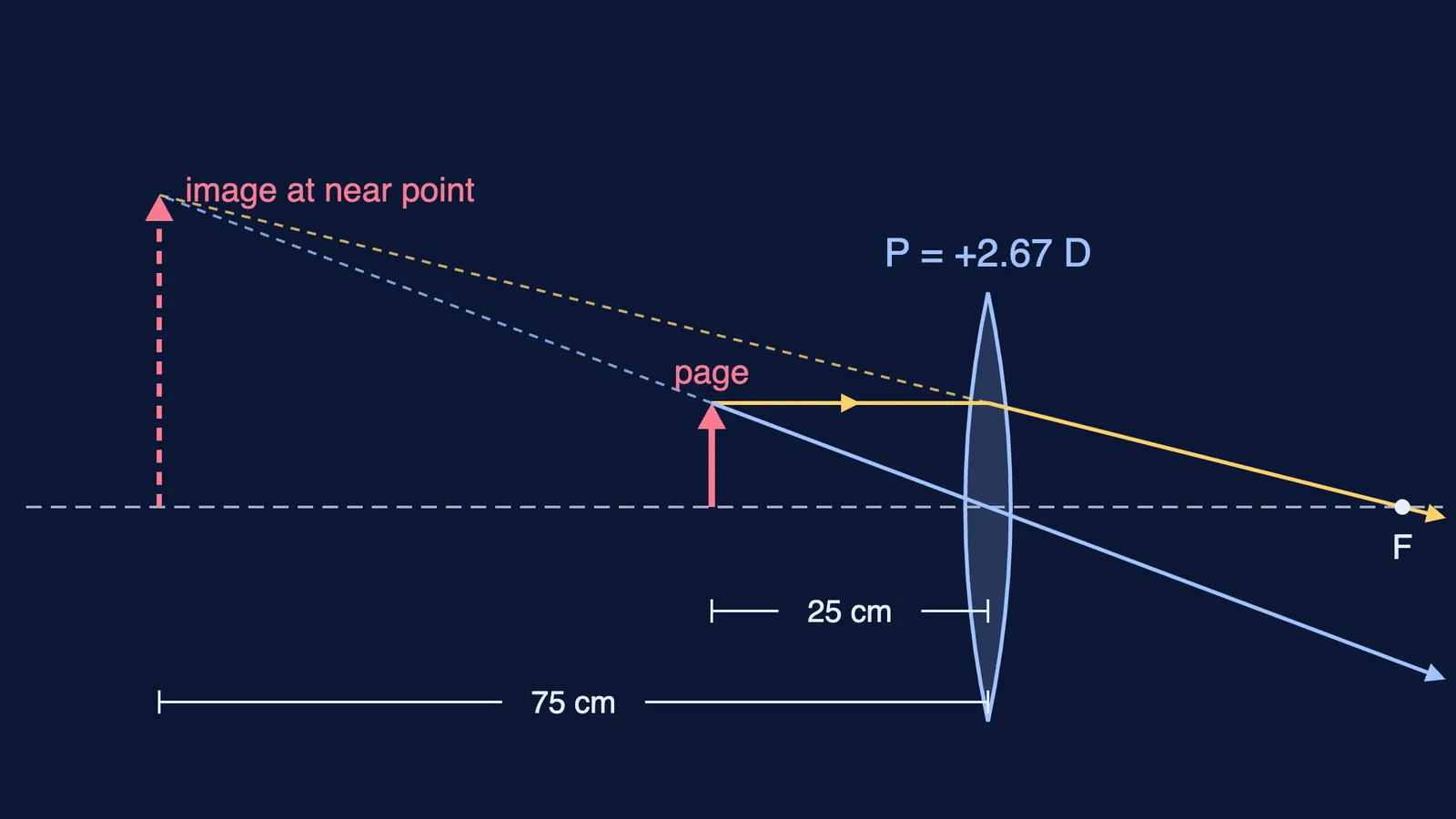
Q10 (hard). Statement I: In a hypermetropic eye, light from a nearby object comes to a focus behind the retina, and the near point lies farther than 25 cm. Statement II: A person whose near point is 75 cm needs a convex lens of about +2.7 D to read at 25 cm.
Answer: (A). I matches NCERT. For II, the lens must form a virtual image of the page (u = −25 cm) at the near point (v = −75 cm): 1/f = 1/v − 1/u = −1/75 + 1/25 = 2/75, so f = 37.5 cm and P = 100/37.5 = +2.67 D.
Trap: using u = +25 cm and getting a concave lens.
How should you use this set?
Attempt all ten in 12 minutes, without the textbook.
Label each miss: wrong fact or wrong link.
For each wrong fact, find the NCERT line and rewrite it.
Redo the misses two days later.
If ray diagrams for defects of vision are hard to picture, the Fermi Simulation Lab has interactive simulations for the ideas that are easier to see than to read.