On this page
Three original cases, easy to hard, with worked answers. For the theory first, read our Class 11 guide to Excretory Products and their Elimination.
What do excretion case-study questions test?
A case gives you a short scene with data, then asks you to name the process, do a small sum and explain it. Class 11 papers are set by schools, so treat these as practice in the case-based style, not as any exam's pattern. Every case stays inside the CBSE 2026-27 Class XI Biology curriculum, which lists modes of excretion, urine formation, regulation of kidney function and dialysis for this chapter. Every fact in the answers matches NCERT Class 11 Biology Chapter 16 (Reprint 2026-27); the people, places and numbers in the passages are ours.
Case 1: A fish pond and a poultry shed
Anjali, a Class 11 student in Thrissur, helps on her uncle's farm. His 600,000-litre pond holds rohu, a bony fish, and a shed next to it holds 400 hens. One week the pump that changes the pond water breaks. Her uncle's test kit shows ammonia in the water rising from 0.15 mg/L on Monday to 0.75 mg/L on Friday. In the shed, the hens' droppings carry a white paste.
(i) Rohu are best described as: (a) ureotelic (b) uricotelic (c) ammonotelic (d) aminotelic.
(ii) Through which surface does most of the fish's ammonia leave, and in what form?
(iii) Assuming none is removed, find the average daily rise in ammonia and the total mass added to the pond over the four days.
(iv) Explain why hens excrete uric acid rather than ammonia.
Answers.
(i) (c) ammonotelic. NCERT lists many bony fishes as ammonotelic.
(ii) Across the gill surfaces, as ammonium ions, by diffusion. Kidneys play no significant role in removing it.
(iii) Rise: 0.75 − 0.15 = 0.60 mg/L over 4 days, or 0.15 mg/L per day. Mass: 0.60 mg/L × 600,000 L = 360,000 mg = 360 g.
(iv) Ammonia is the most toxic waste and needs a large amount of water to remove, which a land animal cannot spare. Uric acid is the least toxic and leaves as a paste or pellet with minimum water loss, so birds, like reptiles, land snails and insects, are uricotelic.
Case 2: A hot day at the nets
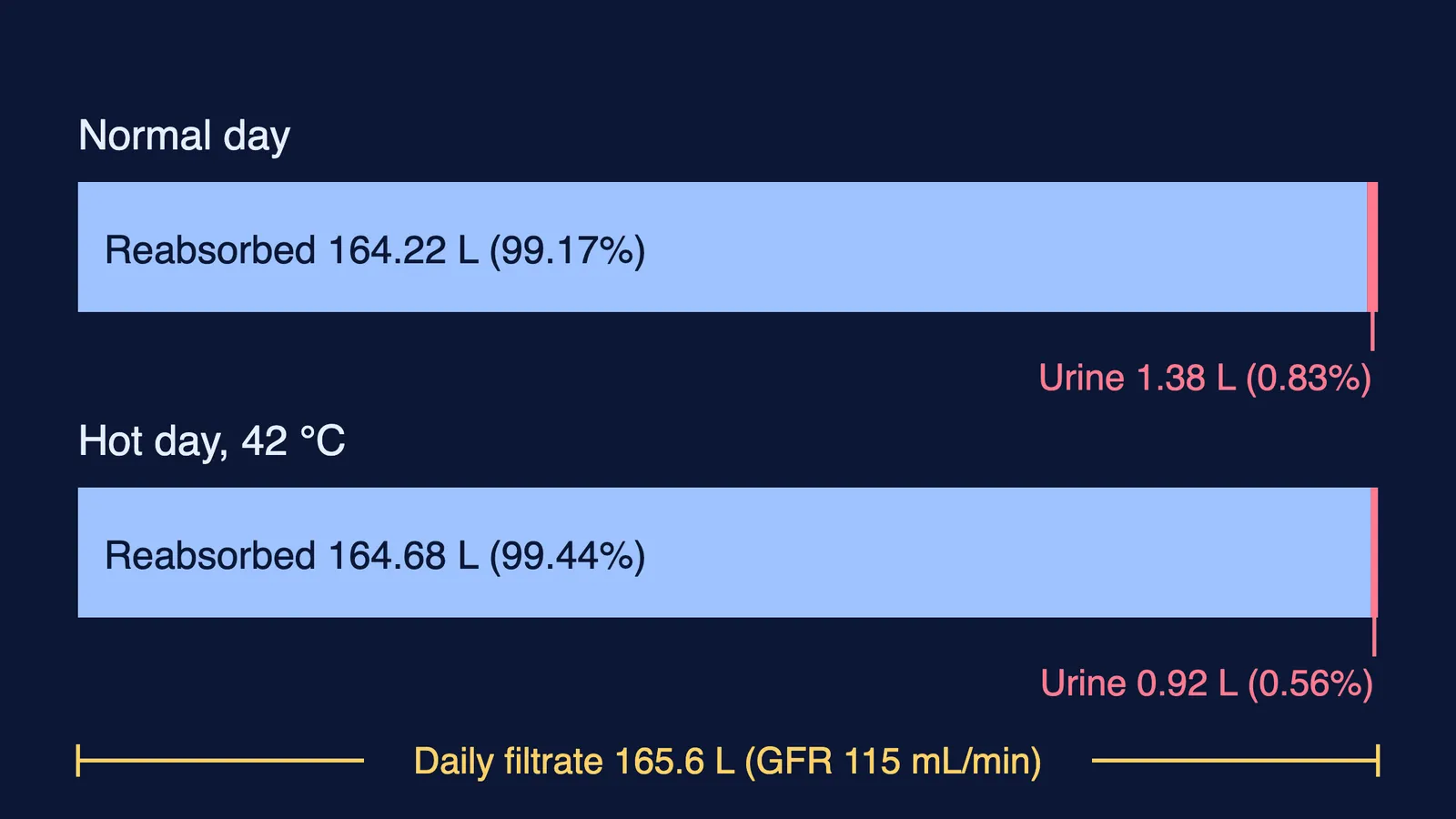
Kabir, 16, plays cricket in Jaipur. On a normal school day he passes about 1.38 litres of urine. One May afternoon he bats for three hours at 42 °C, sweats heavily and drinks little. That day he passes only 0.92 litres, and it is dark yellow. A lab test puts his urine at 1,050 mOsmol/L, against 300 mOsmol/L for the initial filtrate. Take his glomerular filtration rate (GFR) as 115 mL per minute on both days. His coach says the kidneys "just stopped working in the heat".
(i) The hormone released when osmoreceptors sense fluid loss is: (a) aldosterone (b) ANF (c) ADH (d) renin.
(ii) Which gland releases this hormone, and on which parts of the tubule does it act?
(iii) Calculate Kabir's daily filtrate and the percentage of it reabsorbed on each day.
(iv) How many times more concentrated than the filtrate is his urine, and what in the kidney makes this possible? Is the coach right?
Answers.
(i) (c) ADH, also called vasopressin.
(ii) Fluid loss activates osmoreceptors, which stimulate the hypothalamus; ADH is released from the neurohypophysis. It increases water reabsorption from the latter parts of the tubule, the DCT and collecting duct.
(iii) Filtrate: 115 mL × 1,440 min = 165,600 mL, or 165.6 L a day. Normal day: (165.6 − 1.38) ÷ 165.6 × 100 = 99.17%. Hot day: (165.6 − 0.92) ÷ 165.6 × 100 = 99.44%.
(iv) 1,050 ÷ 300 = 3.5 times. The counter-current flow in Henle's loop and the vasa recta keeps the interstitial osmolarity rising from 300 mOsmol/L in the cortex to about 1,200 in the inner medulla, mainly through NaCl and urea, so water leaves the collecting duct easily. The ceiling is about four times (1,200 ÷ 300). The coach is wrong: his kidneys worked harder to save water.
Case 3: A morning in the dialysis unit
Mr Rao, 58, a retired bus driver from Hyderabad, has kidney failure and is treated in a dialysis unit. Before today's four-hour session his blood urea is 180 mg/dL; after it, 72 mg/dL. Blood is drawn from an artery and passed through a coiled cellophane tube bathed in dialysing fluid, then returned through a vein. A trainee technician asks: "Wouldn't pure water pull the urea out faster?" Mr Rao's daughter has offered one of her kidneys for a transplant.
(i) The substance added to blood before it enters the dialysing unit is: (a) anti-heparin (b) heparin (c) renin (d) urea.
(ii) Name the condition in which urea builds up in the blood.
(iii) Find the percentage fall in blood urea and the average fall per hour.
(iv) Answer the trainee, and say why a close relative is preferred as a donor.
Answers.
(i) (b) heparin, an anticoagulant. Anti-heparin is added before the cleared blood returns to the body.
(ii) Uremia, which is highly harmful.
(iii) Fall: 180 − 72 = 108 mg/dL, so 108 ÷ 180 × 100 = 60%. Average: 108 ÷ 4 = 27 mg/dL per hour.
(iv) The cellophane passes molecules down their concentration gradient. Dialysing fluid matches plasma except for nitrogenous wastes, so only those move out. Pure water would draw out ions and nutrients as well. A close relative's kidney is preferred to minimise rejection by the immune system.
How to attack case-study questions on excretion?
Underline every number first and note its unit.
Convert GFR to a daily figure with 1,440 minutes, then subtract urine to get reabsorption.
Match each clue to one hormone: water loss means ADH, falling GFR means renin, angiotensin II and aldosterone, more blood flow to the atria means ANF.
For animal cases, link waste, toxicity and water: ammonia in water, uric acid on dry land.
For "explain" parts, give the NCERT reason in one line.
For quicker drills, try our assertion-reason questions on excretory products, and our guide to case-based questions covers the general method. If the counter-current mechanism is hard to picture, the Fermi Simulation Lab has interactive simulations for the ideas that are easier to see than to read.