

On this page
Evolution is Chapter 6 of the CBSE Class 12 Biology curriculum for 2026-27, in Unit VII, Genetics and Evolution. The CBSE 2026-27 sample paper has 2 case-based questions of 4 marks each in Section D, and its Section C also sets a 3-mark case on a nematode and an ant that asks how natural selection maintains the interaction. Below are three original cases, easy to hard. Every fact is checked against the NCERT Evolution chapter (Reprint 2026-27); the scenarios and data are invented for practice. For notes on the whole chapter, read our Evolution Class 12 board exam guide.
Case 1: Which skull cast is which?
A school in Bhopal sets up an evolution corner before a trip to the Bhimbetka rock shelters. Three skull casts carry only letters. A volunteer's card lists their brain sizes: P about 900 cc, Q about 1400 cc and R about 700 cc. A second card says fossils found in Java in 1891 revealed the species of P, and that Q's species used hides to protect the body and buried its dead. A third card reads: "Q lived in Africa about 1.5 million years ago." The teacher asks the class to check every card against NCERT before the exhibit opens.
(i) Which hominid does R most likely represent?
(ii) Arrange P, Q and R in the order they appeared.
(iii) Of P and R, which one probably did not eat meat?
(iv) Correct the third card, giving two reasons. (2 marks)
Answers.
(i) Homo habilis, whose brain capacity NCERT gives as 650-800 cc.
(ii) R (Homo habilis), then P (Homo erectus, about 900 cc, about 1.5 mya), then Q (Neanderthal man, 1400 cc).
(iii) R. NCERT says Homo habilis probably did not eat meat, while Homo erectus probably did.
(iv) Q is Neanderthal man, who lived in the near east and central Asia, not Africa, and between 1,00,000 and 40,000 years ago, not 1.5 million years ago. The 1.5 million-year date belongs to Homo erectus (P).
Case 2: Why did the spray stop working?
A brinjal farmer near Nagpur sprays the same insecticide at the same dose every season. An agriculture student tests 2,000 insects from the field each year at that dose. Her hypothetical results for survival: 5% in 2021, 18% in 2022, 46% in 2023 and 80% in 2024. The farmer's son says, "The spray made the insects change their bodies to resist it." Her mentor replies that the spray did not create resistance; it only changed which insects were left to breed.
(i) NCERT calls this kind of change evolution by: (a) special creation (b) anthropogenic action (c) saltation (d) use and disuse.
(ii) Which type of natural selection does the data show?
(iii) Why is the son's statement wrong?
(iv) How many insects survived in 2024, how many times the 2021 figure is that, and why did this take only a few years? (2 marks)
Answers.
(i) (b) anthropogenic action. NCERT gives excess use of herbicides and pesticides as selecting resistant varieties in a much shorter time.
(ii) Directional selection: the population shifts towards one end of the range (resistance), away from the old mean value.
(iii) Resistant variants were already present through chance mutation. The spray killed the others, so the survivors left more progeny. Evolution is a stochastic process, not a directed one.
(iv) 80% of 2,000 = 1,600 survivors; in 2021, 5% of 2,000 = 100. 1,600 ÷ 100 = 16 times. Insects have short life cycles, and NCERT links the rate at which new forms appear to life span, so change shows up in years rather than centuries.
Case 3: Is the meadow in Hardy-Weinberg equilibrium?
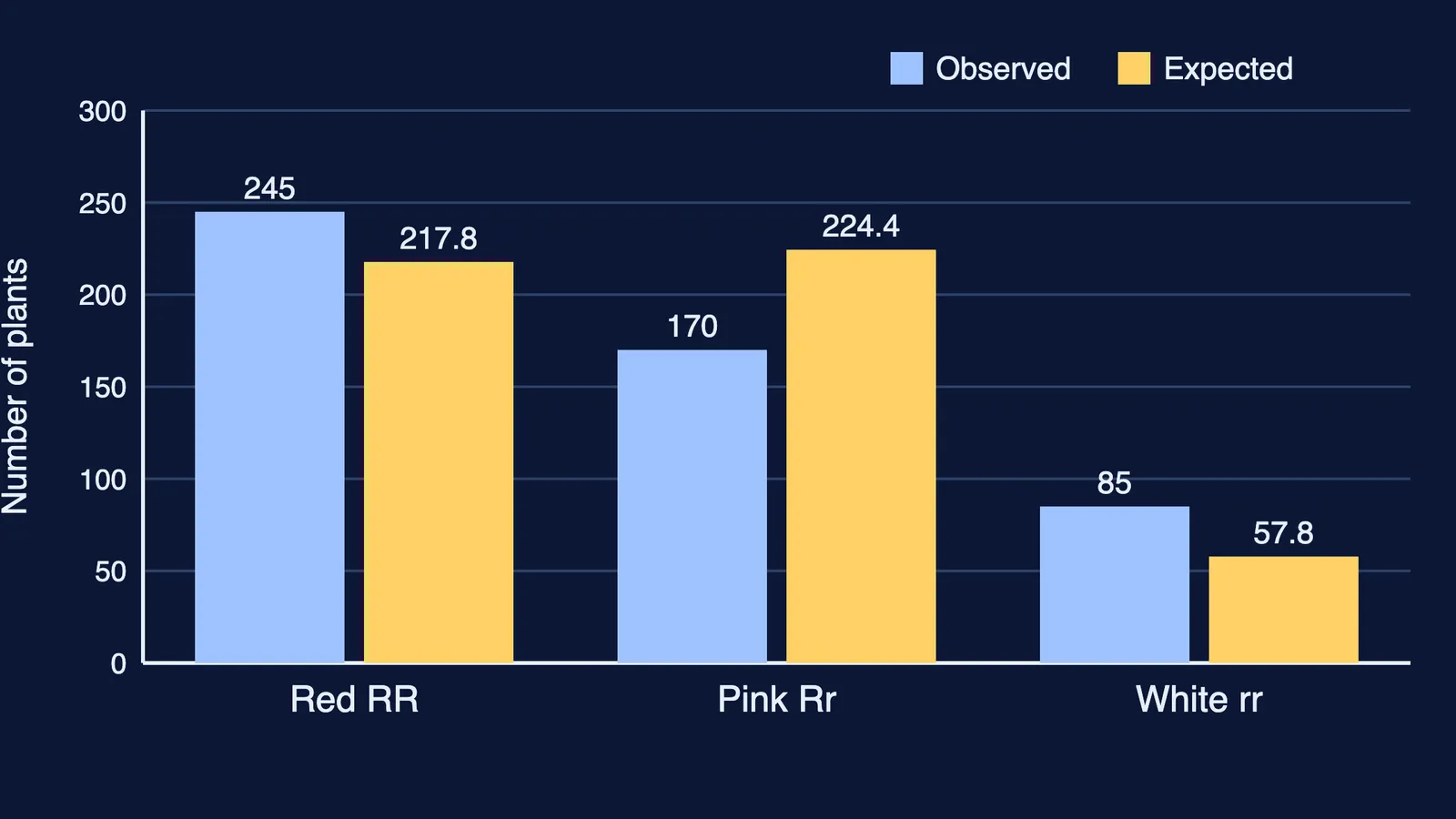
In a hill meadow near Munnar, a wildflower's colour is set by two alleles with incomplete dominance: RR plants are red, Rr pink and rr white. A botany club counts 500 plants: 245 red, 170 pink and 85 white. The club uses p for the frequency of allele R and q for allele r. One member says the meadow is "just sitting still"; another says the numbers show the population is changing.
(i) In p² + 2pq + q² = 1, what does 2pq stand for?
(ii) Find p and q.
(iii) How many pink plants would you expect if the meadow were in equilibrium?
(iv) Which member is right? Name two factors that could explain it. (2 marks)
Answers.
(i) The frequency of heterozygotes, here the pink Rr plants.
(ii) 500 plants carry 1,000 alleles. R = 2 × 245 + 170 = 660, so p = 0.66. r = 2 × 85 + 170 = 340, so q = 0.34. Check: 0.66 + 0.34 = 1.
(iii) 2pq × 500 = 2 × 0.66 × 0.34 × 500 = 224.4, so about 224 pink plants (expected red 217.8, white 57.8).
(iv) The second member. Only 170 pink plants were seen against about 224 expected, so genotype frequencies differ from Hardy-Weinberg values, which NCERT reads as evolutionary change. Any two of the five factors NCERT lists: gene flow, genetic drift, mutation, genetic recombination, natural selection.
How to attack case-study questions
Underline every number first. In Evolution these are brain sizes, dates or counts; most sub-questions hang on one of them.
Match each example to its NCERT idea: pesticides and antibiotics to evolution by anthropogenic action, peppered moths to natural selection, finches and marsupials to adaptive radiation, forelimbs to homology, sweet potato and potato to analogy.
Show the allele count in Hardy-Weinberg sums, then check that p + q = 1. The working earns marks even if the arithmetic slips.
Use NCERT's words for corrections: "reproductive fitness", "chance mutation", "stochastic process".
Keep Darwin and Lamarck apart: any card or claim that a trait was gained by use or by "trying" and then inherited is Lamarck's idea, which NCERT says nobody believes any more.
For a wider method across chapters, see how to answer case-based questions in board exams, then test the chapter's tricky pairs with our Evolution assertion-reason questions. If an idea such as incomplete dominance or genetic drift is shaky, the Fermi Concept Library gives every concept in biology its own lesson and its place in the map.


