On this page
What do these case-study questions on Earth as a system cover?
Every fact below comes from Chapter 13 of the new NCERT Class 9 Science book, Exploration, Earth as a System: Energy, Matter, and Life. The CBSE Class IX Science curriculum for 2026-27 lists the chapter's key concepts: Earth as an interconnected system, solar radiation, differential heating, winds, biogeochemical cycles and human impact. The three scenarios and all their numbers are our own, set as practice and ordered from easy to hard. For the theory first, read our Earth as a System Class 9 chapter guide.
Case 1: Two roofs on a Jaipur street
Two neighbours in Jaipur have identical flat roofs of 50 m². Arjun's is coated with black tar; Farah's is painted with white reflective paint. On a clear May afternoon, a school science club measures the sunlight reaching both roofs at 900 W per m². Their light meter shows that the white paint reflects 0.70 of that sunlight and the tar reflects 0.08. Farah's top-floor room stays noticeably cooler by day. At night, Arjun says heat seems to "pour down" from his ceiling long after sunset.
(i) The fraction of solar radiation reflected by a surface is called its: (a) insolation (b) albedo (c) solar constant (d) lapse rate
(ii) Which roof has the higher albedo?
(iii) How much solar power does each square metre of each roof absorb?
(iv) Why does Arjun's room stay hot after sunset, and what is the city-wide version of this effect called?
Answers.
(i) (b) Albedo.
(ii) Farah's white roof, with albedo 0.70 against 0.08 for tar.
(iii) Absorbed = (1 − albedo) × 900 W per m². White: 0.30 × 900 = 270 W per m². Tar: 0.92 × 900 = 828 W per m², about three times as much.
(iv) The tar and the concrete under it absorb more sunlight by day and re-radiate that heat at night. When many dark, built-up surfaces do this across a city, it is called the urban heat island effect.
Case 2: Breezes on a Himachal trek
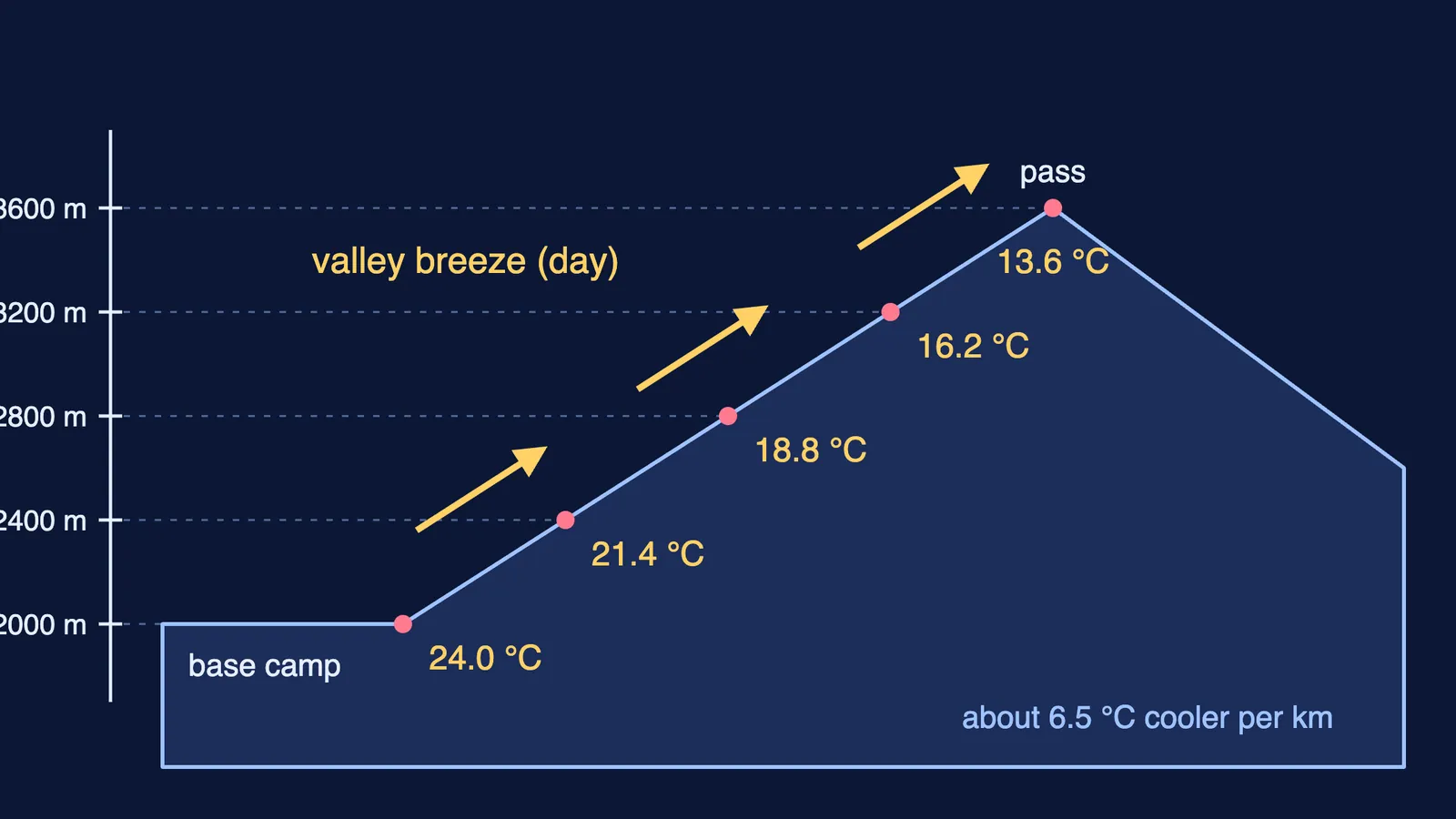
A trekking group camps in a valley in Himachal Pradesh at 2,000 m. At 2 pm the base-camp thermometer reads 24 °C, and the guide notes a steady wind blowing up the sunlit slope towards a pass at 3,600 m. The group plans to cross the pass next afternoon. That evening, after sunset, the wind at camp changes direction. A student, Kavya, wants to estimate how warm the pass will be.
(i) In which layer of the atmosphere do the trek, the clouds and these winds occur? (a) stratosphere (b) mesosphere (c) troposphere (d) thermosphere
(ii) Name the afternoon wind blowing up the slope.
(iii) Using the troposphere's average fall in temperature with height, estimate the temperature at the pass at 2 pm.
(iv) Which way does the wind blow after sunset, and why?
Answers.
(i) (c) Troposphere, where nearly all weather happens.
(ii) A valley breeze. The sunlit slopes heat faster than the valley floor, the air over them warms and rises, and cooler valley air moves up the slope to replace it.
(iii) Height gained = 3,600 − 2,000 = 1,600 m = 1.6 km. Fall ≈ 6.5 °C per km × 1.6 km = 10.4 °C. Estimate: 24 − 10.4 ≈ 13.6 °C.
(iv) Down the slope into the valley, a mountain breeze. After sunset the slopes lose heat faster than the valley floor, so the air over them becomes cooler and denser and flows down.
Case 3: Why did the fish die in a Punjab village pond?
A village pond in Punjab collects runoff from surrounding wheat fields. In one season, farmers spread nitrate fertiliser well beyond what the crop needs. A few weeks after heavy rain, the pond turns bright green with algae. A water-testing team from the district finds that dissolved oxygen has fallen from 8 mg per litre, measured the previous year, to 3 mg per litre, and dead fish float at the edges. The panchayat asks the team for a plan that protects both the pond and the soil.
(i) Which bacteria convert nitrite into nitrate in the soil? (a) Rhizobium (b) Nitrobacter (c) Pseudomonas (d) Azotobacter
(ii) Name the process seen in the pond.
(iii) By what percentage has dissolved oxygen fallen?
(iv) The team suggests growing a legume such as moong between wheat seasons and using less fertiliser. Explain how this helps, and name the spheres the problem passed through.
Answers.
(i) (b) Nitrobacter. (Rhizobium and Azotobacter fix nitrogen; Pseudomonas denitrifies.)
(ii) Eutrophication: excess nitrates cause an algal bloom that depletes oxygen and kills fish.
(iii) Fall = (8 − 3) ÷ 8 × 100 = 62.5 per cent.
(iv) Rhizobium in legume root nodules fixes atmospheric nitrogen into ammonia, which nitrifying bacteria turn into nitrate the next crop can use, so less fertiliser is needed and less washes into the pond. The nitrogen moved from fertiliser into the soil (geosphere), was carried by rainwater (hydrosphere), then fed an algal bloom and killed fish (biosphere); the legume draws it back from the atmosphere.
How to attack case-study questions
Underline every number and its unit; in these cases they are W per m², metres, °C and mg per litre.
For heating questions, decide first whether the surface reflects or absorbs: high albedo means cooler.
For breezes, ask which surface heats or cools faster; warm air rises and cooler air moves in to replace it.
In the nitrogen cycle, match each bacterium to one step: fixation, nitrification or denitrification.
In the last part, trace the change through at least two spheres in one or two sentences.
To revise the vocabulary these cases use, see our Earth as a System Class 9 key terms. If valley and mountain breezes are hard to picture, the Fermi Simulation Lab has interactive simulations for the ideas that are easier to see than to read.