On this page
These three cases on Chapter 6 of NCERT Class 10 Science run from easy to hard. The answers match the NCERT chapter text (reprint 2026-27); the people and numbers in the passages are invented for practice. For the full chapter, see our Control and coordination Class 10 guide.
What do control and coordination case-study questions test?
The CBSE Class 10 Science sample paper for 2026-27 has 39 questions in three sections, with Section A for Biology. Its 4-mark Biology question (Q15) is a short experiment story with sub-parts: you find the textbook idea inside a new situation. Our guide to case-based questions in board exams covers the general method.
Case 1: A thorn in the garden
Meera, 15, is watering plants barefoot in her grandmother's garden in Mysuru. She steps on a babool thorn and her leg jerks up before she has even looked down. She feels the pain a moment later. Her cousin explains that the thinking part of the brain decided nothing: the message went from her sole into the spinal cord and straight back to her leg. Meera asks how a message can jump from one nerve cell to the next if the cells do not touch.
(i) The connections of a reflex arc are formed in the: (a) fore-brain (b) cerebellum (c) spinal cord (d) medulla.
(ii) Which part of a neuron first acquires the information that the thorn has pierced the skin?
(iii) Write the path of the reflex arc in Meera's leg, from receptor to effector.
(iv) Answer Meera's question, and explain why she feels the pain a moment later.
Answers.
(i) (c) spinal cord, where nerves from all over the body meet on their way to the brain.
(ii) The dendritic tip, where the information sets off a chemical reaction that creates an electrical impulse.
(iii) Pain receptors in the skin of the sole → sensory neuron → relay neuron in the spinal cord → motor neuron → effector, the muscles of the leg.
(iv) At the axon's end, the impulse releases chemicals that cross the gap (the synapse) and start a similar impulse in the next neuron's dendrite. The arc is completed in the spinal cord; the input also goes on to the brain, where she becomes aware of the pain just after her leg has moved.
Case 2: Bean seedlings on a windowsill
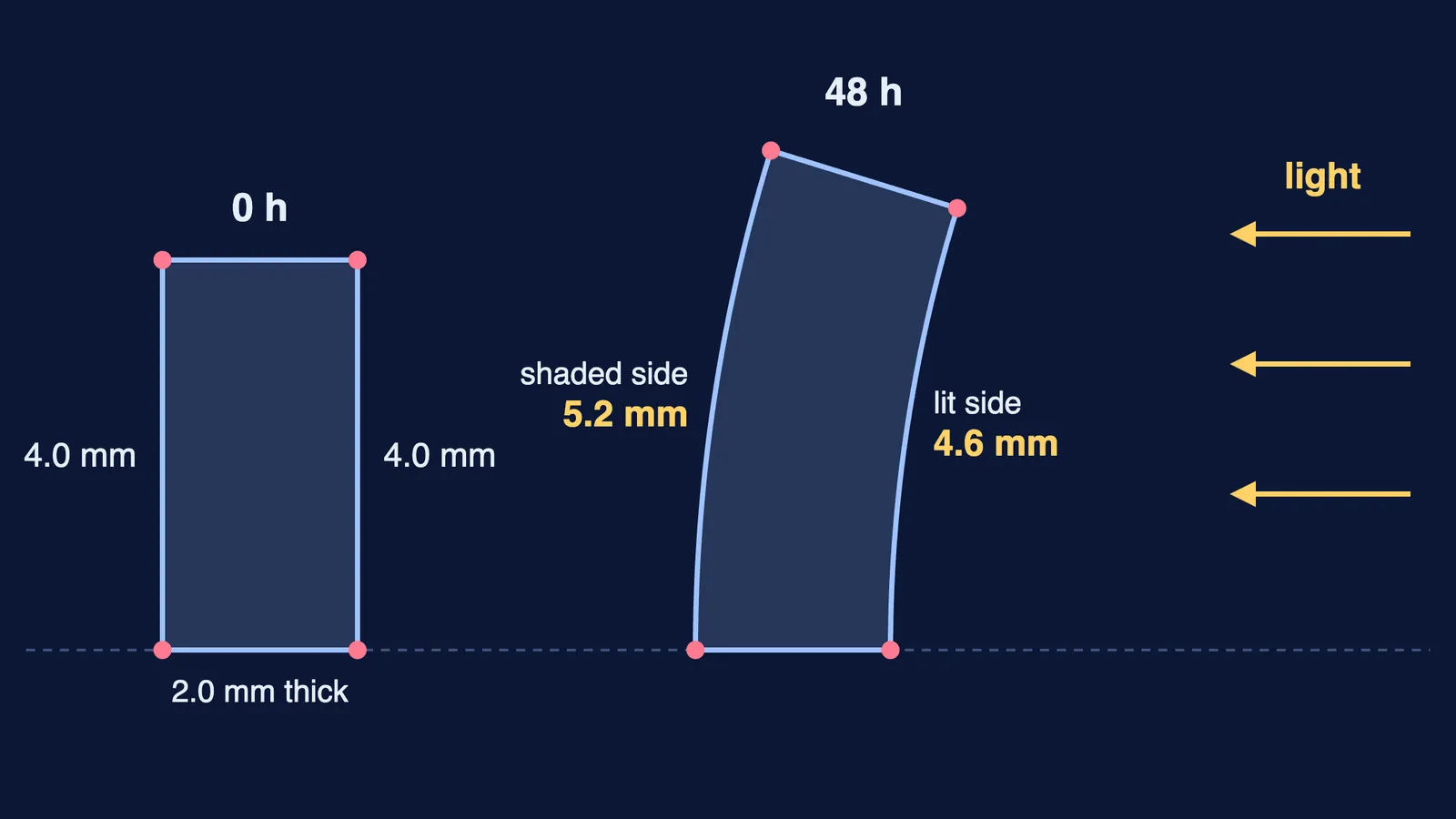
For a project in Jaipur, Kabir keeps a pot of bean seedlings on a shelf in a dark storeroom, lit only by a desk lamp on its right. He marks two ink dots 4.0 mm apart on the lit side of one shoot, which is 2.0 mm thick, and two more 4.0 mm apart on its shaded side. After 48 hours the lit-side dots are 4.6 mm apart, the shaded-side dots 5.2 mm apart, and the shoot leans towards the lamp. Kabir then rotates the pot half a turn, so the shoots now lean away from the lamp.
(i) The hormone made at the shoot tip that helps cells grow longer is: (a) abscisic acid (b) cytokinin (c) auxin (d) thyroxin.
(ii) Name the movement shown by the shoot, and say how roots respond to light from one side.
(iii) Find the percentage increase in length on each side. Which side grew more, and how many times as much?
(iv) Explain the bending using the hormone, and predict what happens to old parts and new growth after the turn.
Answers.
(i) (c) auxin.
(ii) Phototropism. Roots show it too, but they bend away from light while shoots bend towards it.
(iii) Lit side: (4.6 − 4.0) ÷ 4.0 × 100 = 15%. Shaded side: (5.2 − 4.0) ÷ 4.0 × 100 = 30%. The shaded side grew 1.2 mm against 0.6 mm, twice as much.
(iv) With light from one side, auxin diffuses to the shaded side, where its higher concentration makes cells grow longer, so the shoot bends towards light. After the turn, the old parts keep their bend, since it was made by growth already done; new growth of the shoot bends towards the lamp again.
Case 3: Chased on a cycle
Rohan cycles home from tuition in Bhopal at dusk when a barking dog runs after him. He pedals hard and keeps a straight line along the narrow lane without wobbling. His smartwatch logged 72 beats per minute a few minutes earlier and shows 126 when he reaches his gate; his breathing has gone from 15 to 27 breaths a minute. His father says one hormone prepared his whole body to flee, and asks why the body did not just send nerve impulses to every organ.
(i) The part of the brain that keeps Rohan balanced and his steering precise is the: (a) medulla (b) cerebellum (c) fore-brain (d) mid-brain.
(ii) Name the hormone, the gland that secretes it, and how it reaches the heart.
(iii) Calculate the percentage rise in heart rate and say why the heart beats faster.
(iv) Explain the faster breathing and the change in blood flow to his gut and skin, then answer his father.
Answers.
(i) (b) cerebellum, responsible for precision of voluntary actions, posture and balance.
(ii) Adrenaline, from the adrenal glands, secreted directly into the blood, which carries it to the heart.
(iii) (126 − 72) ÷ 72 × 100 = 54 ÷ 72 × 100 = 75%. A faster heartbeat supplies more oxygen to the muscles.
(iv) Breathing speeds up through contractions of the diaphragm and rib muscles. Muscles around small arteries in the digestive system and skin contract, diverting blood to skeletal muscles. Nerve impulses reach only cells connected by nervous tissue, and a cell needs time to reset between impulses; a hormone in the blood reaches all cells, more slowly but steadily.
How do you attack control and coordination case-study questions?
Decide which system the story is about: nerves, plant hormones or animal hormones.
For a reflex, write the five-step arc in order.
For plant data, compare the two sides as percentages, then link the faster side to auxin.
For adrenaline, list all three effects: heart, blood diversion, breathing.
Use NCERT's exact terms (synapse, dendritic tip, phototropism). If one idea keeps tripping you up, read its lesson in the Fermi Concept Library, then retry the case.
For one-mark drills, try our control and coordination assertion-reason set.