On this page
These 10 original questions cover Control and Coordination, Chapter 6 of NCERT Science for Class 10 (Reprint 2026-27). They run from easy to hard, every statement is checked against that chapter, and several hinge on a statement that is true but is not the reason.
How do you answer assertion-reason questions?
Judge each statement on its own first. Only when both are true, ask: does R directly cause A? Use these keys throughout.
For assertion-reason items:
(A) Both A and R are true and R is the correct explanation of A.
(B) Both A and R are true but R is NOT the correct explanation of A.
(C) A is true but R is false.
(D) A is false but R is true.
For Statement I and Statement II items:
(A) Both statements are correct.
(B) Both statements are incorrect.
(C) Statement I is correct, Statement II is incorrect.
(D) Statement I is incorrect, Statement II is correct.
Assertion-reason questions on control and coordination
All facts in this section are from NCERT Class 10 Science, Chapter 6, sections 6.1 to 6.3.
Q1 (easy). Assertion (A): Picking up a pencil depends on the cerebellum, a part of the hind-brain. Reason (R): The cerebellum is responsible for the precision of voluntary actions.
Answer: (A). Both are true. Picking up a pencil is a voluntary action needing precision, which R says the cerebellum provides.
Trap: thinking a deliberate action is run only by the fore-brain.
Q2 (easy). Assertion (A): The roots of a plant grow downwards into the soil. Reason (R): Roots respond by bending away from light.
Answer: (B). Both are true. But the downward growth of roots is a response to gravity (geotropism), not to light. R describes phototropism, a different stimulus.
Trap: choosing (A) because "away from light" sounds like "down into the dark soil".
Q3 (medium). Assertion (A): Cytokinins are present in low concentration in fruits and seeds. Reason (R): Cytokinins promote cell division.
Answer: (D). R is true. A is false: because cytokinins promote cell division, they are present in greater concentration in areas of rapid cell division, such as fruits and seeds.
Trap: knowing the function but reversing where the hormone collects.
Q4 (medium). Assertion (A): A reflex arc lets us pull our hand back from a flame before we have time to think about it. Reason (R): Reflex arcs are formed in the brain, the main coordinating centre of the body.
Answer: (C). A is true. R is false: reflex arcs are formed in the spinal cord, where nerves from the body first meet, although the information also goes on to reach the brain.
Trap: assuming every quick response must be run by the brain.
Q5 (hard). Assertion (A): The sensation of feeling full after a meal comes from a centre in the fore-brain. Reason (R): The fore-brain has separate areas specialised for hearing, smell and sight.
Answer: (B). Both are true. Fullness comes from a centre associated with hunger, which sits in a separate part of the fore-brain. The sensory areas in R do not explain it.
Trap: picking (A) because both statements mention the fore-brain.
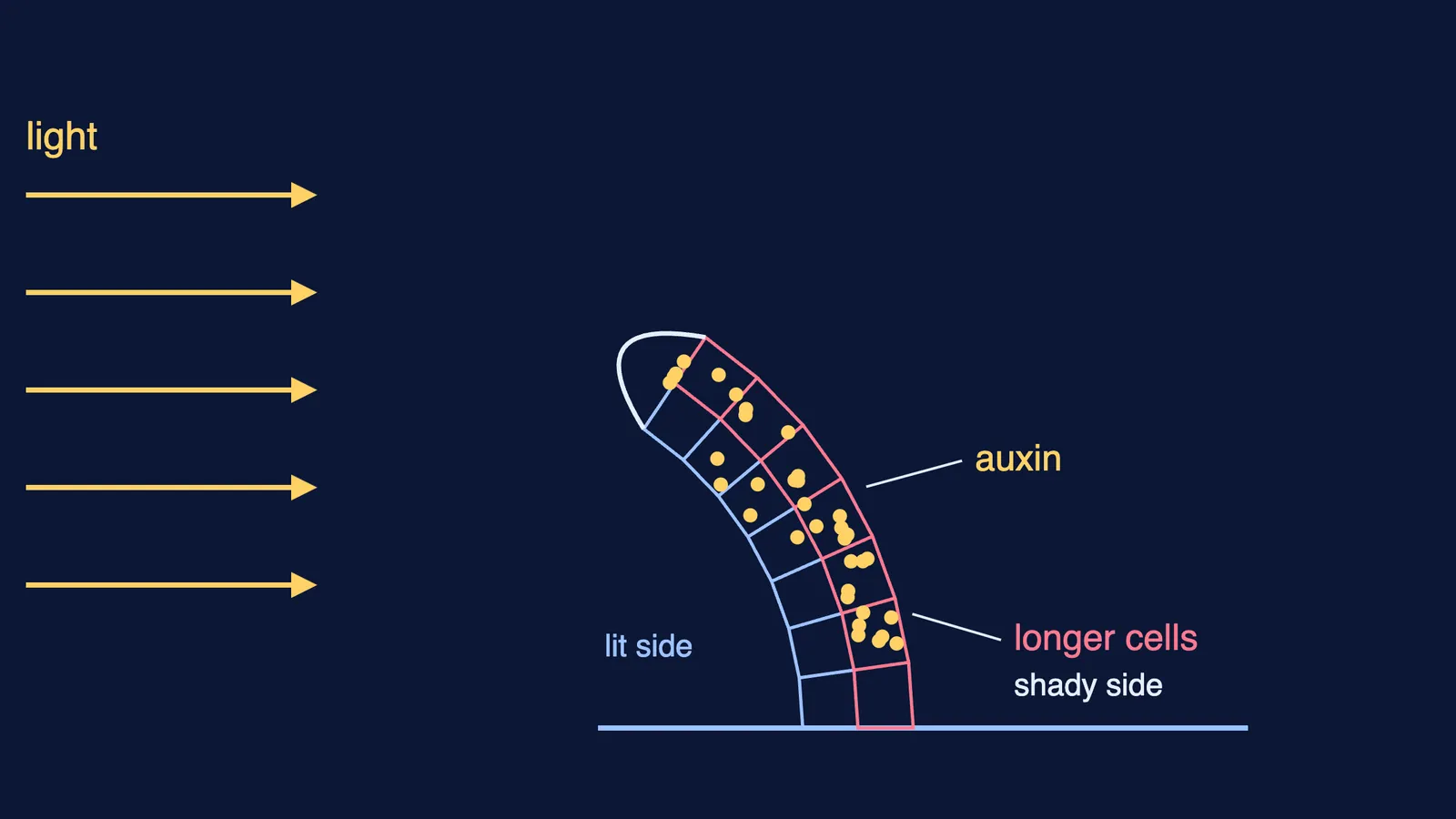
Q6 (hard). Assertion (A): In a shoot lit from one side, the cells on the side away from the light grow longer. Reason (R): Auxin, made at the shoot tip, diffuses towards the shady side of the shoot and makes the cells there grow longer.
Answer: (A). Both are true, and R is the cause. More auxin on the shady side means longer cells on that side, so the shoot bends towards the light.
Trap: thinking auxin moves towards the light, or that the lit side grows faster.
Statement I and Statement II questions on control and coordination
Q7 (easy). Statement I: Gibberellins, like auxins, help in the growth of the stem. Statement II: Abscisic acid inhibits growth, and its effects include wilting of leaves.
Answer: (A). Both match NCERT: gibberellins promote growth, while abscisic acid signals the plant to stop growing.
Trap: assuming every plant hormone promotes growth.
Q8 (medium). Statement I: The brain and spinal cord together form the peripheral nervous system. Statement II: Cranial nerves arise from the spinal cord.
Answer: (B). Both are wrong. The brain and spinal cord form the central nervous system. Cranial nerves arise from the brain; spinal nerves arise from the spinal cord.
Trap: swapping "central" and "peripheral", then the two kinds of nerves.
Q9 (medium). Statement I: Electrical impulses reach only those cells that are connected by nervous tissue. Statement II: A nerve cell can create and transmit electrical impulses continuously, without any pause.
Answer: (C). Statement I is correct. Statement II is wrong: after a cell sends an impulse, it needs time to reset before it can send a new one. These two limits are why the body also uses hormones.
Trap: thinking that "fast" means "non-stop".
Q10 (hard). Statement I: When the blood sugar level falls, the pancreas releases more insulin. Statement II: The timing and amount of hormone released are regulated by feedback mechanisms.
Answer: (D). Statement I is wrong: insulin secretion goes up when blood sugar rises and is reduced as it falls. Statement II is correct; insulin is NCERT's own example of it.
Trap: reading "insulin controls sugar" and assuming it rises whenever sugar changes.
How should you use this set?
Attempt all 10 without the answers, writing a key and one line of reasoning for each.
Sort each mistake: a false statement you believed, or two true statements you linked wrongly.
For linking mistakes, say the pair as "A, because R" and check whether NCERT gives R as the cause.
Reread sections 6.1.2 (the brain) and 6.2 (plants); they hold most of the traps here.
After two days, retry only the ones you missed.
If a trap caught you because the idea itself is shaky, the Fermi Concept Library has every concept in physics, chemistry, biology, mathematics and computing, each with its own lesson.
For a method that works across chapters, see a step-by-step strategy for assertion-reason questions. To revise first, read our Class 10 notes on reflexes, the brain and hormones, and see how the CBSE Class 10 science paper is built.