On this page
Three original cases, easy to hard, with worked answers. For the theory first, read our Class 11 guide to cell cycle and cell division.
What do cell cycle case-study questions test?
A case gives you a short scene with data, then asks you to name stages, count chromosomes and DNA, and explain the data. Class 11 papers are set by schools, so treat these as practice in the case-based style, not as any exam's pattern. Every case stays inside the CBSE 2026-27 Class XI Biology curriculum, whose topic line for Chapter 10 is "Cell cycle, mitosis, meiosis and their significance". Every fact matches NCERT Class 11 Biology Chapter 10 (Reprint 2026-27); the scenarios and numbers are ours.
Case 1: Counting cells in a root tip
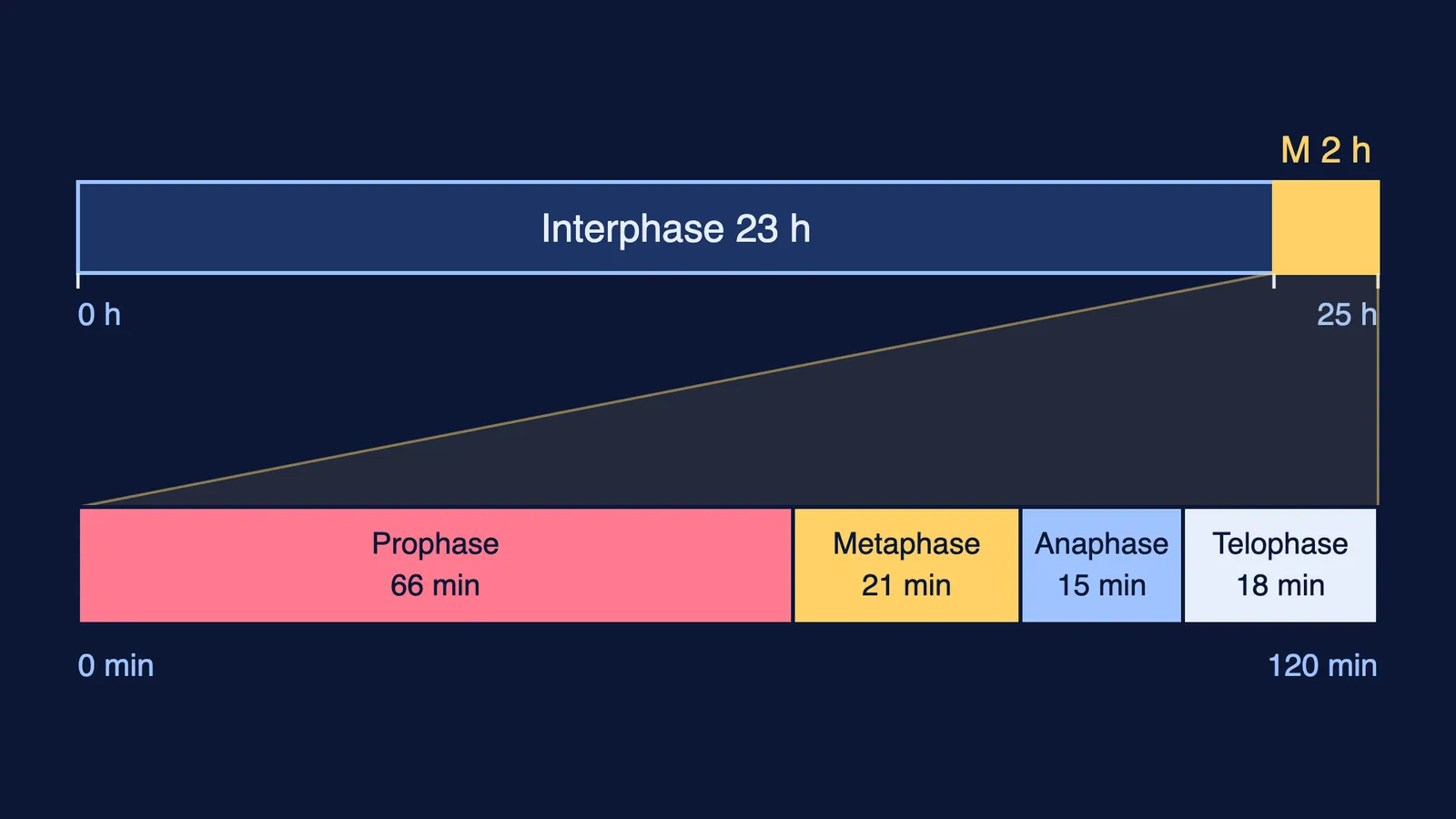
Riya, a Class 11 student in Pune, grows roots on a plant whose body cells have 2n = 12. She stains a squash of a root tip, where cells divide often, and sorts 1,000 cells under the microscope: 920 in interphase, 44 in prophase, 14 in metaphase, 10 in anaphase and 12 in telophase. Her teacher says a full cycle in this tissue takes about 25 hours, and because cells divide at random times, the share of cells in a stage roughly matches the share of the cycle spent in it.
(i) In which stage can Riya most easily study the shape of the chromosomes? (a) Prophase (b) Metaphase (c) Anaphase (d) Telophase
(ii) What percentage of the cells she counted are in M phase?
(iii) Estimate how many hours the cycle spends in M phase and in interphase.
(iv) In one anaphase cell, how many chromosomes are moving to the poles in all, and what is its DNA content if a G1 cell has 2C?
Answers.
(i) (b). Condensation is complete at metaphase, so NCERT calls it the stage at which chromosome morphology is most easily studied.
(ii) 44 + 14 + 10 + 12 = 80 cells. 80 ÷ 1,000 × 100 = 8%.
(iii) M phase: 8% of 25 h = 2 h. Interphase: 92% of 25 h = 23 h.
(iv) Centromeres have split, so 12 chromosomes have become 24 daughter chromosomes, 12 to each pole. The cell has not divided, so it still holds 4C.
Case 2: Sorting cells by DNA content
A cell-biology lab in Hyderabad grows animal cells in culture. The cells divide at random times, so every stage is present at once. A researcher stains 20,000 of them with a dye that glows in proportion to the DNA in each cell, so a cell with twice the DNA glows twice as brightly, then sorts them: 11,000 cells have 2C, 3,000 have between 2C and 4C, and 6,000 have 4C. She then tests cells from adult heart muscle: practically none fall between 2C and 4C.
(i) The 3,000 cells with DNA between 2C and 4C are in: (a) G1 (b) S phase (c) G2 (d) G0
(ii) What percentage of the culture is in S phase, and what is their chromosome number if G1 cells are 2n?
(iii) Which phases do the 6,000 cells with 4C belong to, and why can this dye test not separate them?
(iv) Explain the heart-muscle result using the cell cycle.
Answers.
(i) (b). DNA is copied only in S phase, so a cell partway through replication has between 2C and 4C.
(ii) 3,000 ÷ 20,000 × 100 = 15%. Still 2n: replication adds DNA but no new centromeres.
(iii) G2 and M phase (until the cell divides). Both have 4C, so the dye sees one group of 30%; only a microscope shows which cells have condensed chromosomes.
(iv) Heart cells do not appear to divide. They leave G1 for the quiescent stage, G0, staying metabolically active but not replicating DNA, so practically none are in S phase.
Case 3: Meiosis in a crop research station
During a summer visit to a crop research station in Ludhiana, Kabir watches a scientist stain young anthers of a plant whose body cells have 2n = 20. Inside, diploid pollen mother cells divide by meiosis, and each forms four haploid cells that go on to become pollen. In G1, one pollen mother cell has 5 pg of DNA. One slide shows homologous chromosomes held together only at X-shaped points; another shows 10 paired structures lined up at the equator. In one anther slice, 240 pollen mother cells complete meiosis.
(i) The slide with X-shaped points, just after the synaptonemal complex dissolves, is in: (a) Zygotene (b) Pachytene (c) Diplotene (d) Diakinesis
(ii) Name the 10 paired structures and the stage of the second slide.
(iii) How many haploid cells form from the 240 pollen mother cells, and how many chromosomes does each have?
(iv) Kabir says each haploid cell has 5 pg of DNA, because meiosis halves DNA once. Find his error and give the correct value.
Answers.
(i) (c). The X-shaped points are chiasmata, seen at diplotene; crossing over itself happened in pachytene.
(ii) Bivalents (also called tetrads), lined up on the equatorial plate in metaphase I.
(iii) 240 × 4 = 960 haploid cells, each with n = 10 chromosomes.
(iv) He forgot S phase. DNA doubles from 5 to 10 pg before meiosis I, then halves twice, with no replication in interkinesis: 10 to 5 pg, then 5 to 2.5 pg. Each cell has 2.5 pg.
How to attack case-study questions on the cell cycle?
Underline every number in the passage first: cell counts, hours, 2n and pg.
Fill a two-column table, chromosome number and DNA content, stage by stage.
Count chromosomes by centromeres, never by chromatids; the count rises only when centromeres split, in mitotic anaphase or anaphase II.
For prophase I, match each clue to one word: pairing is zygotene, recombination nodules are pachytene, chiasmata are diplotene, terminalisation is diakinesis.
For "explain" parts, give the NCERT reason in one line, such as G0 for cells that have stopped dividing.
For a different drill, try our assertion-reason questions on cell division; our guide to case-based questions in board exams covers the general method. If spindles and chromosome movement are hard to picture, the Fermi Simulation Lab has interactive simulations for the ideas that are easier to see than to read.