

On this page
What do these case-study questions on breathing cover?
Class 11 exams are set by your school, so treat these as practice. They stay inside Chapter 14 of the CBSE Biology curriculum for 2026-27: breathing, gas exchange and transport, regulation, lung volumes and disorders.
Every fact below matches the NCERT chapter Breathing and Exchange of Gases (Reprint 2026-27); the scenarios are our own. For the theory, read our Class 11 guide to breathing and exchange of gases.
Case 1: What did the spirometer show?
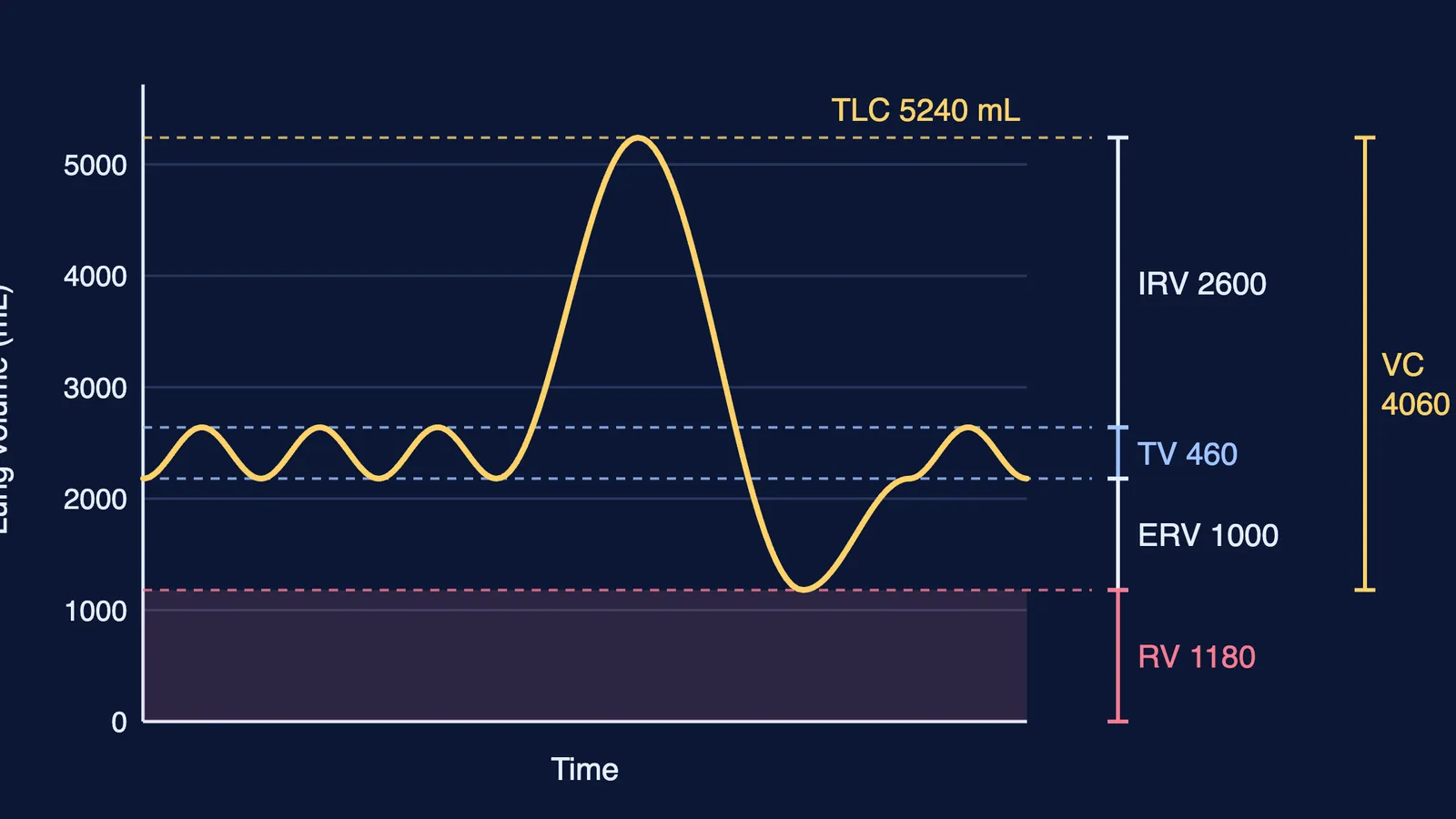
At a school health camp in Kochi, a pulmonologist tests Class 11 students on a spirometer. Meera breathes quietly, then in as deeply and out as hard as she can. Her printout reads: tidal volume 460 mL, inspiratory reserve volume 2600 mL, expiratory reserve volume 1000 mL, breathing rate 15 per minute. The doctor adds that about 1180 mL of air stays in her lungs even after the hardest breath out.
(i) Which muscles contract during a quiet breath in? (a) Diaphragm and external intercostals (b) Diaphragm and internal intercostals (c) Abdominal muscles only (d) External intercostals only
(ii) How much air does Meera breathe in per minute at rest?
(iii) Find her inspiratory capacity, functional residual capacity and vital capacity.
(iv) Meera writes "total lung capacity = vital capacity = 4060 mL". Correct her and give the right value.
Answers.
(i) (a). The diaphragm contracts and the external intercostals lift the ribs and sternum.
(ii) 460 × 15 = 6900 mL per minute, inside the 6000 to 8000 mL NCERT gives for a healthy man.
(iii) IC = TV + IRV = 460 + 2600 = 3060 mL. FRC = ERV + RV = 1000 + 1180 = 2180 mL. VC = ERV + TV + IRV = 1000 + 460 + 2600 = 4060 mL.
(iv) The 1180 mL left after a forced breath out is the residual volume, and it never leaves the lungs. TLC = VC + RV = 4060 + 1180 = 5240 mL.
Case 2: Dust, smoke and the diffusion membrane
A district hospital team runs a check-up camp at a sandstone quarry near Jodhpur. Workers grind stone for 8 hours a day in fine dust. The doctor finds that Ramesh, who has worked there for 20 years without a mask, has fibrosis in his lungs. Another worker, Suresh, has smoked for 30 years and now has emphysema. A chart shows a healthy alveolus: air at a pO2 of 104 mm Hg, deoxygenated blood at 40 mm Hg, and a membrane much thinner than a millimetre between them.
(i) Emphysema is a disorder in which (a) bronchi are inflamed and breathing wheezes (b) alveolar walls are damaged and the respiratory surface decreases (c) dust causes fibrous tissue to grow (d) the pleural fluid dries up
(ii) Which part of the respiratory system is meant to clear dust from inhaled air before it reaches the alveoli?
(iii) Why does years of quarry work damage the lungs, and what protection does NCERT say such workers need?
(iv) In Suresh, the pO2 gradient from alveolar air to blood can still be 64 mm Hg, yet less oxygen enters his blood. Explain.
Answers.
(i) (b). Option (a) is asthma; (c) is occupational dust disease.
(ii) The conducting part, from the nostrils to the terminal bronchioles, which also humidifies and warms the air.
(iii) Grinding and stone-breaking make so much dust that the body's defences cannot cope. Long exposure causes inflammation that leads to fibrosis, a proliferation of fibrous tissue, and serious lung damage. Workers should wear protective masks.
(iv) The gradient is 104 − 40 = 64 mm Hg, so the driving force is unchanged. But damaged alveolar walls leave a smaller respiratory surface, so less oxygen can diffuse across in total each minute.
Case 3: How much oxygen does blood deliver each minute?
A sports-science lab in Chandigarh studies a 17-year-old cyclist at rest before a training test. Its instruments estimate that 5200 mL of blood flows through his tissues, then his lungs, each minute. An intern uses two NCERT figures: every 100 mL of oxygenated blood delivers about 5 mL of O2 to the tissues, and every 100 mL of deoxygenated blood delivers about 4 mL of CO2 to the alveoli. She notes that his red blood cells are packed with an enzyme that speeds up the reaction of CO2 with water.
(i) At most, how many O2 molecules can one haemoglobin molecule carry? (a) 1 (b) 2 (c) 4 (d) 8
(ii) Name the enzyme the intern means.
(iii) How much O2 reaches his tissues each minute? Taking NCERT's figure that about 3 per cent of O2 is carried dissolved in plasma, how much of this O2 travelled that way?
(iv) How much CO2 reaches his alveoli each minute? Taking NCERT's figure that about 70 per cent of CO2 is carried as bicarbonate, about how much of it travelled that way, and why does the bicarbonate turn back into CO2 in the lungs?
Answers.
(i) (c) 4.
(ii) Carbonic anhydrase, found at very high concentration in RBCs.
(iii) 5200 ÷ 100 × 5 = 260 mL of O2 per minute. About 3 per cent travels dissolved in plasma: 0.03 × 260 = 7.8 mL.
(iv) 5200 ÷ 100 × 4 = 208 mL of CO2 per minute. About 70 per cent goes as bicarbonate: 0.70 × 208 ≈ 146 mL. At the alveoli pCO2 is low, so carbonic anhydrase drives the reaction the other way, HCO₃⁻ + H⁺ → H₂CO₃ → CO₂ + H₂O, and the CO2 is breathed out.
How to attack case-study questions on breathing
Write TLC = RV + ERV + TV + IRV first, then cross out what each capacity leaves out.
Keep Table 14.1 in your head: O2 104, 40, 95, 40 and CO2 40, 45, 40, 45 mm Hg.
For transport sums, scale per 100 mL first (5 mL O2, 4 mL CO2), then apply the percentages.
In regulation answers, say CO2 and H⁺ drive breathing; NCERT calls the role of oxygen quite insignificant.
Our guide to case-based questions covers pacing; the assertion-reason set on breathing and exchange of gases tests the same ideas another way. If a step feels shaky, the Fermi Concept Library has every concept in biology, each with its own lesson and its place in the map.


