On this page
These three case studies cover Biotechnology: Principles and Processes and Biotechnology and its Applications, and run from easy to hard. Every fact in the answers matches the NCERT Class 12 Biology chapters on principles and processes and applications (reprint 2026-27); the people, places and numbers in the passages are invented for practice. For model answers across the chapter, use our Biotechnology principles and processes Class 12 board answer guide.
What do biotechnology case-study questions test?
The CBSE Biology sample paper for 2026-27 has 2 case-based questions of 4 marks each, in Section D. They check whether you can find the tool or step hidden inside a lab or farm story. Our guide to case-based questions in board exams covers the general method.
Case 1: Two bands on the gel
At a college open day in Pune, Aditi watches a demonstration. A circular plasmid of 6,000 base pairs (bp) has two EcoRI sites, at positions 1,200 and 3,700. Lane 1 of an agarose gel is loaded with uncut plasmid and lane 2 with the plasmid fully digested by EcoRI. After the run, the gel looks blank under room light. The demonstrator stains it, places it on a UV box, and orange bands appear. He then cuts one band out of lane 2 because the lab wants that fragment for cloning.
(i) EcoRI recognises the sequence: (a) 5'-GGATCC-3' (b) 5'-GAATTC-3' (c) 5'-AAGCTT-3' (d) 5'-GTTAAC-3'.
(ii) Towards which electrode do the DNA fragments move, and why?
(iii) How many bands appear in lane 2, what are their sizes, and which travels farther from the well?
(iv) Why was the gel blank under room light, and what is the step of recovering DNA from the cut band called?
Answers.
(i) (b) 5'-GAATTC-3', a palindrome that reads the same on both strands in the 5' to 3' direction.
(ii) Towards the anode, because DNA fragments are negatively charged.
(iii) A circle cut at two sites gives two pieces: 3,700 − 1,200 = 2,500 bp and 6,000 − 2,500 = 3,500 bp. The 2,500 bp band travels farther, since the agarose gel's sieving effect lets smaller fragments move faster.
(iv) Pure DNA cannot be seen in visible light without staining; it shows only after ethidium bromide staining and UV exposure. Cutting out the band and extracting the DNA from the gel piece is called elution.
Case 2: Copying a gene by PCR
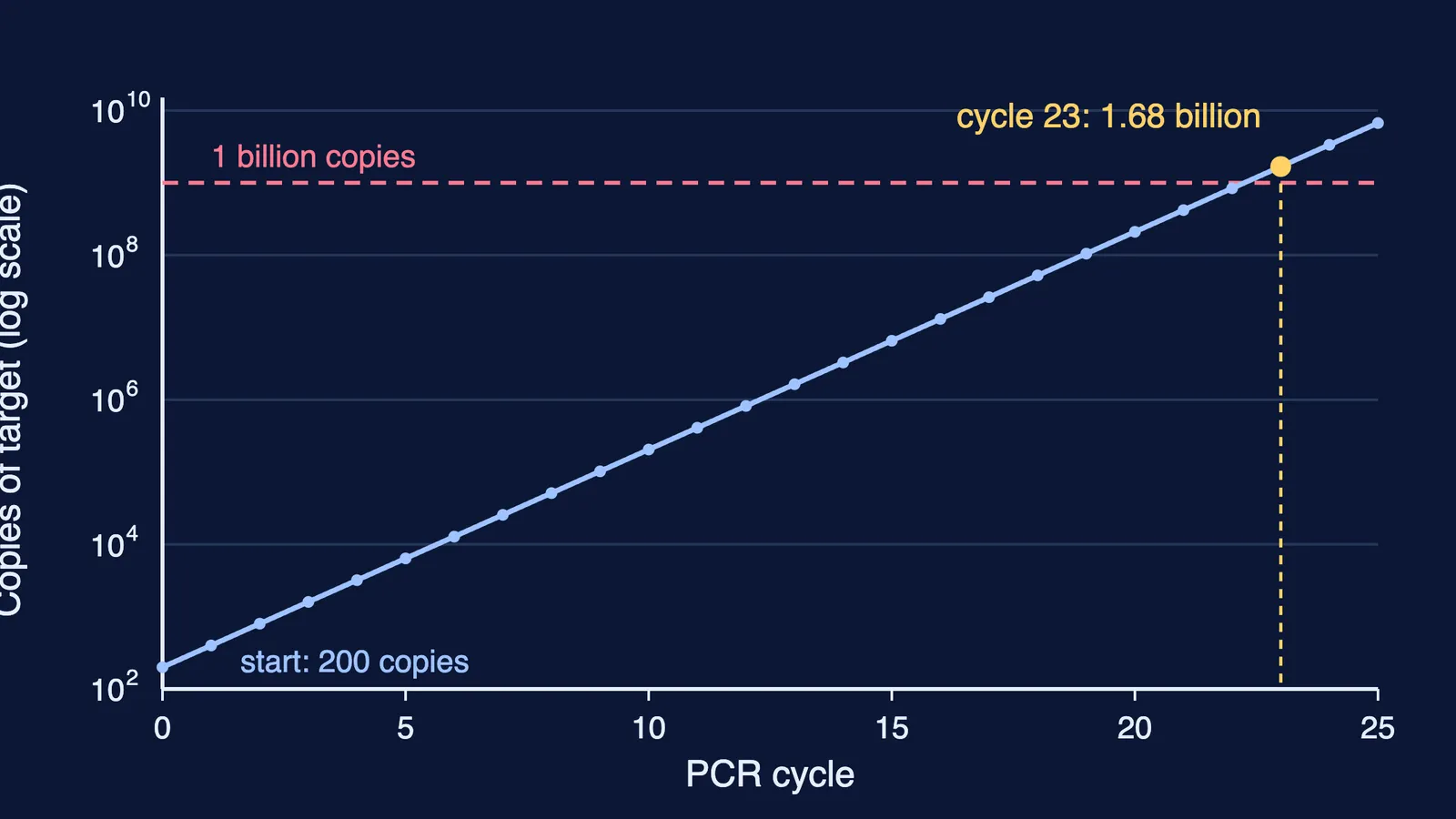
A seed-testing lab in Hyderabad wants to check whether a cotton seed batch carries a particular gene. Its sample contains 200 copies of the target DNA. The technician adds two primers, nucleotides and a DNA polymerase, and sets the machine for repeated cycles. Assume every cycle exactly doubles the target. The lab wants at least 1 billion copies before it runs the product on a gel to look for a band. A trainee suggests saving money by using an ordinary DNA polymerase from *E. coli* instead of the costly enzyme in the kit.
(i) The DNA polymerase used in PCR is isolated from: (a) *Escherichia coli* (b) *Agrobacterium tumefaciens* (c) *Thermus aquaticus* (d) *Bacillus thuringiensis*.
(ii) Name the three steps of each PCR cycle in order.
(iii) How many copies are there after 20 cycles, and how many cycles are needed to cross 1 billion copies?
(iv) Why would the trainee's idea fail, and why are two primers needed rather than one?
Answers.
(i) (c) *Thermus aquaticus*.
(ii) Denaturation, primer annealing, extension of primers.
(iii) After 20 cycles: 200 × 2^20 = 209,715,200 copies, about 210 million. After 22 cycles there are 838,860,800 copies and after 23 cycles 1,677,721,600, so 23 cycles are needed.
(iv) Each cycle begins with high-temperature denaturation; an ordinary polymerase would not stay active, so copying would stop. The thermostable enzyme remains active through this step. Two primers, complementary to the regions at either end of the target, let both strands be copied, so only that segment is amplified.
Case 3: Bollworms in two plots
A farmer in Yavatmal, Maharashtra, grows Bt cotton in one plot and a non-Bt variety in the next. In October, an agriculture student checks 1,200 bolls in each plot. She finds bollworm damage in 324 bolls of the non-Bt plot and 42 bolls of the Bt plot. The farmer's brother grows maize nearby and asks for Bt cotton seeds, hoping they will stop the corn borers in his crop. A friend wonders why the bacterium that makes the toxin is not killed by it.
(i) The genes whose proteins control cotton bollworms are: (a) *cryIAb* and *cryIIAb* (b) *cryIAc* and *cryIIAb* (c) *cryIAb* only (d) *nif* genes.
(ii) Why does the Bt toxin not kill *Bacillus thuringiensis* itself?
(iii) Find the percentage of damaged bolls in each plot and the percentage reduction in damage.
(iv) Explain how the toxin kills a bollworm larva, and why Bt cotton seeds will not solve the brother's problem.
Answers.
(i) (b) *cryIAc* and *cryIIAb*.
(ii) Inside the bacterium the toxin exists as an inactive protoxin, held in protein crystals; it becomes active only in the alkaline gut of an insect.
(iii) Non-Bt: 324 ÷ 1,200 × 100 = 27%. Bt: 42 ÷ 1,200 × 100 = 3.5%. Reduction: (324 − 42) ÷ 324 × 100 = 87.0%.
(iv) In the larva's alkaline gut the crystals dissolve and the toxin becomes active; it binds to midgut epithelial cells and creates pores, causing swelling, lysis and death. Most Bt toxins are insect-group specific: NCERT links *cryIAc* and *cryIIAb* to cotton bollworms but *cryIAb* to corn borer. Cotton seed would grow cotton, not protect maize, so the brother needs a maize variety carrying the corn-borer gene.
How do you attack biotechnology case-study questions?
Name the tool in your first line: restriction enzyme, ligase, gel, PCR or *cry* gene.
Draw a small plasmid circle and mark cut sites before counting fragments.
For PCR, write the doubling formula and show every step.
Learn the exact NCERT terms (palindrome, elution, protoxin); examiners look for them.
If one idea keeps tripping you up, read its lesson in the Fermi Concept Library, where every biology concept has its own lesson, then retry the case.
For quicker drills, try our biotechnology principles assertion-reason set.