On this page
What do Biomolecules case-study questions test?
A case-study question sets graded questions on a short passage about a real situation. Class 11 exams are set by your school, so treat these as practice in the case-based style.
The CBSE Biology curriculum for 2026-27 lists Chapter 9, Biomolecules, with proteins, carbohydrates, lipids, nucleic acids and enzyme types, properties and action. The cases and numbers below are our own; every fact follows the NCERT Class 11 Biology chapter (Reprint 2026-27).
For the chapter in brief, read our Biomolecules Class 11 guide. For the general method, see how to handle case-based questions.
Case 1: What is inside a drumstick leaf?
Anjali weighs 40.0 g of fresh drumstick (moringa) leaves (wet weight). She dries them in an oven until the mass stops falling: dry weight 8.4 g. She then burns the dry leaves completely in a crucible, leaving 1.2 g of grey ash. Next day she grinds fresh leaves in trichloroacetic acid with a mortar and pestle and strains the slurry through cheesecloth, collecting a clear filtrate and a solid retentate.
(i) The grey ash mainly contains: (a) proteins (b) inorganic elements such as calcium and magnesium (c) lipids (d) carbon dioxide
(ii) What percentage of the wet weight was water?
(iii) What mass of carbon compounds was burnt off, and what fraction of the dry weight is that?
(iv) Lecithin, like other lipids, is under 800 Da, yet Anjali finds it in the retentate, not the filtrate, while glucose stays in the filtrate. Explain.
Answers.
(i) (b). Burning removes carbon compounds as CO₂ and water vapour.
(ii) Water = 40.0 − 8.4 = 31.6 g, so 31.6 ÷ 40.0 × 100 = 79%. That sits inside NCERT's 70-90% for water in cells.
(iii) Carbon compounds burnt = 8.4 − 1.2 = 7.2 g, which is 7.2 ÷ 8.4 × 100 ≈ 85.7% of the dry weight.
(iv) Lecithin is a phospholipid of cell membranes. Grinding breaks membranes into vesicles that are not water soluble, so they separate with the acid-insoluble fraction. Glucose is a free small molecule and stays in the acid-soluble pool.
Case 2: Why does potato turn blue but paper does not?
A school team in Jaipur visits a paper mill that turns sugarcane bagasse pulp into notebooks. Back in class, they put a drop of iodine solution on boiled potato paste and on a strip of the mill's unsized paper, made without any starch coating. The potato turns blue; the paper keeps the brown colour of iodine. Their teacher adds three more samples to the table: crab-shell powder from a seafood unit, a jar of inulin and a jar of collagen. She asks the team to sort them by the units they are built from.
(i) The monomer of the polysaccharide in the paper is: (a) fructose (b) glucose (c) ribose (d) glucosamine
(ii) Why does the potato paste turn blue with iodine?
(iii) Name the polysaccharide in crab shell and the kind of building blocks it has.
(iv) Sort starch, cellulose, inulin and collagen into homopolymers and heteropolymers, giving the reason in each case.
Answers.
(i) (b). Paper made from plant pulp is cellulosic, and cellulose is made of glucose only.
(ii) Starch forms helical secondary structures that hold I₂ molecules, and the starch-I₂ complex is blue. Cellulose lacks complex helices, so it cannot hold I₂ and the paper stays brown.
(iii) Chitin, a complex polysaccharide of arthropod exoskeletons, built from amino-sugars and chemically modified sugars such as glucosamine.
(iv) Starch and cellulose (only glucose) and inulin (only fructose) are homopolymers: one type of monomer repeats. Collagen is a protein, built from many of the 20 types of amino acids, so it is a heteropolymer.
Case 3: Can a hot-spring enzyme clean clothes?
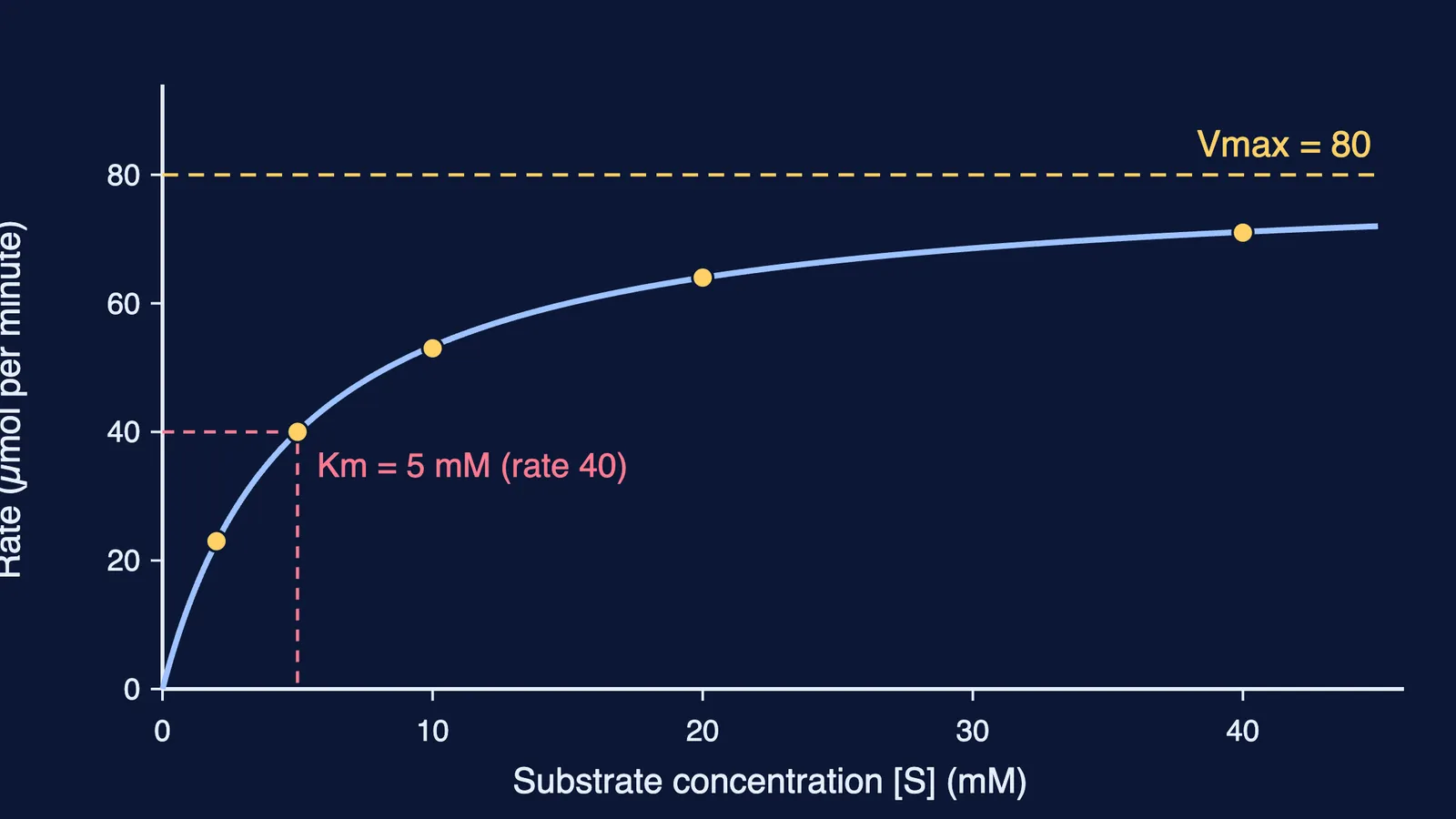
A detergent company in Vadodara wants a protein-digesting enzyme for hot wash water. It isolates Enzyme X from a bacterium in a hot sulphur spring and measures its rate at 70°C and fixed pH, raising the substrate concentration:
2 mM: 23 µmol per minute
5 mM: 40 µmol per minute
10 mM: 53 µmol per minute
20 mM: 64 µmol per minute
40 mM: 71 µmol per minute
At very high substrate the rate levels off near 80 µmol per minute. In a later test, the team strips the zinc ions from the enzyme with a chelating agent and dialysis: activity falls to zero though the protein chain is intact. Adding zinc back restores it.
(i) Enzyme X breaks peptide bonds by adding water. Its class is: (a) lyases (b) ligases (c) hydrolases (d) isomerases
(ii) At what substrate concentration is the rate half of the maximum, and what is that value called?
(iii) Raising substrate from 2 to 5 mM adds 17 µmol per minute to the rate, but doubling it from 20 to 40 mM adds only 7, about 11%. Explain.
(iv) Name the protein part and the type of cofactor in Enzyme X, and explain why removing zinc stops catalysis.
Answers.
(i) (c). Hydrolases catalyse hydrolysis, including of peptide bonds.
(ii) Half of 80 is 40 µmol per minute, reached at 5 mM. On NCERT's substrate-velocity graph this concentration is labelled Km, where the rate is Vmax/2.
(iii) 71 ÷ 64 ≈ 1.11, an 11% rise. The enzyme molecules are fewer than the substrate molecules; near 40 mM almost all active sites are busy, so extra substrate finds no free enzyme and the rate approaches Vmax.
(iv) The protein part is the apoenzyme and zinc is a metal-ion cofactor. Metal ions form coordination bonds with side chains at the active site and with the substrate, as zinc does in carboxypeptidase. NCERT notes that catalytic activity is lost when the cofactor is removed, which shows that zinc is essential for catalysis.
How to attack case-study questions on Biomolecules
Turn each number into a step: wet minus dry gives water; dry minus ash gives carbon compounds.
Place a molecule in a fraction by size, then check if it sits in membranes; lipids are the exception.
Link the test to the structure: blue with iodine means helices that hold I₂.
On a rate table, find where the rise flattens; half the plateau marks Km.
Use NCERT's exact terms: apoenzyme, prosthetic group, coenzyme, metal ion.
For another format, try our Biomolecules assertion-reason questions. If an idea such as cofactors still feels shaky, the Fermi Concept Library gives every concept in biology its own lesson.