On this page
Three original cases, easiest first, with worked answers. For the full chapter, read our Biological Classification Class 11 guide to the five kingdoms.
What do these case study questions cover?
Class 11 exams are set by your school, so the pattern varies. Treat these as practice in the case-based style: read a situation, then answer parts that build on each other.
Every fact follows Chapter 2 of NCERT Class 11 Biology (Reprint 2026-27) and the CBSE 2026-27 Class XI Biology syllabus, which lists the five kingdom classification, the major groups of Monera, Protista and Fungi, and lichens, viruses and viroids. R.H. Whittaker proposed the five kingdom classification in 1969, using cell structure, body organisation, mode of nutrition, reproduction and phylogenetic relationships as his main criteria (NCERT).
Case 1: A drop of lake water in Bhopal
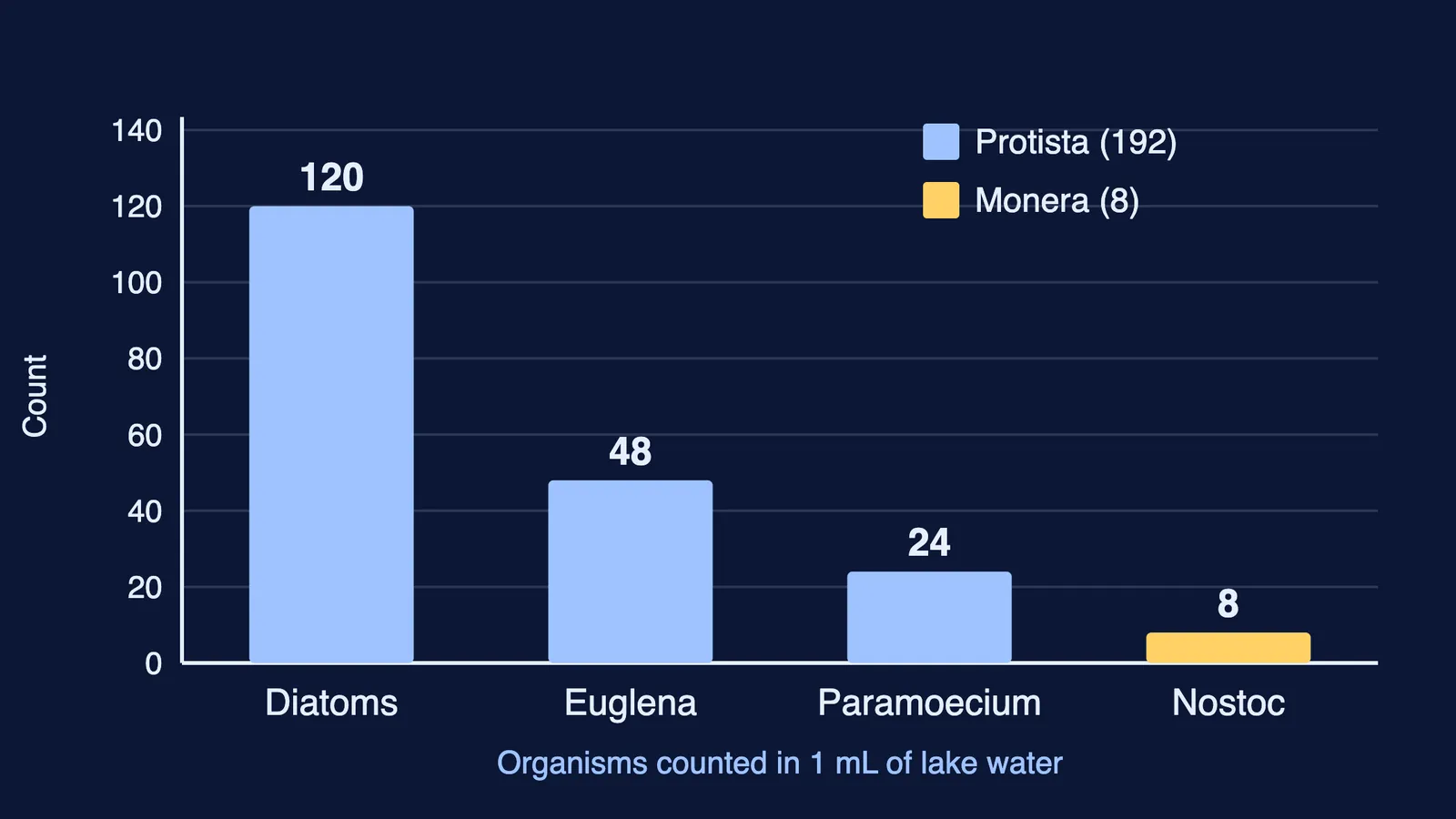
Meher, a Class 11 student in Bhopal, collects water from the edge of a lake for a biology club project. Under the school microscope she scans a 1 mL sample and records four kinds of organisms: 120 diatoms with glassy, box-like shells, 48 green Euglena cells swimming with flagella, 24 Paramoecium cells covered in cilia, and 8 blue-green filaments of Nostoc showing a few thick-walled cells along their length. Her teacher asks her to sort the sample by Whittaker's kingdoms. Meher then keeps a sealed jar of the same water in a dark cupboard for a week and checks it again.
(i) The organism whose cell wall forms two overlapping silica shells is: (a) Euglena (b) Diatom (c) Paramoecium (d) Nostoc
(ii) Which organism in her sample belongs to Kingdom Monera, and why?
(iii) Counting each Nostoc filament as one entry, what percentage of her entries belong to Kingdom Protista?
(iv) After a week in the dark, the Euglena are still active. Explain how they survive without light.
Answers.
(i) (b) Diatoms are chrysophytes; their silica walls fit together like a soap box.
(ii) Nostoc. It is a cyanobacterium, a prokaryote with no nuclear membrane. The thick-walled cells are heterocysts, which fix atmospheric nitrogen.
(iii) Protista = 120 + 48 + 24 = 192 of 200 counted. 192 ÷ 200 × 100 = 96%.
(iv) Euglena photosynthesise in sunlight, but when deprived of it they behave like heterotrophs, preying on smaller organisms.
Case 2: Three fungi on one farm near Bikaner
A farmer near Bikaner grows mustard and wheat and runs a small shed of button mushrooms (Agaricus). His daughter, a Class 11 student, walks a mustard field and checks 400 plants: 92 have white spots on their leaves. In the wheat field next door, several leaves carry rust-coloured streaks, which the agriculture officer identifies as Puccinia. She places a thin slice of a mushroom gill under a microscope and counts 150 mature basidia in one field of view.
(i) The white spots on the mustard leaves are caused by: (a) Puccinia (b) Albugo (c) Ustilago (d) Agaricus
(ii) What percentage of the mustard plants she checked are infected?
(iii) Compare the mycelium of the mustard pathogen with that of the wheat pathogen.
(iv) How many basidiospores can those 150 basidia produce, and what nuclear events come before them?
Answers.
(i) (b) Albugo, a parasitic phycomycete.
(ii) 92 ÷ 400 × 100 = 23%.
(iii) Albugo (phycomycete) has an aseptate, coenocytic mycelium. Puccinia (basidiomycete) has a branched, septate mycelium.
(iv) Each basidium makes four basidiospores, so 150 × 4 = 600. Two vegetative cells of different strains fuse (plasmogamy), giving a dikaryotic (n + n) stage. Karyogamy and meiosis then take place in the basidium, so the spores, borne exogenously, are haploid.
Case 3: Testing seed potatoes in a Jalandhar lab
A seed-potato lab in Jalandhar tests 250 tubers before sale. Sap from each sprout is passed through a filter fine enough to hold back bacteria, and the filtrate is rubbed onto healthy test plants. Filtrate from 35 tubers causes mottled, mosaic-patterned leaves; analysis of this agent finds rod-shaped particles of protein and RNA (agent A). Filtrate from 15 other tubers produces spindle-shaped tubers on the test plants; this agent turns out to be a small, free RNA with no protein at all (agent B). The remaining tubers cause no symptoms.
(i) That the agents pass through a bacteria-proof filter shows they are: (a) larger than bacteria (b) smaller than bacteria (c) fungal spores (d) protists
(ii) What percentage of the tested tubers are free of both agents?
(iii) Identify agents A and B and give the one feature that separates them.
(iv) A trainee notes that agent A contains RNA and says it "must contain DNA too, since it is alive". Evaluate this claim, and say why neither agent appears in Whittaker's five kingdoms.
Answers.
(i) (b) Ivanowsky (1892) used this test on the tobacco mosaic agent.
(ii) Infected = 35 + 15 = 50, so 250 − 50 = 200 clean tubers. 200 ÷ 250 × 100 = 80%.
(iii) A is a virus: nucleic acid inside a protein coat (capsid). B is a viroid, free RNA of low molecular weight without a protein coat, first found by T.O. Diener (1971) in potato spindle tuber disease. The capsid is the difference.
(iv) Wrong. No virus contains both RNA and DNA, and plant viruses generally carry single-stranded RNA. Viruses are non-cellular, inert outside a host cell and obligate parasites, so they find no place in a classification of cellular organisms; the same holds for viroids.
How should you attack case-study questions?
Underline the classification clues first: nucleus present or not, the outer layer (a chitin, cellulose or silica wall, or a pellicle instead of a wall), and how the organism feeds.
For fungi, match the class to three things: septate or aseptate mycelium, the spore type, and whether spores form inside (endogenous) or outside (exogenous).
Keep look-alike names apart: Albugo on mustard, Puccinia on wheat, Ustilago for smut, Agaricus for mushroom.
In virus questions, ask "is there a protein coat?" before anything else: coat means virus, no coat means viroid.
Lichens are an easy final part: the phycobiont is autotrophic, the mycobiont heterotrophic, and lichens do not grow in polluted areas.
For more on the format, see how to handle case-based questions. If one group keeps blurring into another, the Fermi Concept Library covers every concept in biology, each with its own lesson and its place in the map.