On this page
Three original cases with worked answers. For theorems, see our Application of Derivatives Class 12 board guide first.
What do case-study questions on Application of Derivatives look like?
The CBSE 2026-27 Mathematics sample paper has three case study-based questions of 4 marks each in Section E, and calculators are not allowed. Every number here works out by hand, and each case stays inside the CBSE 2026-27 Mathematics syllabus and the rationalised NCERT Chapter 6 (Reprint 2026-27).
Case 1: The Uttarayan kite
On Uttarayan in Ahmedabad, Riya flies a kite from her terrace. A steady breeze holds it 30 m above her hand for several minutes while it drifts horizontally away at 2 m/s. The string stays straight; ignore any sag and measure every length from her hand. Let x be the kite's horizontal distance from her hand, L the string length and θ the string's angle with the horizontal. Consider the moment when x = 40 m.
(i) L and x are related by: (a) L = x + 30 (b) L² = x² + 30² (c) L = 30x (d) L² = x² − 30²
(ii) How much string is out when x = 40 m?
(iii) At what rate is Riya letting out string at that moment?
(iv) At what rate is the angle of elevation θ changing at that moment?
Answers.
(i) (b). Height, horizontal distance and string form a right triangle.
(ii) L = √(40² + 30²) = √2500 = 50 m.
(iii) Differentiate L² = x² + 900 with respect to t: 2L dL/dt = 2x dx/dt, so dL/dt = (40/50) × 2 = 1.6 m/s.
(iv) tan θ = 30/x, so sec²θ dθ/dt = −(30/x²) dx/dt. At x = 40, sec²θ = 1 + (3/4)² = 25/16, so dθ/dt = −(30/1600) × 2 × (16/25) = −0.024 rad/s: θ is decreasing at 0.024 rad/s.
Case 2: The Western Ghats trail
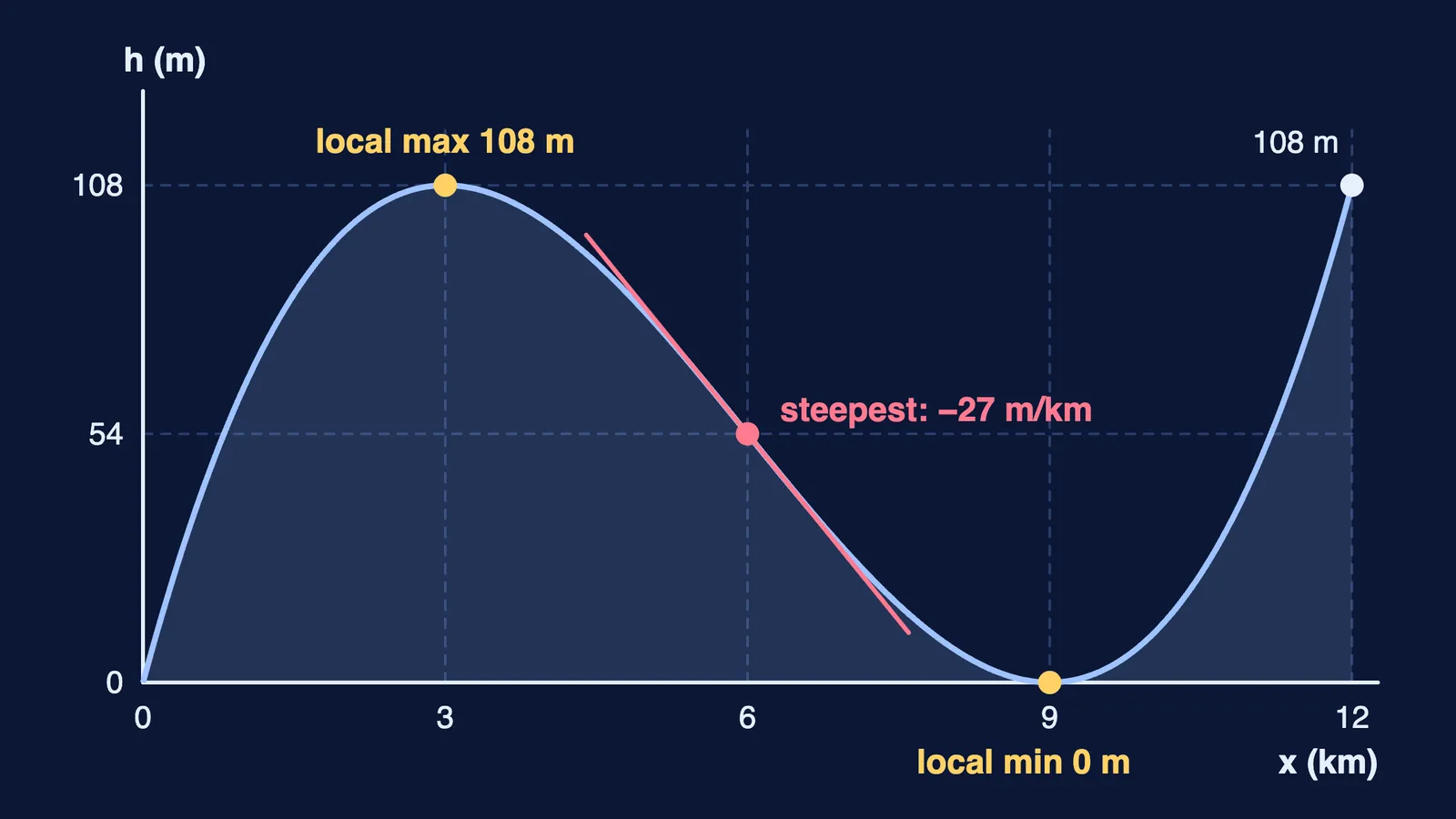
A trekking club near Lonavala maps a 12 km monsoon trail. Its height above the start is h(x) = x³ − 18x² + 81x metres, where x is the horizontal distance in km from the start, 0 ≤ x ≤ 12. The path climbs to a ridge, drops into a rocky stream valley and finally rises to a viewpoint.
(i) h′(x) equals: (a) 3x² − 36x + 81 (b) x² − 18x + 81 (c) 3x² − 18x + 81 (d) 3x² − 36x
(ii) On which stretch of the trail does the path go downhill?
(iii) Use the second derivative test to find the heights of the ridge and the valley floor.
(iv) Where is the downhill slope steepest, and how steep is it there?
Answers.
(i) (a).
(ii) h′(x) = 3(x − 3)(x − 9), which is negative for 3 < x < 9. So h is decreasing on [3, 9]: downhill from the 3 km to the 9 km mark.
(iii) h″(x) = 6x − 36. At x = 3, h″ = −18 < 0, a local maximum: h(3) = 27 − 162 + 243 = 108 m. At x = 9, h″ = 18 > 0, a local minimum: h(9) = 729 − 1458 + 729 = 0 m, back at the starting level.
(iv) Minimise the slope s(x) = h′(x): s′(x) = 6x − 36 = 0 at x = 6, and s″ = 6 > 0, so the steepest downhill slope is h′(6) = −27 m per km, at height 54 m.
Case 3: The canal pipeline
A farmer near Ludhiana needs a pipe from a pumping station P on a straight canal bank to his farmhouse F. F is 3 km from the canal, and the foot of the perpendicular from F to the bank is 8 km along the bank from P. Pipe along the bank costs ₹4 lakh per km; across the fields, ₹5 lakh per km. The contractor runs it x km along the bank, then straight across the fields to F (0 ≤ x ≤ 8).
(i) The length of pipe across the fields is: (a) √(x² + 9) (b) √((8 − x)² + 9) (c) 11 − x (d) √((8 − x)² + 3)
(ii) What does the route cost if the pipe runs all 8 km along the bank and then straight across?
(iii) Write the cost C(x) and find the x that makes C′(x) = 0.
(iv) Show that this x gives the least cost, find that cost, and check it against laying the pipe straight from P to F.
Answers.
(i) (b). It is the hypotenuse of a right triangle with sides 8 − x and 3.
(ii) 4 × 8 + 5 × 3 = ₹47 lakh.
(iii) C(x) = 4x + 5√((8 − x)² + 9). C′(x) = 4 − 5(8 − x)/√((8 − x)² + 9) = 0. Put u = 8 − x: 5u = 4√(u² + 9), so 25u² = 16u² + 144, u² = 16, u = 4. So x = 4 km.
(iv) C″(x) = 45/((8 − x)² + 9)^(3/2), positive for every x, so x = 4 gives the minimum. The field pipe is √(16 + 9) = 5 km, so C(4) = 16 + 25 = ₹41 lakh. The straight route costs C(0) = 5√73 lakh, which is more, since 25 × 73 = 1825 > 41² = 1681.
How do you solve case-study questions on Application of Derivatives?
Name each letter with its unit before you differentiate.
In related rates, write the relation first, differentiate with respect to time, and substitute values only at the end.
For increasing and decreasing stretches, factorise f′(x) and check its sign on each interval.
On a closed interval, compare critical points with both end points before naming the greatest or least value.
In optimisation, state the domain, show C″ or a sign change of C′, and answer in the passage's units.
See our guide to case-based questions in board exams and the assertion-reason set on Application of Derivatives. If a step keeps slipping, the Fermi Problem Library has worked problems with a step-by-step solver that explains the reasoning rather than printing an answer.