On this page
Here are three original cases on Animal Kingdom, Chapter 4 of NCERT Class 11 Biology (Reprint 2026-27). The CBSE 2026-27 Biology curriculum covers non-chordates up to phyla and chordates up to classes, the depth these cases test. Your school sets Class 11 papers, so treat these as practice, not a prediction.
New to the format? Read our guide to case-based questions in board exams. For the chapter, start with the Animal Kingdom Class 11 guide.
Case 1: Are a sea anemone and a starfish close relatives?
At an aquarium in Chennai, a guide shows Meera's class group a tank of marine animals. She adds a few drops of harmless food dye beside a vase-shaped sponge. Soon a coloured stream rises from the single large opening at its top. Nearby, a sea anemone sits fixed to a rock, tentacles waving. When the lights dim, small transparent animals with eight shimmering rows along their bodies start to glow. Pointing to a starfish, the guide says, "The anemone and the starfish are both shaped like a wheel, so they must be close relatives."
(i) Through which structure did the dyed water leave the sponge? (a) Ostia (b) Osculum (c) Spongocoel (d) Nephridium
(ii) Name the level of organisation of the sponge and of the sea anemone.
(iii) Name the property shown by the glowing animals, and the structures that help them swim.
(iv) Is the guide right about the anemone and the starfish? Give two reasons from the chapter.
Answers.
(i) (b) Osculum. Water enters through the ostia into the spongocoel and leaves through the osculum.
(ii) The sponge shows the cellular level of organisation; the sea anemone (*Adamsia*, a cnidarian) shows the tissue level.
(iii) Bioluminescence, the property of a living organism to emit light. These are ctenophores, which swim with eight external rows of ciliated comb plates.
(iv) No. Radial symmetry is shared, but echinoderm larvae are bilaterally symmetrical, and the starfish is triploblastic and coelomate with organ-system organisation, while the anemone is diploblastic with tissue-level organisation and no coelom.
Case 2: Do all worms belong to one phylum?
A pathology lab in Patna logs three worm cases in one month. A child passes seven long worms, circular in cross-section; the technician measures four females at 24, 27, 30 and 22 cm and three males at 17, 19 and 15 cm. An adult's sample contains flat, ribbon-like segments, and the head end of the worm carries hooks and suckers. A trekker back from the Western Ghats brings a blood-sucking worm pulled off her ankle, its body marked into ring-like segments.
(i) What kind of body cavity does the round worm have? (a) Coelom (b) Pseudocoelom (c) No body cavity (d) Spongocoel
(ii) Work out the mean length of the females and of the males. Which feature of this phylum does the result illustrate?
(iii) Name the flat worm's phylum and the specialised cells it uses for osmoregulation and excretion.
(iv) A student says all three are worms, so they belong to one phylum. Correct him using the body cavity of each.
Answers.
(i) (b) Pseudocoelom. *Ascaris* is an aschelminth, and its body cavity is not lined by mesoderm.
(ii) Females: (24 + 27 + 30 + 22) / 4 = 103 / 4 = 25.75 cm. Males: (17 + 19 + 15) / 3 = 51 / 3 = 17 cm. The females are about 1.5 times as long, which fits NCERT's note that sexes are separate and females are often longer than males.
(iii) Platyhelminthes (a tapeworm, *Taenia*); flame cells.
(iv) They sit in three phyla. The tapeworm is acoelomate (no body cavity). *Ascaris* is pseudocoelomate (mesoderm as scattered pouches between ectoderm and endoderm). The leech is an annelid (like NCERT's example *Hirudinaria*) and a true coelomate, with a body cavity lined by mesoderm.
Case 3: Does a four-chambered heart make an animal warm-blooded?
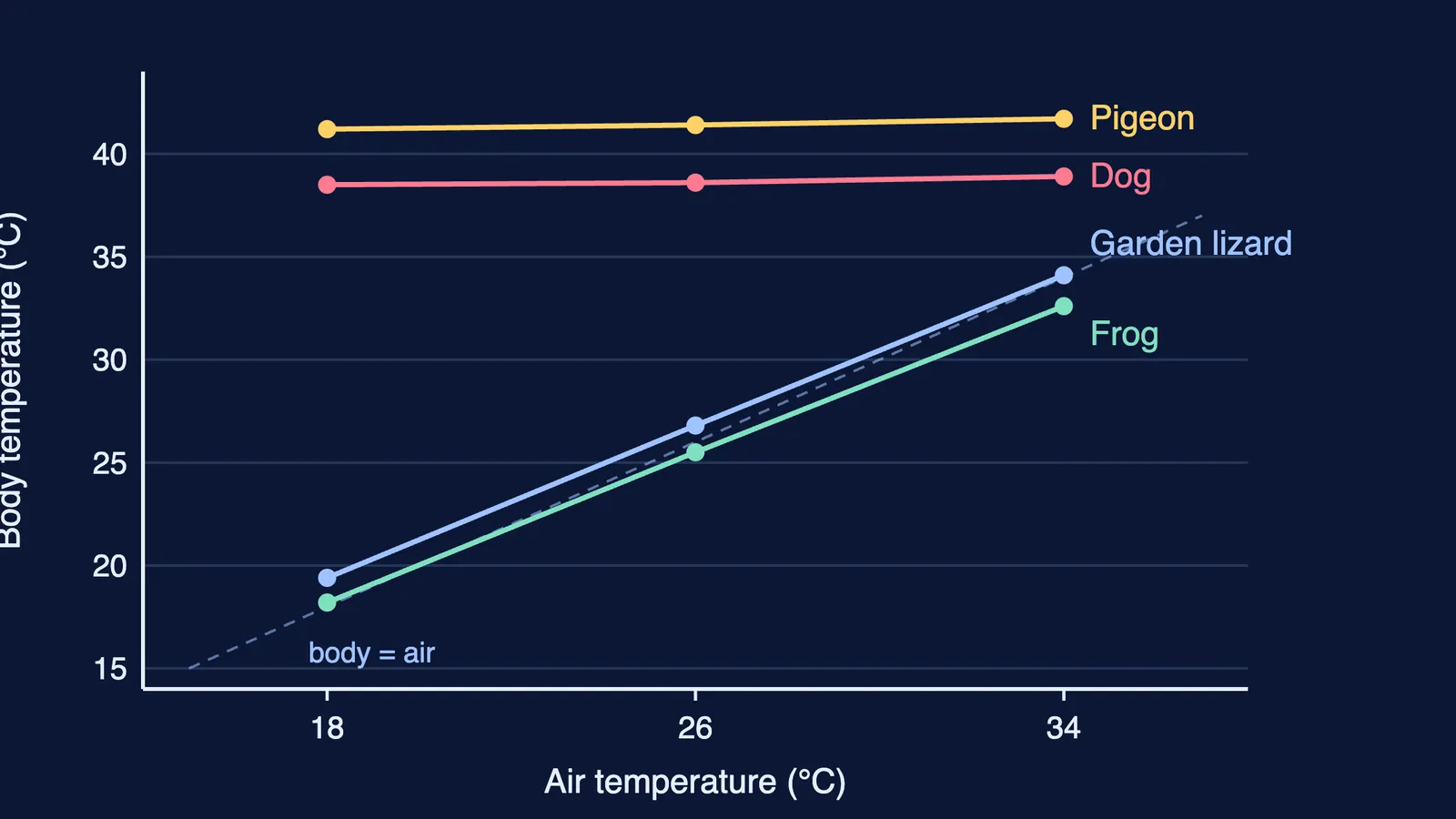
For a project, Arjun joins a zoo veterinarian in Bhopal who records body temperatures with an infrared thermometer. The air temperature is 18 °C at 6 am, 26 °C at 10 am and 34 °C at 2 pm. A garden lizard reads 19.4, 26.8 and 34.1 °C; a frog in a shaded pond, 18.2, 25.5 and 32.6 °C; a pigeon, 41.2, 41.4 and 41.7 °C; and the zoo's dog, 38.5, 38.6 and 38.9 °C. Arjun notices that the two animals with steady readings both have four-chambered hearts.
(i) Which pair is homoiothermous? (a) Lizard and frog (b) Pigeon and dog (c) Frog and pigeon (d) Lizard and dog
(ii) Calculate how much the lizard's and the pigeon's body temperature changed over the day, per degree of air temperature.
(iii) Which animal in the passage has moist skin without scales? Name its three respiratory surfaces and its heart chambers.
(iv) Arjun concludes that a four-chambered heart makes an animal warm-blooded. Which reptile in the same zoo would disprove this, and why?
Answers.
(i) (b) Pigeon and dog. Birds and mammals are homoiothermous; fishes, amphibians and reptiles are poikilothermous.
(ii) Air rose by 34 − 18 = 16 °C. Lizard: 34.1 − 19.4 = 14.7 °C, so 14.7 / 16 ≈ 0.92 °C per °C. Pigeon: 41.7 − 41.2 = 0.5 °C, so 0.5 / 16 ≈ 0.03 °C per °C.
(iii) The frog. It breathes through gills, lungs and skin, and its heart is three-chambered (two auricles and one ventricle).
(iv) A crocodile. NCERT says the reptile heart is usually three-chambered but four-chambered in crocodiles, yet all reptiles are poikilotherms. A four-chambered heart goes with warm blood in birds and mammals, but it does not cause it.
How do you attack case-study questions on Animal Kingdom?
Underline the clues first: openings, symmetry, segments, body cavity, skin, heart chambers.
Name the group first, then the feature. Most wrong answers in this chapter are a true feature pinned to the wrong group.
Check claims against the full feature list, not one feature. Symmetry alone (Case 1) and heart chambers alone (Case 3) both mislead.
In data parts, write each subtraction and division on its own line with units.
Learn the exceptions as pairs: crocodile with four chambers among reptiles, earthworm and leech monoecious among annelids, larvae bilateral among echinoderms.
If the three kinds of body cavity still blur together, the Fermi Concept Library covers every concept in biology, each with its own lesson and its place in the map.