On this page
Three original Alternating Current cases: a geyser, a radio dial and a village power line. Each has four sub-questions that get harder, with worked answers.
What do AC case-study questions test?
The CBSE Physics Sample Question Paper 2026-27 has two case study-based questions of four marks each in Section D, and calculators are not allowed. The CBSE 2026-27 Physics curriculum lists peak and rms values, reactance, impedance, the LCR series circuit (phasors only), resonance, power factor, wattless current and the transformer.
Every case stays inside that list and NCERT Class 12 Physics Chapter 7 (Reprint 2026-27). For derivations and a revision plan, see our Alternating Current Class 12 board guide.
Case 1: The geyser on a winter morning
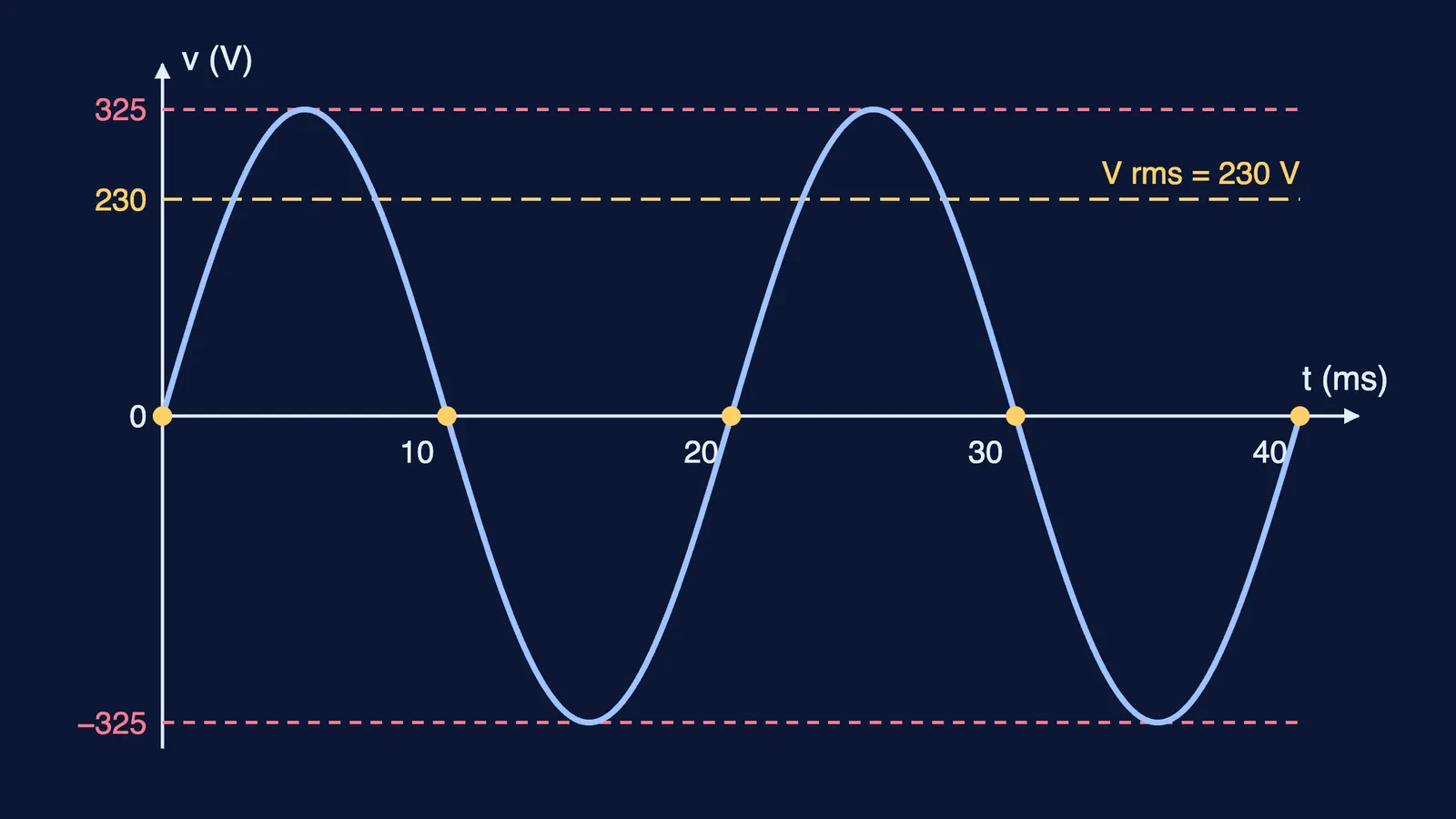
Meera's family fits a new geyser in their Pune flat. Its label reads 2000 W, 230 V, 50 Hz. Her brother asks how a voltage that "keeps changing direction" can heat water at all. Meera reads that 230 V is the rms value of the mains voltage, and that the voltage actually swings above and below zero fifty times every second. She decides to treat the heating element as a pure resistor and work out what is really happening inside it.
(i) How many times in one second does the current through the element become zero? (a) 25 (b) 50 (c) 100 (d) 200
(ii) What is the peak value of the supply voltage?
(iii) Find the resistance of the element and the peak current through it.
(iv) Her brother says, "The average current is zero, so the average power is zero too." Explain why he is wrong and find the average power.
Answers.
(i) (c) 100. Two zero crossings per cycle, 50 cycles a second: the current is zero every 10 ms.
(ii) vm = √2 × 230 ≈ 325 V.
(iii) R = V²/P = 230²/2000 = 26.45 Ω. I = P/V = 2000/230 ≈ 8.70 A rms, so im = √2 × 8.70 ≈ 12.3 A.
(iv) Heating depends on i², which is never negative, so its average is not zero even though the average of i is. Average power = I²R = 8.70² × 26.45 ≈ 2000 W, the rated value.
Case 2: Tuning a medium-wave radio
A science club in Kochi builds a medium-wave radio. The tuning circuit is a coil of inductance 250 μH and resistance 15 Ω in series with a variable capacitor. The antenna picks up many stations at once. The club's target station broadcasts at 1.0 MHz and produces an emf of 2.0 mV rms in the circuit. A second station at 1.5 MHz produces the same 2.0 mV. Turning the knob changes only the capacitance; the coil stays fixed, so the club wants to know which capacitor settings they need.
(i) When tuned to a station: (a) XL = XC (b) Z = 0 (c) the current is zero (d) XL = R
(ii) Find the capacitance needed to tune to 1.0 MHz.
(iii) By what factor must the capacitance change to tune to the 1.5 MHz station, and in which direction?
(iv) With the dial at 1.0 MHz, compare the currents due to the two stations.
Answers.
(i) (a). At resonance Z = R and the current is maximum.
(ii) ω0 = 1/√(LC) gives C = 1/(4π²f²L) = 1/(4π² × 10¹² × 2.5 × 10⁻⁴) ≈ 1.01 × 10⁻¹⁰ F ≈ 101 pF.
(iii) C ∝ 1/f², so C must fall 2.25 times, to about 45 pF.
(iv) At 1.0 MHz, XL = XC = 2π × 10⁶ × 2.5 × 10⁻⁴ ≈ 1571 Ω and Z = R, so I = 2.0 mV/15 Ω ≈ 133 μA. At 1.5 MHz, XL rises and XC falls 1.5 times: XL − XC ≈ 1571 × (1.5 − 0.667) ≈ 1309 Ω, so Z ≈ 1309 Ω and I ≈ 1.5 μA. The tuned station drives about 87 times more current, so it is the one you hear.
Case 3: Sending hydro power to a hill village
A small hydro plant in Uttarakhand generates 100 kW at 400 V for a village a few kilometres away. The two wires of the line have a total resistance of 0.4 Ω. Engineers compare sending the power at 400 V with first stepping it up to 11 kV using a transformer whose primary has 120 turns. The village needs most of that power for its homes, a school and a flour mill. Treat the transformer as ideal and the line as a simple resistor.
(i) A transformer works on the principle of: (a) self-induction (b) mutual induction (c) resonance (d) the heating effect of current
(ii) How many turns must the secondary have?
(iii) Find the line current and the power lost in the line when the power is sent at 11 kV.
(iv) By what factor does the line loss fall compared with sending at 400 V? Explain why.
Answers.
(i) (b) mutual induction.
(ii) Ns/Np = Vs/Vp = 11 000/400 = 27.5, so Ns = 27.5 × 120 = 3300 turns.
(iii) I = P/V = 100 000/11 000 ≈ 9.09 A. Loss = I²R = 9.09² × 0.4 ≈ 33 W.
(iv) At 400 V, I = 250 A and the loss is 250² × 0.4 = 25 000 W, a quarter of the power. Stepping up 27.5 times cuts the current 27.5 times, and since loss = I²R, it falls 27.5² ≈ 756 times. This is why NCERT says the voltage is stepped up for transmission.
How do you attack case-study questions on AC?
Mark rms or peak on every value first. NCERT's household 220 V is an rms value; peak = √2 × rms.
Name the circuit first. Pure R, L, C or LCR decides the formula and the phase.
Use ratios. C ∝ 1/f² and loss ∝ 1/V² save time without a calculator.
Give a one-line reason in explain parts. "Loss = I²R and I falls 27.5 times" shows the reasoning, not just the number.
Check against the story. A geyser should draw its rated 2000 W; the tuned station should give the larger current.
For the general method, see our guide to case-based questions in board exams, then try our assertion-reason questions on electromagnetic induction and AC. If resonance is hard to picture, the Fermi Simulation Lab has interactive simulations for the ideas that are easier to see than to read.