On this page
Case-based questions give you a short passage and then linked parts. The CBSE 2026-27 Chemistry sample paper puts 2 case-based questions of 4 marks each in Section D, each with two 1-mark parts and a 2-mark part that offers an internal choice. Here are three original Unit 7 cases, each with one extra 1-mark part for practice, easiest first, checked against the NCERT chapter (Reprint 2026-27). For full chapter revision, start with our Alcohols, phenols and ethers Class 12 board guide.
Case 1: Which drum holds the ether?
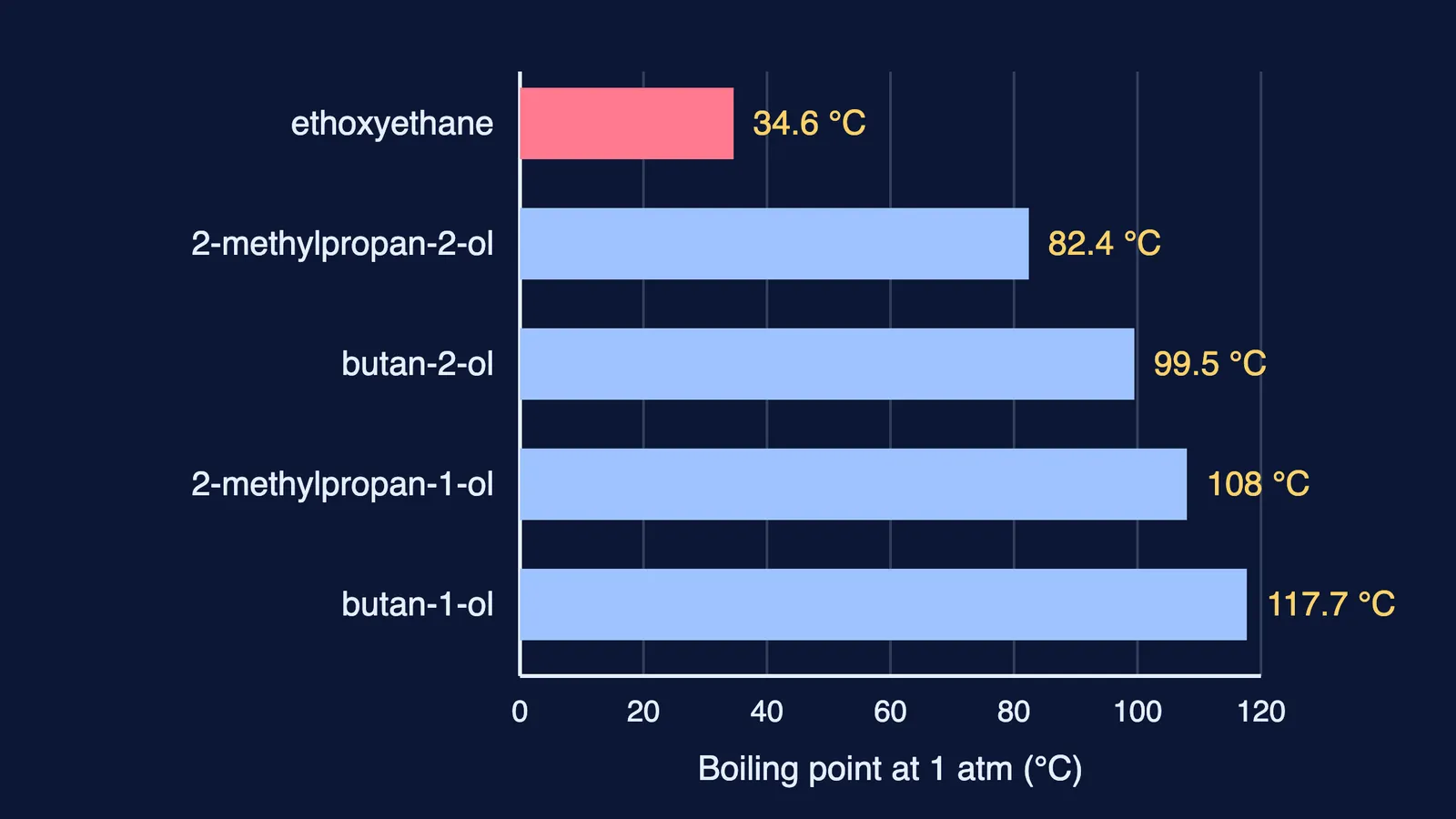
A solvent trader in Ankleshwar receives five unlabelled drums. The invoice says each holds a compound of formula C4H10O (74.12 g/mol), four alcohols and one ether. A chemist distils each at 1 atm: drum P boils at 34.6 °C, Q at 82.4 °C, R at 99.5 °C, S at 108 °C and T at 117.7 °C. The candidates are butan-1-ol, butan-2-ol, 2-methylpropan-1-ol, 2-methylpropan-2-ol and ethoxyethane. She then runs the Lucas test (conc. HCl with ZnCl2) on drums Q and T.
The boiling points are the experimental values PubChem lists for butan-1-ol, butan-2-ol, 2-methylpropan-1-ol, 2-methylpropan-2-ol and ethoxyethane.
(i) Which drum holds the ether? (a) P (b) Q (c) S (d) T
(ii) Drum Q holds 2-methylpropan-2-ol and drum T holds butan-1-ol. Classify each as a primary, secondary or tertiary alcohol.
(iii) P and T share a molar mass. Why does T boil higher?
(iv) (2 marks) Explain why the boiling point falls from T to Q among the alcohols, and predict what the Lucas test shows for Q and T at room temperature.
Answers.
(i) (a) P. Ethers have no O–H, so no hydrogen bonds between molecules.
(ii) Q is tertiary: the carbon carrying –OH is bonded to three other carbons. T is primary: that carbon is bonded to one other carbon.
(iii) The gap is 117.7 − 34.6 = 83.1 °C. Butan-1-ol molecules are held together by intermolecular hydrogen bonds through –OH; ethoxyethane has none.
(iv) All four alcohols hydrogen-bond, so the difference comes from branching: NCERT says more branching means less surface area and weaker van der Waals forces. Straight-chain butan-1-ol (T) boils highest and the most branched, 2-methylpropan-2-ol (Q), lowest (1 mark). In the Lucas test, Q turns turbid immediately; T, a primary alcohol, gives no turbidity at room temperature (1 mark).
Case 2: How much phenol is in the effluent?
A pollution-control lab in Vadodara tests effluent from a resin factory. An analyst adds bromine water to 250 mL of filtered effluent until the bromine colour persists. A white precipitate forms at once, with no catalyst added. Dried, it weighs 0.1654 g. Ethanol from the factory's cleaning step is also present but gives no precipitate. She must report phenol in mg/L. Take the molar masses of phenol (94.11 g/mol) and 2,4,6-tribromophenol (330.80 g/mol) from PubChem.
(i) The white precipitate is: (a) 2-bromophenol (b) 4-bromophenol (c) 2,4,6-tribromophenol (d) bromobenzene
(ii) Why does phenol react with bromine here without FeBr3?
(iii) Calculate the phenol concentration in mg/L, assuming all of it precipitates.
(iv) (2 marks) NCERT Table 7.3 gives pKa 10.0 for phenol and 15.9 for ethanol. By what factor is the Ka of phenol larger, and what structural reason explains it?
Answers.
(i) (c). With bromine water, phenol gives 2,4,6-tribromophenol as a white precipitate.
(ii) The –OH group strongly activates the ring, so the bromine molecule is polarised even without a Lewis acid.
(iii) Moles of precipitate = 0.1654 ÷ 330.80 = 5.00 × 10⁻⁴ mol. One phenol gives one tribromophenol, so phenol = 5.00 × 10⁻⁴ × 94.11 = 0.0471 g = 47.1 mg in 250 mL, which is 47.1 × 4 = 188 mg/L.
(iv) Ka ratio = 10^(15.9 − 10.0) = 10^5.9 ≈ 7.9 × 10⁵, close to the "million times" NCERT states (1 mark). Phenoxide spreads its negative charge over the ring by resonance; ethoxide keeps it on oxygen (1 mark).
Case 3: What should a phenol plant do with its acetone?
A chemical plant makes phenol from cumene (isopropylbenzene). Air oxidises cumene to an intermediate, which dilute acid splits into phenol and acetone. One batch uses 3.00 tonnes of cumene, and the plant records 90% of the theoretical yield. To use surplus acetone, a team proposes hydrogenating it over a nickel catalyst to an alcohol, then turning that alcohol into the ether 2-methoxypropane by Williamson synthesis. Route A: sodium methoxide with 2-bromopropane. Route B: sodium propan-2-oxide with bromomethane. Molar masses from PubChem: cumene 120.19, phenol 94.11, acetone 58.08 g/mol.
(i) The intermediate is: (a) cumene hydroperoxide (b) benzoic acid (c) benzene (d) propene
(ii) Which alcohol does hydrogenating acetone give, and what is its class?
(iii) Calculate the mass of phenol and of acetone from one batch.
(iv) (2 marks) Which route gives 2-methoxypropane? What competing product does the other route give, and why?
Answers.
(i) (a) Cumene hydroperoxide.
(ii) Propan-2-ol, a secondary alcohol: NCERT says catalytic hydrogenation turns ketones into secondary alcohols.
(iii) Moles of cumene = 3.00 × 10⁶ g ÷ 120.19 = 2.496 × 10⁴ mol. The ratio is 1 : 1 : 1, so theoretically phenol = 2.496 × 10⁴ × 94.11 g = 2.35 t and acetone = 2.496 × 10⁴ × 58.08 g = 1.45 t. At 90%: 2.11 t phenol and 1.30 t acetone.
(iv) Route B: (CH3)2CH–O⁻Na⁺ + CH3Br → (CH3)2CH–O–CH3 + NaBr, an SN2 attack on an unhindered methyl halide (1 mark). Route A uses a secondary halide; methoxide is a strong base as well as a nucleophile, so elimination competes and propene forms (1 mark).
How to attack case-study questions
Classify every alcohol (primary, secondary, tertiary) as you read; the Lucas test and Williamson choices depend on it.
For numericals, write the equation and mole ratio first and keep units on every line.
For acidity, turn a pKa gap into a Ka ratio (10^ΔpKa), then give one structural reason per mark.
For timing and reading strategy, see our guide to case-based questions in board exams, and for drills, our Alcohols, phenols and ethers JEE Main practice questions. If a numerical keeps going wrong, the Fermi Problem Library has worked problems with a step-by-step solver that explains the reasoning rather than printing an answer.