On this page
What do case-study questions on this chapter test?
The CBSE Class X Science curriculum for 2026-27 lists source-based, case-based and passage-based questions among its question types. For this chapter it covers indicators, reactions, neutralisation, the pH scale (no logarithm definition), pH in daily life and five salts: sodium hydroxide, bleaching powder, baking soda, washing soda and Plaster of Paris.
Every fact below matches the NCERT chapter Acids, Bases and Salts (Reprint 2026-27); the scenarios and numbers are our own. For the theory, start with our Acids, bases and salts Class 10 guide.
Case 1: Which school plot needs lime?
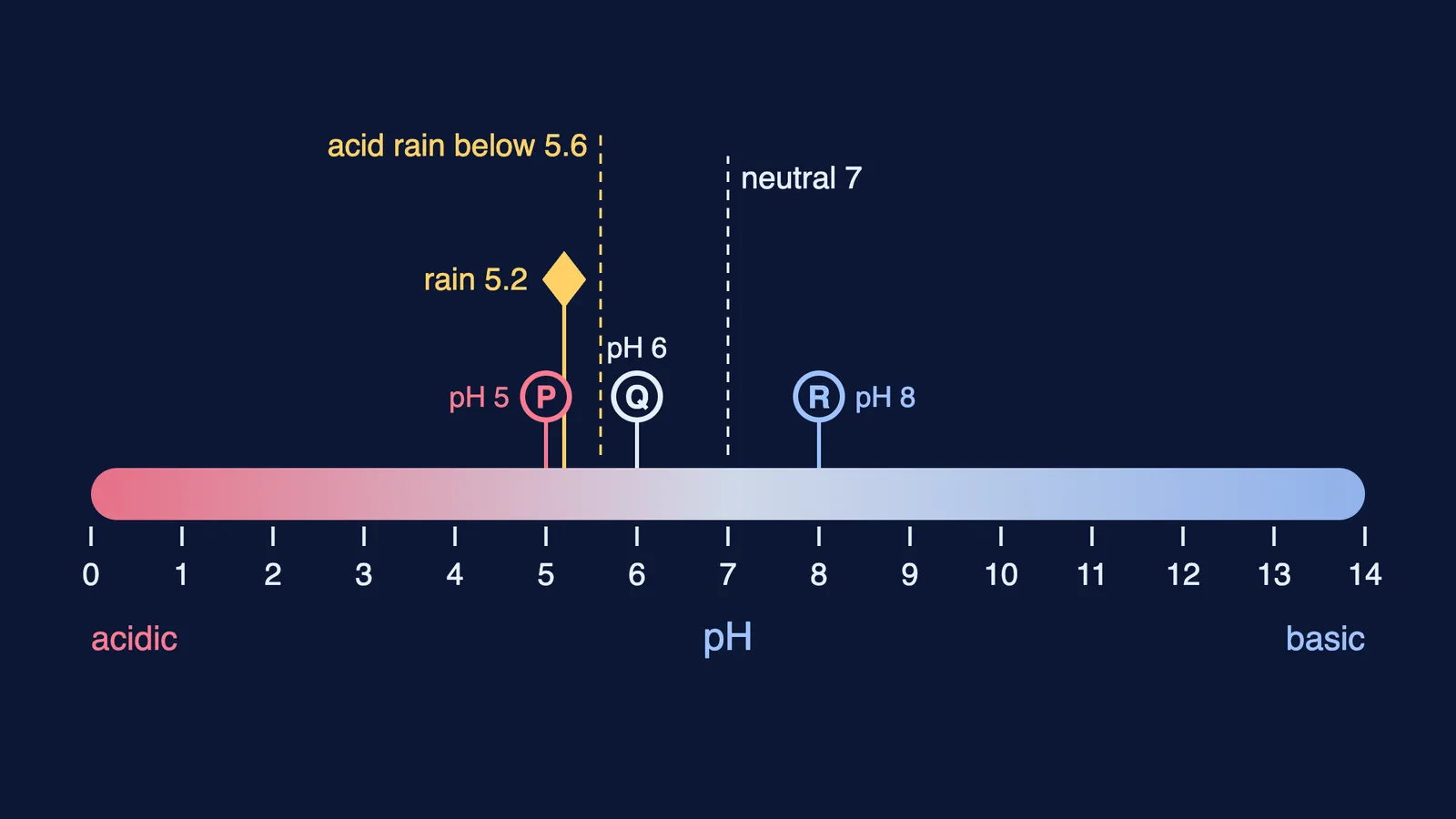
The eco-club of a school in Nashik is planning a vegetable garden on three plots. For each plot, Tanvi shakes 10 g of soil with 25 mL of distilled water, filters it, and dips universal indicator paper in the filtrate. The readings are: Plot P, pH 5; Plot Q, pH 6; Plot R, pH 8. The club's rain gauge, emptied the same week, holds rainwater with pH 5.2. The gardener has enough slaked lime for only one plot and asks the club which one.
(i) Which filtrate has the highest concentration of hydrogen ions? (a) P (b) Q (c) R (d) all three are equal
(ii) Which plot's soil is basic, and which ion is in excess in its filtrate?
(iii) On which plot should the gardener spread slaked lime, and what does it do there?
(iv) Is the rainwater acid rain? If this rain keeps falling on Plot Q, which way will its pH move?
Answers.
(i) (a) P. Higher hydronium ion concentration means lower pH.
(ii) Plot R, since pH 8 is above 7. Its filtrate has more OH⁻ ions than H⁺ ions.
(iii) Plot P, the most acidic. Slaked lime, Ca(OH)₂, is a base; it neutralises the excess acid and raises the pH towards 7.
(iv) Yes. NCERT calls rainwater acid rain when its pH is below 5.6, and 5.2 is below that. Plot Q is at pH 6, so rain at pH 5.2 adds more H⁺ ions than the soil water holds, and Q's pH will tend to fall.
Case 2: Two sponge cakes, one recipe
Meera runs a home-baking business in Indore. To test a recipe, she bakes two sponge cakes from the same batter. In Batch A she adds 2.1 g of baking soda and no other raising agent. In Batch B she adds 2.1 g of baking soda along with tartaric acid, which together make baking powder. Both tins go into the same oven at the same temperature for the same time. Batch B rises noticeably higher and is softer. Meera wants to know why.
(i) What is the chemical formula of baking soda? (a) Na₂CO₃ (b) NaHCO₃ (c) NaOH (d) Na₂CO₃·10H₂O
(ii) Name the gas that makes the batter rise and give one test for it.
(iii) Write the balanced equation for what happens to the baking soda in Batch A, and name the solid it leaves behind.
(iv) Use the equations for the two batches to explain why Batch B rose more from the same 2.1 g of baking soda.
Answers.
(i) (b) NaHCO₃, sodium hydrogencarbonate.
(ii) Carbon dioxide. Passed through lime water, it turns the lime water milky.
(iii) 2NaHCO₃ → Na₂CO₃ + H₂O + CO₂ on heating. The solid left is sodium carbonate.
(iv) In Batch A, heat alone acts: every two NaHCO₃ give one CO₂. In Batch B, the acid reacts: NaHCO₃ + H⁺ → CO₂ + H₂O + sodium salt of the acid, one CO₂ for every NaHCO₃. The same baking soda can release up to twice as much carbon dioxide in Batch B, and more gas makes the cake rise higher and softer.
Case 3: Where does the chlorine for bleaching powder come from?
A chlor-alkali unit on the Gujarat coast passes electricity through brine, a solution of common salt in water. The hydrogen is sold as fuel and the sodium hydroxide is sold as solution. All the chlorine goes by pipe to a bleaching powder unit next door, which treats it with dry slaked lime. The manager wants a one-page note for trainees on where each product forms and how the chlorine is used next door.
(i) Which product of the plant is the raw material for bleaching powder? (a) H₂ (b) Cl₂ (c) NaOH (d) NaCl
(ii) Write the balanced equation for the electrolysis of brine.
(iii) At which electrode is chlorine given off, and where does the sodium hydroxide solution form?
(iv) Write the balanced equation for the bleaching powder unit. How many Ca(OH)₂ units react with each Cl₂ molecule, and what are two uses of the product?
Answers.
(i) (b) Cl₂, which reacts with dry slaked lime.
(ii) 2NaCl(aq) + 2H₂O(l) → 2NaOH(aq) + Cl₂(g) + H₂(g).
(iii) Chlorine is given off at the anode. Hydrogen is given off at the cathode, and the sodium hydroxide solution forms near the cathode.
(iv) 2Ca(OH)₂ + 2Cl₂ → Ca(ClO)₂ + CaCl₂ + 2H₂O. The coefficients are 2 and 2, so one Ca(OH)₂ reacts with each Cl₂. Bleaching powder is used to make drinking water free from germs and to bleach cotton and linen in the textile industry. NCERT notes it is written as Ca(ClO)₂, though its actual composition is quite complex.
How to attack case-study questions
Underline every number and condition first; here the pH values and the two batch recipes are the case.
Read pH one way: below 7 is acidic, and a lower number means more H⁺ ions.
Write the balanced equation before you explain. Its coefficients (two NaHCO₃ to one CO₂ on heating, one to one with an acid) carry the answer.
Learn the five salts as sets: raw materials, equation and one use each.
End the last part with one sentence linking your number back to the story.
Our guide to case-based questions in board exams covers timing; the assertion-reason set on this chapter tests the same facts another way. If balancing the equations in Cases 2 and 3 tripped you up, the Fermi Problem Library has worked problems with a step-by-step solver that explains the reasoning rather than printing an answer.