On this page
Ten original questions on Class 10 Acids, Bases and Salts, built around common slips: pH direction, non-neutral salts, and reactions "only acids" do.
Do CBSE Class 10 science papers have assertion-reason questions?
Yes. The CBSE Class 10 Science sample question paper for 2026-27 has four assertion-reason questions of 1 mark each (Q8, Q9, Q24 and Q32), and Q24 in the chemistry section is on acids and bases. Every statement below is checked against the NCERT chapter Acids, Bases and Salts (Reprint 2026-27).
Keys for Q1 to Q6:
(A) Both A and R are true and R is the correct explanation of A.
(B) Both A and R are true but R is NOT the correct explanation of A.
(C) A is true but R is false.
(D) A is false but R is true.
Keys for Q7 to Q10:
(A) Both statements are correct.
(B) Both statements are incorrect.
(C) Statement I is correct, Statement II is incorrect.
(D) Statement I is incorrect, Statement II is correct.
Mark each statement true or false on its own first; only then ask whether R causes A. Our assertion-reason strategy guide explains this habit.
Assertion-reason questions with answers
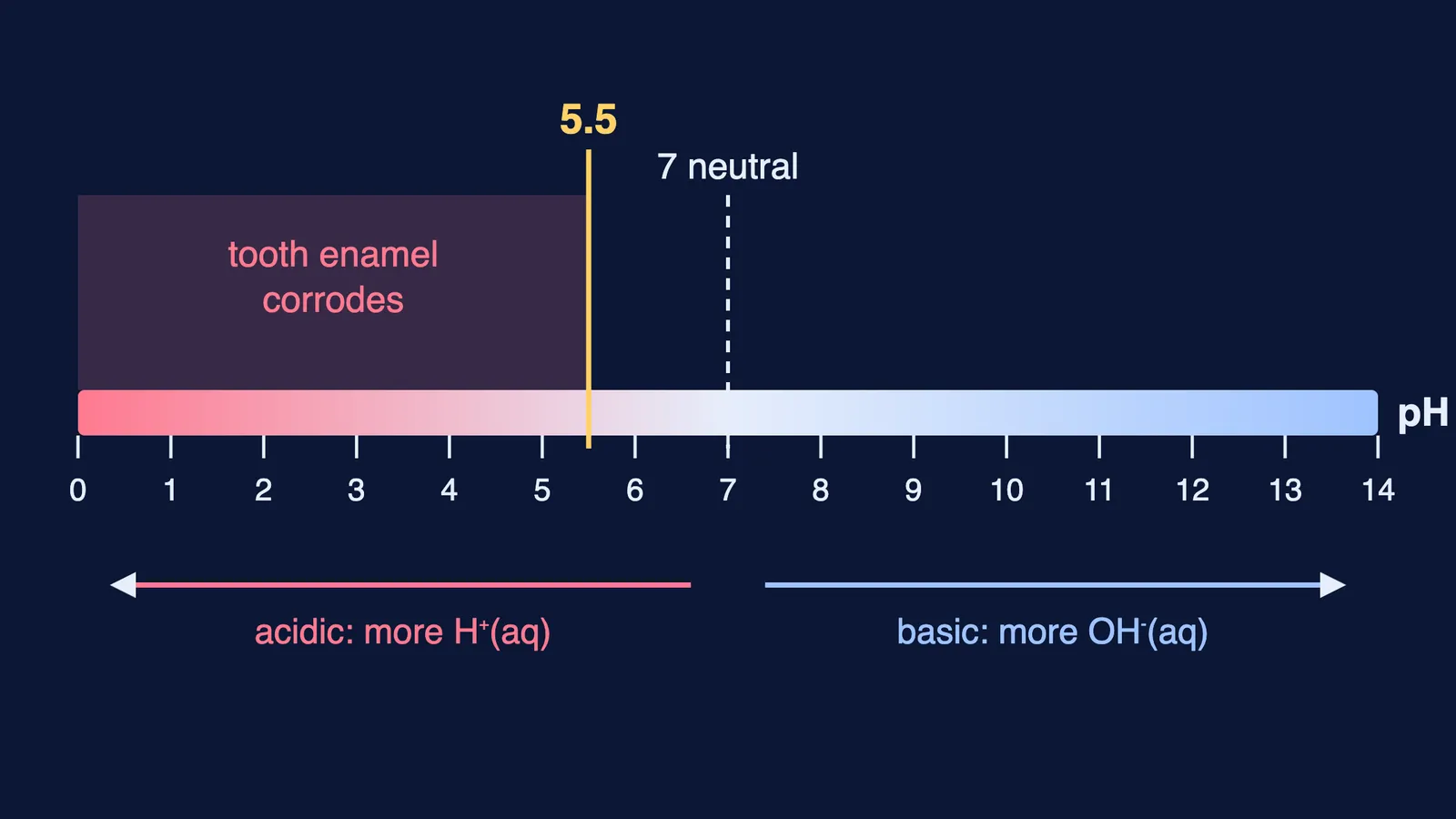
Q1 (easy). Assertion (A): Tooth decay starts when the pH in the mouth falls below 5.5. Reason (R): Toothpastes are generally basic.
Answer: (B). Both are NCERT facts. Decay starts because mouth bacteria turn leftover sugar into acids. R explains why brushing prevents decay, not why decay starts.
Trap: picking (A) because both lines are about teeth.
Q2 (easy). Assertion (A): Pouring water into concentrated sulphuric acid can make the mixture splash out and crack the glass container. Reason (R): Mixing a concentrated acid with water releases a large amount of heat.
Answer: (A). The local heating makes the mixture splash and the glass break. R is the cause NCERT gives.
Trap: blaming the acid's strength, not the heat.
Q3 (medium). Assertion (A): Zinc granules warmed with sodium hydroxide solution give off hydrogen gas. Reason (R): Only acids release hydrogen gas when they react with metals.
Answer: (C). NCERT shows 2NaOH + Zn → Na₂ZnO₂ (sodium zincate) + H₂. So R is false: a base can also give hydrogen with some metals.
Trap: learning "metal + acid → salt + hydrogen" as the only way to get hydrogen.
Q4 (medium). Assertion (A): Every salt dissolved in water gives a solution of pH 7. Reason (R): A salt of a strong acid and a strong base gives a neutral solution of pH 7.
Answer: (D). R is true, as with sodium chloride. A is false: a salt of a strong acid and a weak base is acidic (pH below 7), and a salt of a strong base and a weak acid, like sodium carbonate, is basic (pH above 7).
Trap: assuming "neutralisation gives a salt" means "every salt is neutral".
Q5 (medium). Assertion (A): A test tube of lime water that has turned milky with carbon dioxide can turn clear again if the gas keeps bubbling through. Reason (R): Calcium carbonate reacts with water and more CO₂ to give calcium hydrogencarbonate, which dissolves in water.
Answer: (A). The milkiness is insoluble CaCO₃; excess CO₂ turns it into soluble Ca(HCO₃)₂. R is the direct cause.
Trap: marking A false because you only remember "CO₂ turns lime water milky".
Q6 (hard). Assertion (A): Hydrochloric acid and acetic acid, both one molar, have the same pH. Reason (R): The strength of an acid depends on the number of H⁺ ions it produces.
Answer: (D). NCERT notes that the two acids at the same concentration produce different amounts of H⁺ ions: HCl gives more H⁺ and has the lower pH. R is true, and it is exactly what makes A false.
Trap: equating "same concentration" with "same strength".
Statement I and Statement II questions with answers
Q7 (medium). Statement I: Plaster of Paris is formed when gypsum is heated at 373 K. Statement II: Plaster of Paris is written as CaSO₄·½H₂O because two formula units of CaSO₄ share one molecule of water.
Answer: (A). Both are NCERT statements. Gypsum (CaSO₄·2H₂O) loses water on heating to give the hemihydrate.
Trap: rejecting Statement II because "half a molecule" sounds impossible.
Q8 (medium). Statement I: Bleaching powder is made by the action of chlorine on dry slaked lime. Statement II: In the chlor-alkali process, chlorine is given off at the cathode and sodium hydroxide forms near the anode.
Answer: (C). Statement I is correct. Statement II swaps the electrodes: chlorine is given off at the anode, hydrogen at the cathode, and sodium hydroxide forms near the cathode.
Trap: accepting the right products at the wrong electrodes.
Q9 (hard). Statement I: Diluting hydrochloric acid with water increases the concentration of H₃O⁺ ions per unit volume. Statement II: An alkali is a base that dissolves in water.
Answer: (D). Dilution spreads the same ions through more water, so H₃O⁺ concentration per unit volume decreases. Statement II is the NCERT definition of an alkali.
Trap: thinking more water means more H₃O⁺.
Q10 (hard). Statement I: In the NCERT chapter, baking powder is described as a mixture of baking soda and citric acid. Statement II: On heating, sodium hydrogencarbonate gives sodium carbonate, water and oxygen.
Answer: (B). NCERT names tartaric acid, a weak edible acid, in baking powder. Heating baking soda gives sodium carbonate, water and carbon dioxide, not oxygen.
Trap: two near-miss words. Citric acid is in lemons, and the gas that makes cakes rise is CO₂.
How should you use this set?
Cover the answers; mark each statement true or false before choosing a key.
For every (A) or (B), write the one line from the chapter that links R to A, or write "not the cause".
For every false statement, write the corrected version, for example "chlorine at the anode".
Redo the ones you missed after two days, without notes.
For the same format in other subjects, see our assertion-reason questions guide. To revise the reactions and pH rules behind these questions, read our Acids, Bases and Salts Class 10 chapter guide. If a key was right but you could not say why, the Fermi Concept Library has a lesson for every concept in chemistry, each with its place in the map.