On this page
Right now, somewhere on Earth, two places exactly opposite each other have the same temperature and the same air pressure, provided both vary continuously. It follows from one theorem in topology, and the simplest case needs only the intermediate value theorem from school calculus.
What does the Borsuk–Ulam theorem say?
The Borsuk–Ulam theorem states that every continuous map from the sphere to the plane maps some pair of antipodal points to the same point. Two points are antipodal when they lie in exactly opposite directions from the centre, like the North and South Poles.
In symbols: if f is a continuous function from the n-sphere to n-dimensional space, there is a point x with f(x) = f(−x). The ordinary sphere is the case n = 2, and a circle is the case n = 1.
Karol Borsuk published the first proof in 1933 in Fundamenta Mathematicae, and the history section of the same article notes that he attributed the problem to Stanisław Ulam.
Do two opposite points on Earth really have the same temperature and pressure?
Yes, with one assumption. Send each point on Earth's surface to a pair of numbers: (temperature, pressure). That is a map from the sphere to the plane. If both quantities vary continuously, the theorem gives an antipodal pair where both numbers match; this is the standard n = 2 illustration in the Borsuk–Ulam article.
Two limits:
The theorem proves such a pair exists, not where it is, and the pair moves as the weather changes.
Real temperature can jump, for example across a weather front, so the result is about a continuous model.
How do you prove the equator version with the intermediate value theorem?
The circle case, such as the equator, has a short proof using the intermediate value theorem, as set out in the proofs section of the Borsuk–Ulam article.
Let f(θ) be the temperature at longitude angle θ on the equator. The opposite point is θ + π.
Define g(θ) = f(θ) − f(θ + π). It is continuous because f is.
Then g(θ + π) = f(θ + π) − f(θ) = −g(θ): the same size with the opposite sign.
If g(0) = 0 you are done. If not, g(0) and g(π) have opposite signs, so by the intermediate value theorem g is zero somewhere between 0 and π. There f(θ) = f(θ + π).
The trick is step 2: turn "two values are equal" into "one function is zero", then use a sign change.
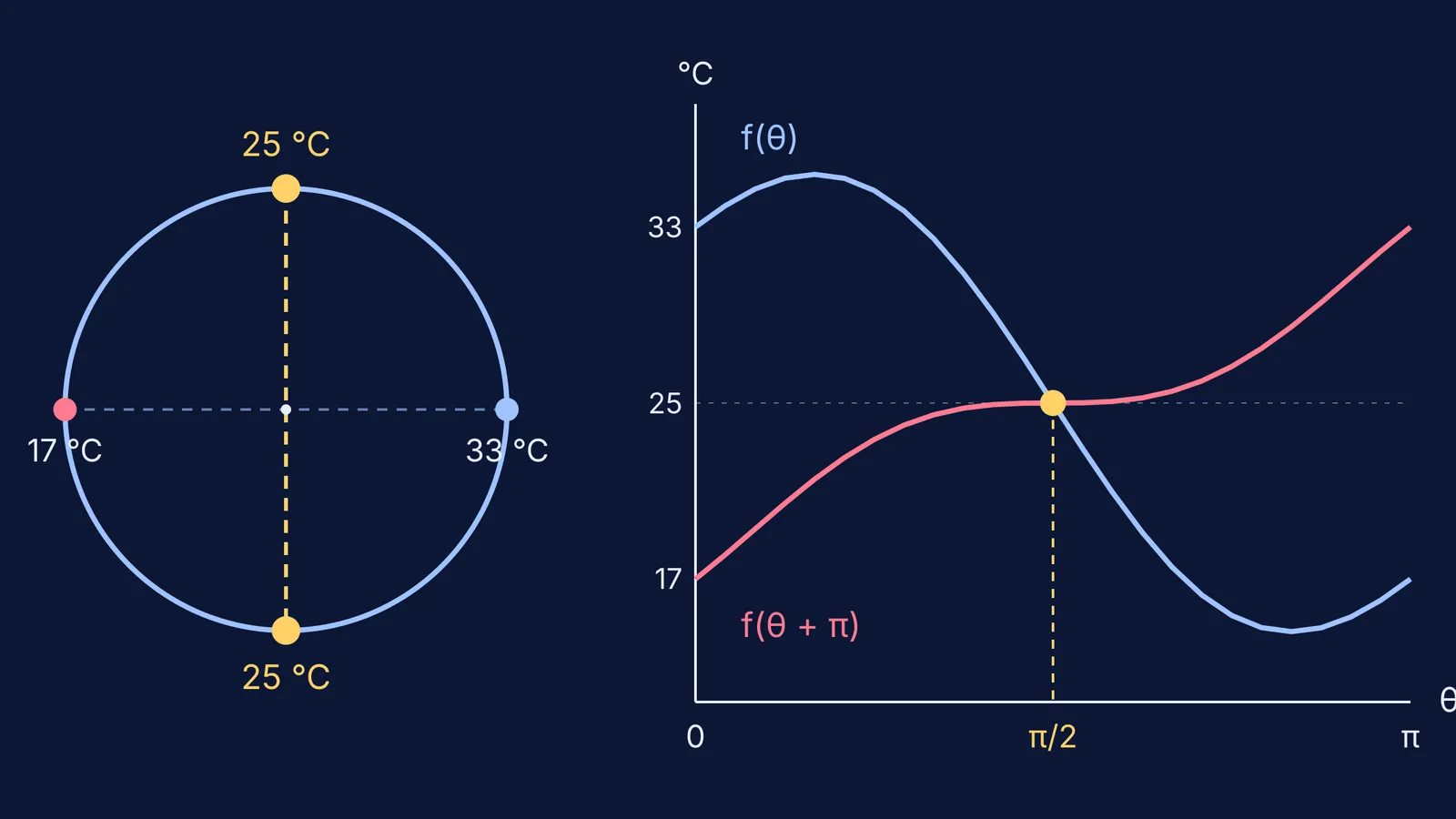
To check it by hand, invent a smooth equator temperature: f(θ) = 25 + 8 cos θ + 4 sin 2θ, in °C. Then f(θ + π) = 25 − 8 cos θ + 4 sin 2θ, because cos changes sign after a half-turn and sin 2θ does not.
The difference is g(θ) = 16 cos θ.
At θ = 0: f = 33 and the opposite point has 17, so g = 16.
At θ = π the roles swap, so g = −16.
g = 0 at θ = π/2: f(π/2) = 25 + 0 + 4 sin π = 25, and f(3π/2) = 25 + 0 + 4 sin 3π = 25.
So the points at 90° and 270° share 25 °C, and the diagram above shows the two curves crossing there.
What is the ham sandwich theorem?
The ham sandwich theorem says that n objects in n-dimensional space can each be cut exactly in half, by volume, with a single flat cut, even if the objects overlap. In three dimensions: bread, ham and cheese, one straight knife stroke, each halved.
It was proposed by Hugo Steinhaus and proved by Stefan Banach in three dimensions; Arthur H. Stone and John W. Tukey proved more general forms in Generalized "sandwich" theorems in the Duke Mathematical Journal in 1942.
The two-pancake version follows from the circle case:
For each direction u, take the line perpendicular to u that halves pancake A.
Let h(u) be the fraction of pancake B on the u side of that line.
Reversing u flips the sides, so h(−u) = 1 − h(u).
So h(u) − 1/2 changes sign between u and −u, and is zero for some direction. That line halves both pancakes.
How can you practise this idea?
Try these on paper:
Prove that on any circular running track, some two opposite points are at the same height.
Explain why one straight line can halve the areas of two overlapping triangles drawn on a sheet.
If the intermediate value theorem itself feels shaky, the Fermi Concept Library gives every mathematics concept its own lesson, so you can revisit continuity first. When a proof stalls at a step, the Fermi Problem Library has worked problems with a step-by-step solver that explains the reasoning rather than printing an answer.
For related ideas, read what topology is and why a mug equals a doughnut, the Jordan curve theorem and its ray test, and Darboux's theorem on why a derivative cannot jump.