On this page
In Class 12 you learn that a differentiable function must be continuous. Does the derivative itself have to be continuous? No. But it is not free to do anything either. Darboux's theorem names the one thing every derivative keeps, and it gives you a quick check on piecewise functions.
What is Darboux's theorem on derivatives?
Darboux's theorem: if f is differentiable on an open interval containing a and b, then for every number y between f′(a) and f′(b) there is a point x in [a, b] with f′(x) = y (statement on Wikipedia, citing Rudin and Apostol)).
In words, a derivative has the intermediate value property: it cannot get from one value to another without passing through everything in between. If f′ is continuous, this is just the intermediate value theorem you already know. The surprise is that continuity of f′ is not needed.
The French mathematician Gaston Darboux (1842 to 1917, per his MacTutor biography) published the original proof in 1875, in his Mémoire sur les fonctions discontinues in the Annales scientifiques de l'École normale supérieure.
Can a derivative be discontinuous? The x² sin(1/x) example
Yes. The standard example, which Wikipedia's article also uses, is f(x) = x² sin(1/x) for x ≠ 0, with f(0) = 0. Work it through once by hand.
At x = 0, use the definition: f′(0) = limit as h → 0 of h² sin(1/h) / h = limit of h sin(1/h). Since |h sin(1/h)| ≤ |h|, this limit is 0. So f′(0) = 0.
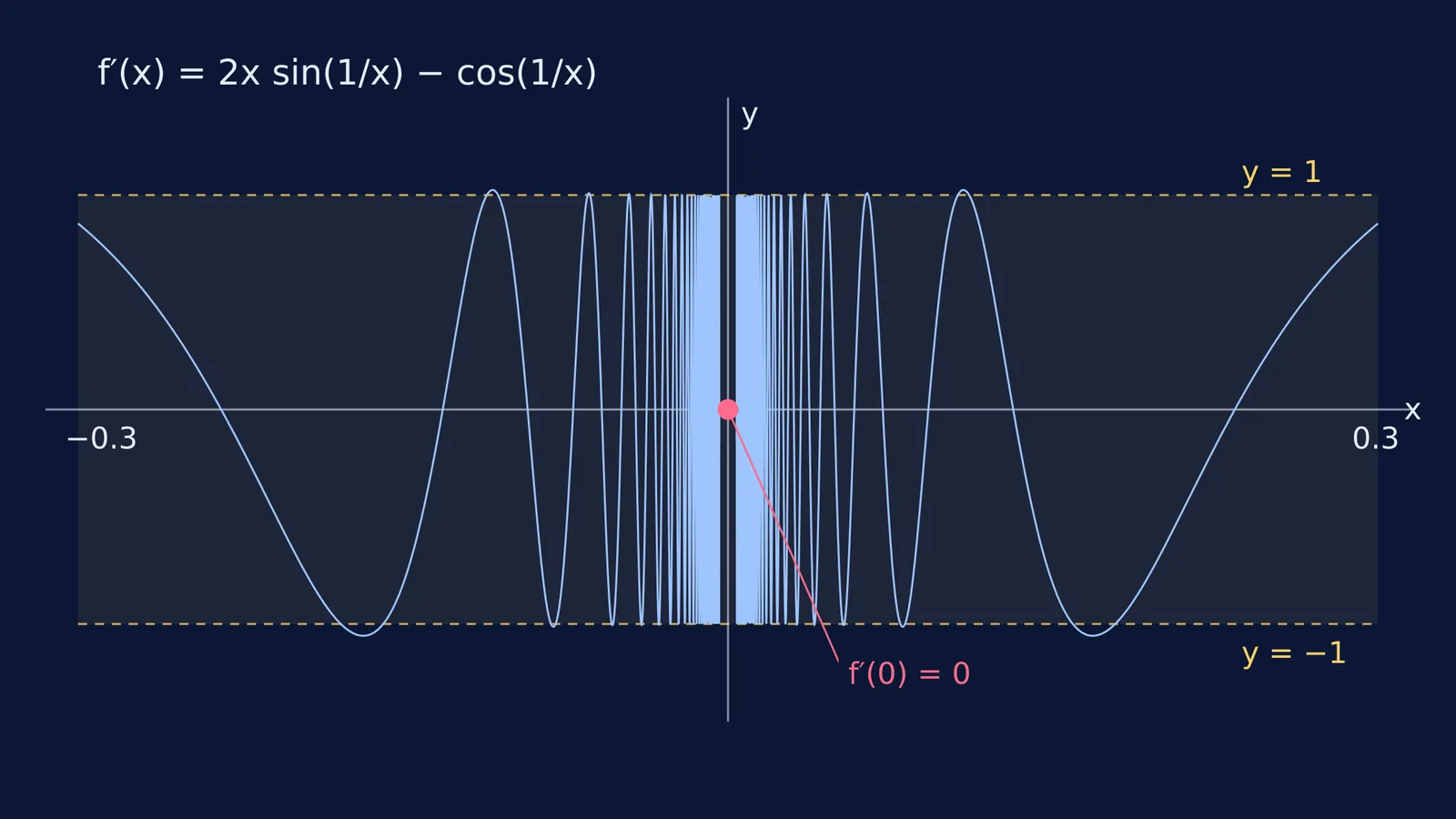
For x ≠ 0, use the product and chain rules: f′(x) = 2x sin(1/x) − cos(1/x).
Now let x → 0. The term 2x sin(1/x) goes to 0, but cos(1/x) keeps swinging between −1 and 1, faster and faster. So f′(x) has no limit at 0.
So f is differentiable everywhere, yet f′ is discontinuous at 0. Darboux still holds: on any small interval (0, δ), f′ swings close to −1 and close to 1 again and again, hitting every value between them infinitely often. It never skips a value; it just refuses to settle.
Why can a derivative never have a jump?
A jump discontinuity at c means both one-sided limits exist but differ, like the floor function [x] at an integer. Darboux's theorem rules this out, and also a removable gap where the limits agree but miss the value at c. Wikipedia's section on Darboux functions) states that every discontinuity of such a function is essential: at least one one-sided limit fails to exist.
Here is why, in one step. Suppose f′(x) → L as x → c from the right, with L ≠ f′(c). Pick y strictly between L and f′(c). Close enough to c on the right, f′ stays near L, so it never equals y there. But f′(c) and f′ at a nearby right-hand point lie on opposite sides of y, so Darboux says f′ must equal y in between. Contradiction.
This also shows why |x| cannot be differentiable at 0. Its slope is −1 for every x < 0 and 1 for every x > 0; a derivative at 0 would complete a function with a clean jump, and no derivative is allowed to do that.
How do you prove Darboux's theorem?
The neat proof uses only the extreme value theorem and the fact that the derivative is zero at an interior maximum (both on the same Wikipedia page)).
Suppose f′(a) > y > f′(b). Define φ(t) = f(t) − yt.
φ is differentiable, so it is continuous on [a, b], and the extreme value theorem gives it a maximum there.
φ′(a) = f′(a) − y > 0, so φ rises just to the right of a. The maximum is not at a.
φ′(b) = f′(b) − y < 0, so φ is larger just to the left of b. The maximum is not at b.
So the maximum is at some interior point x, where φ′(x) = 0, that is, f′(x) = y.
If instead f′(a) < y < f′(b), use the minimum. Nowhere did we need f′ to be continuous; that is the whole trick.
If the extreme value theorem or interior extrema feel shaky, the Fermi Concept Library gives each concept in mathematics its own lesson. For the neighbouring results, see our explainer on Cauchy's mean value theorem and its proof.
A three-question self-check
Is there a function on ℝ whose derivative is 1 for x > 0 and 0 for x ≤ 0? No. That would be a jump at 0, which Darboux forbids.
Can the floor function [x] be the derivative of anything on (0, 2)? No, for the same reason: it jumps at 1.
For f(x) = x² sin(1/x), is f′ bounded near 0? Yes. |f′(x)| ≤ 2|x| + 1, so near 0 it stays within about ±1, oscillating without a limit.
When a piecewise question goes wrong and you cannot see which step broke, the Fermi Problem Library has a step-by-step solver that explains the reasoning rather than printing an answer. If wild functions interest you, read next about Weierstrass's function, continuous but nowhere differentiable, and uniform continuity explained.