

On this page
If you have met Lagrange's mean value theorem, you already know half of this one. Cauchy's mean value theorem, also called the extended mean value theorem, does for two functions what Lagrange's does for one: it links how much f and g change over an interval to how fast they change at one point inside it.
What is Cauchy's mean value theorem?
If f and g are continuous on [a, b] and differentiable on (a, b), then there is some c in (a, b) with (f(b) − f(a))g′(c) = (g(b) − g(a))f′(c), as stated in the mean value theorem reference.
If g′ is never zero on (a, b), then g(a) ≠ g(b) by Rolle's theorem, so you can divide to get the textbook form: (f(b) − f(a))/(g(b) − g(a)) = f′(c)/g′(c).
Lagrange's theorem is the special case g(t) = t.
How do you prove it from Rolle's theorem?
Build one function that takes equal values at a and b, as in the standard proof:
Define h(x) = (g(b) − g(a))f(x) − (f(b) − f(a))g(x).
Check the ends: expand both and the cross terms cancel, so h(a) = h(b) = f(a)g(b) − f(b)g(a).
h is continuous on [a, b] and differentiable on (a, b) because f and g are, so Rolle's theorem gives a c in (a, b) with h′(c) = 0.
h′(c) = (g(b) − g(a))f′(c) − (f(b) − f(a))g′(c) = 0, which is the theorem.
What does it look like as a parametric curve?
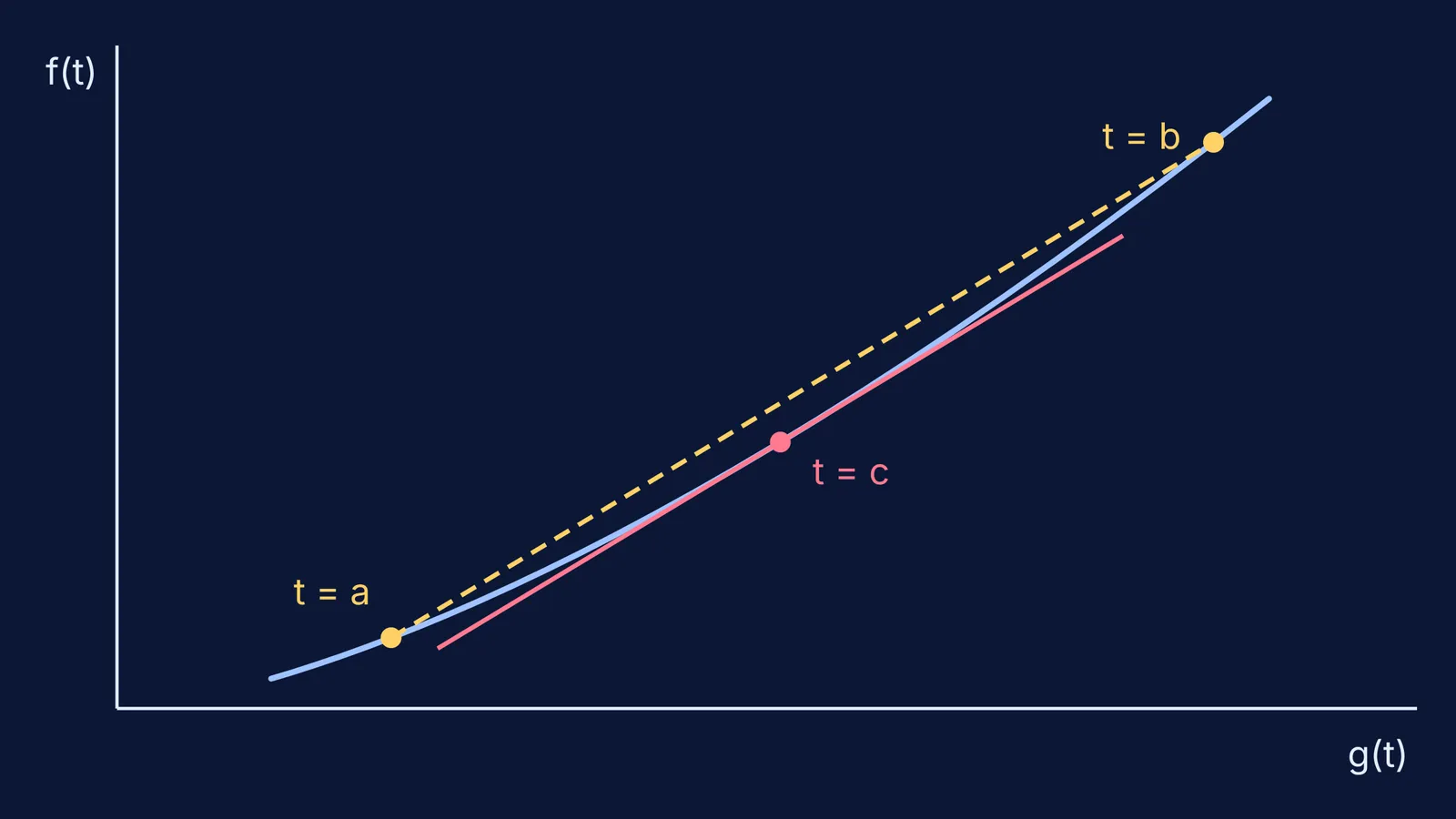
Picture the point (g(t), f(t)) moving as t runs from a to b. The left side of the theorem is the slope of the chord from the start point to the end point, and f′(c)/g′(c) is the slope dy/dx of the curve at t = c. So somewhere on the path the tangent is parallel to the chord: the geometric reading of the result, drawn at the top of this post.
One caveat from the same source: if f′ and g′ are both zero at the same t, the curve can have a cusp with no tangent. The product form still holds; only the picture breaks.
How do you find c in a worked example?
Take f(t) = t³ and g(t) = t² on [1, 2].
Chord slope: (8 − 1)/(4 − 1) = 7/3.
Ratio of derivatives: f′(c)/g′(c) = 3c²/(2c) = 3c/2.
Set 3c/2 = 7/3 to get c = 14/9 ≈ 1.556, which lies inside (1, 2).
Now test the trap from the callout. Lagrange on f alone gives 3c₁² = 7, so c₁ = √(7/3) ≈ 1.528. On g alone, 2c₂ = 3, so c₂ = 1.5. Two different points; only c = 14/9 works for both.
How does it justify L'Hospital's rule?
L'Hospital's rule says that if f(x) and g(x) both tend to 0 as x → c, g′(x) ≠ 0 near c, and f′(x)/g′(x) tends to a limit L, then f(x)/g(x) tends to L as well. The rule is named after Guillaume de l'Hôpital, who published it in his 1696 textbook after learning it from his tutor Johann Bernoulli, according to the history of the rule.
Here is the idea of the proof in the simple case f(c) = g(c) = 0, with f and g continuous at c:
Fix x close to c, say x > c, and apply Cauchy's theorem on [c, x].
You get a ξ between c and x with f(x)/g(x) = (f(x) − f(c))/(g(x) − g(c)) = f′(ξ)/g′(ξ).
As x → c, ξ is squeezed towards c, so f′(ξ)/g′(ξ) → L, and so f(x)/g(x) → L.
The full proof uses the same step for any two points near c, then a squeeze argument, and covers ∞/∞ too. The condition g′(x) ≠ 0 near c matters: the same page gives Otto Stolz's counterexample, where the rule fails without it.
A quick use: find the limit of (x − sin x)/x³ as x → 0. Three rounds of 0/0 give (1 − cos x)/(3x²), then sin x/(6x), then cos x/6, so the limit is 1/6. Cauchy's theorem is what makes each round legal.
How should you revise this for exams?
Learn the product form first. It needs no condition on g′ and is the version you prove.
Memorise h(x) by its shape: (change in g) times f minus (change in f) times g.
Sketch the parametric picture once; it is easier to recall than a formula.
For inequalities, the method in proving inequalities with the mean value theorem carries over to two functions.
Place it in the wider chapter with how to prepare limits, continuity and differentiability for JEE Advanced.
If Rolle's theorem still feels shaky, the Fermi Concept Library covers every concept in mathematics. When a L'Hospital limit will not come out, the Fermi Problem Library has a step-by-step solver that explains the reasoning, so you can see which round went wrong.


