On this page
Body Fluids and Circulation (Chapter 15, NCERT Class 11 Biology) introduces many new terms. Below, they are grouped as the chapter runs, with examples and "Don't confuse with" pairs. It follows the NCERT chapter (Reprint 2026-27), which sits under Unit V of the CBSE Biology curriculum for 2026-27. For notes and practice questions, see our Body Fluids and Circulation Class 11 chapter guide.
This is a study glossary, not medical advice; for any symptom, see a doctor.
What is blood made of?
Numbers here are from the NCERT chapter.
Blood: a connective tissue whose liquid matrix (plasma) carries cells and cell fragments (formed elements).
Plasma: the pale yellow, thick liquid, nearly 55 per cent of blood, mostly water. Main proteins: fibrinogen (clotting), globulins (defence), albumins (osmotic balance). Don't confuse with: serum, which is plasma with the clotting factors removed.
Formed elements: red cells, white cells and platelets, nearly 45 per cent of blood.
Erythrocytes (RBCs): the most numerous blood cells, biconcave and without a nucleus in most mammals, packed with haemoglobin. They live about 120 days and are destroyed in the spleen.
Haemoglobin: the red, iron-containing protein in RBCs that carries respiratory gases.
Granulocytes: neutrophils (most abundant, phagocytic), eosinophils (infection, allergy) and basophils (release histamine, serotonin, heparin). Don't confuse with: agranulocytes, lymphocytes (B and T cells) and monocytes.
Platelets (thrombocytes): fragments of megakaryocytes in bone marrow; they release substances that start clotting.
How do blood groups and clotting work?
Antigen: a chemical that can trigger an immune response. Example: A and B antigens on RBCs. Don't confuse with: antibody, the protein made in response, such as anti-A in the plasma of a group B person.
Universal donor: group O, whose RBCs carry neither A nor B antigen. Don't confuse with: universal recipient, group AB, with neither anti-A nor anti-B in plasma.
Rh factor: an RBC antigen similar to one found in Rhesus monkeys; the NCERT chapter says nearly 80 per cent of people carry it (Rh positive).
Erythroblastosis foetalis: anti-Rh antibodies, made by an Rh negative mother after exposure at her first Rh positive delivery, crossing into a later Rh positive foetus and destroying its RBCs.
Coagulation: clotting. Injury sets off a cascade forming thrombokinase, needed to turn prothrombin into thrombin; thrombin turns fibrinogen into a fibrin mesh that traps cells. Calcium ions are essential.
Our post on platelets, thrombin and fibrin covers the cascade step by step.
What is the difference between lymph and blood?
Tissue fluid (interstitial fluid): fluid that seeps from capillaries into the gaps between cells with small dissolved substances, while big proteins and most cells stay in the vessels; blood and cells swap nutrients and gases through it.
Lymph: tissue fluid once it has been collected by the lymphatic system, which returns it to major veins. It is colourless, carries lymphocytes, and takes up fats through lacteals in the intestinal villi. Don't confuse with: blood, which also carries RBCs, platelets and more protein.
Open circulatory system: blood leaves vessels and fills open spaces called sinuses. Example: arthropods, molluscs. Don't confuse with: closed circulatory system, where blood stays inside vessels (annelids, chordates).
Single circulation: blood passes through the heart once per round trip. Example: fish (two-chambered heart). Don't confuse with: incomplete double circulation, where oxygenated and deoxygenated blood mix in one ventricle (amphibians, most reptiles).
How does the heart beat?
Rates and volumes are averages from the NCERT chapter.
Tricuspid valve: the three-flap valve between the right atrium and right ventricle. Don't confuse with: bicuspid (mitral) valve, between the left atrium and left ventricle.
Semilunar valves: guard the ventricle exits into the pulmonary artery and aorta, stopping backflow.
Sino-atrial node (SAN): nodal tissue in the upper right corner of the right atrium that fires the most action potentials, 70-75 a minute, so it is the pacemaker.
Atrio-ventricular node (AVN): nodal tissue near the atrio-ventricular septum that relays the signal to the bundle of His (AV bundle), whose branches end as Purkinje fibres in the ventricles.
Myogenic heart: its beat starts in its own nodal muscle, not a nerve.
Cardiac cycle: one round of contraction (systole) and relaxation (diastole) of atria and ventricles; at 72 beats a minute it lasts 0.8 seconds.
Stroke volume: blood pushed out by each ventricle per beat, about 70 mL. Don't confuse with: cardiac output, stroke volume times heart rate, about 5 litres a minute.
Heart sounds: "lub" comes from the tricuspid and bicuspid valves closing; "dub" from the semilunar valves closing.
ECG: a graph of the heart's electrical activity. The P-wave is atrial depolarisation, the QRS complex ventricular depolarisation, and the T-wave ventricular repolarisation.
What do double circulation and the heart disorders mean?
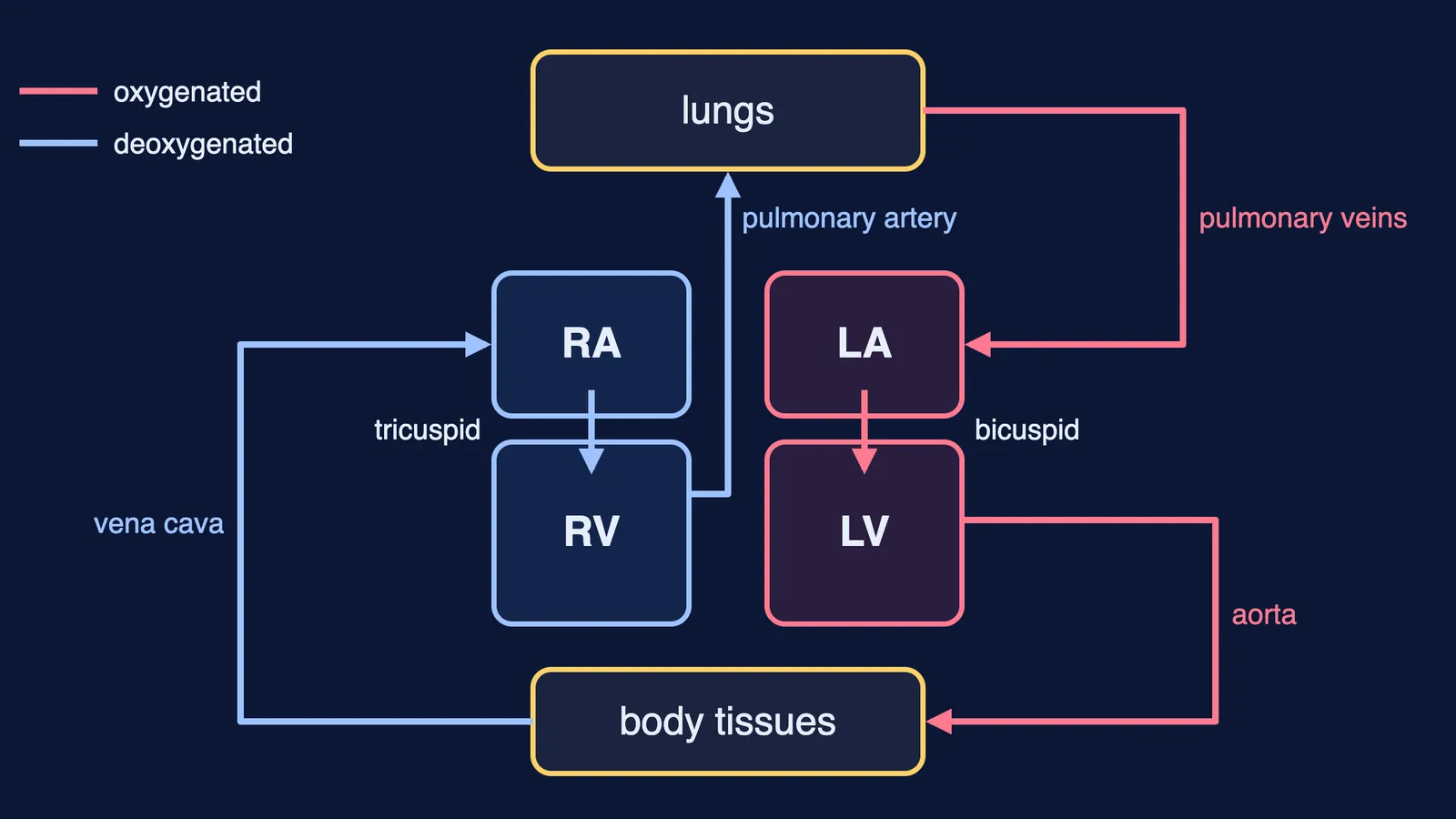
Double circulation: blood passes through the heart twice per round trip, in two separate circuits (birds, mammals). Pulmonary circulation: right ventricle, lungs, left atrium. Systemic circulation: left ventricle, body, right atrium.
Hepatic portal system: the hepatic portal vein takes blood from the intestine to the liver before it joins the systemic circulation. Don't confuse with: coronary system, the vessels serving the heart muscle itself.
Sympathetic signals: speed up the heart and strengthen its beat. Don't confuse with: parasympathetic signals, which slow it.
Hypertension: blood pressure repeatedly 140/90 or higher (normal is 120/80), per the NCERT chapter.
Coronary artery disease (atherosclerosis): deposits of calcium, fat, cholesterol and fibrous tissue narrowing the arteries to the heart muscle. Acute chest pain when too little oxygen reaches the heart muscle is angina pectoris.
Heart failure: the heart cannot pump enough for the body's needs. Not the same as: cardiac arrest (the heart stops) or heart attack (muscle suddenly damaged by poor blood supply).
How to learn these terms
Trace the loop aloud. Start at the vena cava; name every chamber, valve and vessel.
Learn the pairs together. Write each pair with one difference.
Fill Table 15.1 from memory. Antigens, antibodies and donor groups, then check.
Check the arithmetic. Using the NCERT chapter averages, 70 mL × 72 beats is 5,040 mL, which is why cardiac output is about 5 litres a minute.
For the cells, see our post on RBCs, WBC types and platelets. If a term feels hazy, the Fermi Concept Library gives every concept in biology its own lesson and its place in the map.