On this page
Biotechnology: An Overview is the only chapter in Unit I of the CBSE Class 11 Biotechnology (045) course. It is short, but it sets up words you will use all year.
How many marks is Biotechnology: An Overview in Class 11?
The CBSE Biotechnology curriculum 2026-27 prints Unit I at 5 marks out of 70 for theory. Unit I holds just this one chapter, so the whole 5 marks rest on it.
Its listed topics are historical perspectives, technology and applications, the global market, and biotech products.
The prescribed book is CBSE's own A Text Book of Biotechnology, Class XI. We could not find an official PDF of it on cbseacademic.nic.in, so this guide follows the curriculum's topic list and uses the NCERT reference book, Biotechnology Class XI, Chapter 1 "Introduction" (Reprint 2026-27), for every fact below.
That split is printed in the CBSE Biology curriculum 2026-27. If you take core Biology too, our Biotechnology and its Applications Class 12 guide covers the mechanisms that chapter tests.
What does the history section cover?
NCERT defines biotechnology as using living cells or biological molecules to make useful products, and sorts its story into three stages.
Ancient: growing wheat and barley and taming sheep, goats and cattle, about 10,000 years ago.
Classical: fermentation, used long before anyone understood it. NCERT dates Chinese fermented foods to 4000 B.C. Indian examples include dahi, idli and kinema. Louis Pasteur showed in the 1850s and 1860s that microbes drive fermentation, and World War II led to the modern fermenter, or bioreactor, built to mass-produce penicillin.
Modern: recombinant DNA (rDNA) technology, which cuts and joins pieces of DNA and places the new DNA in a host, so a gene can move from one organism to another.
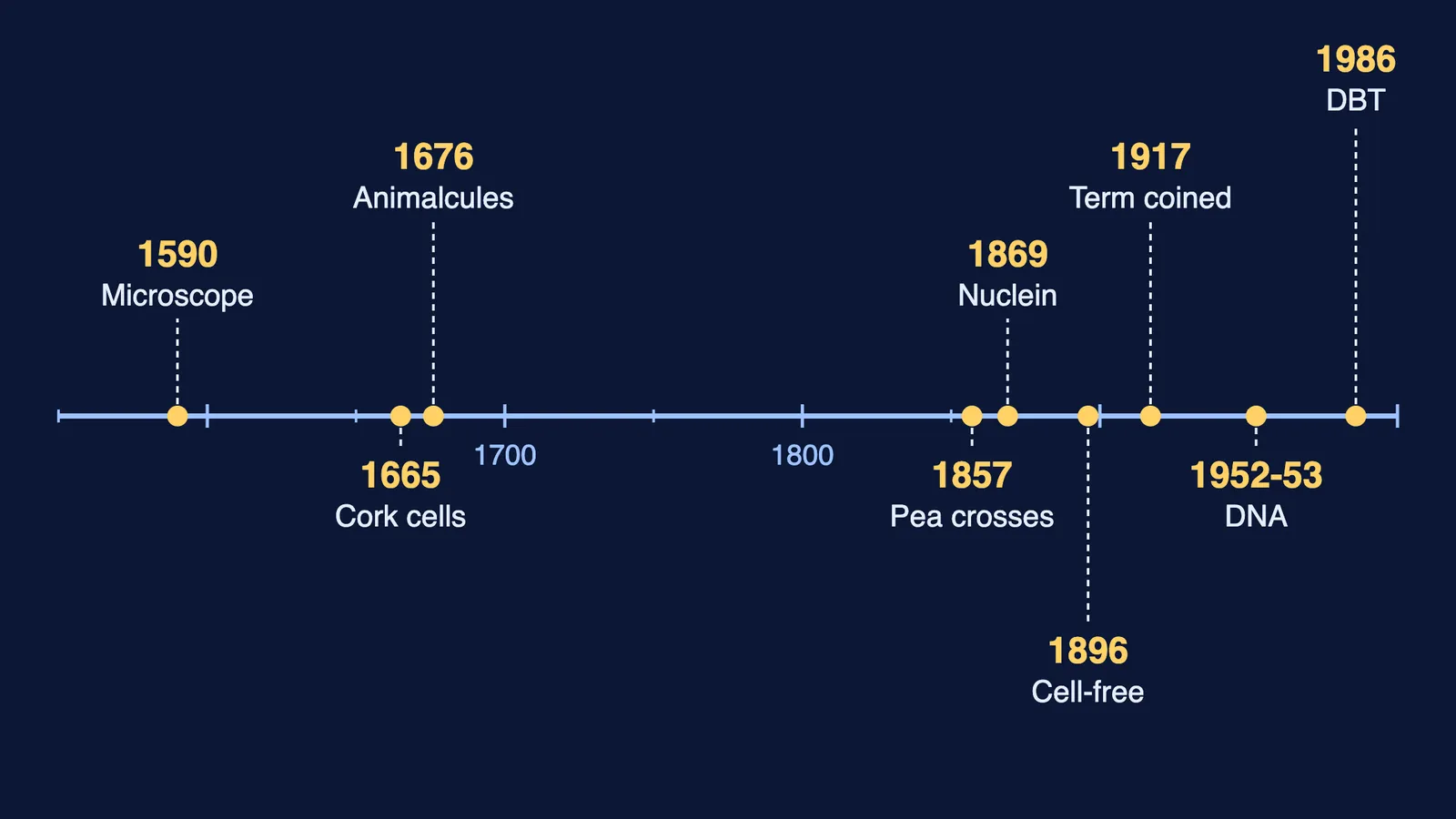
The timeline above plots a selection of NCERT's dated milestones. Karl Ereky, a Hungarian scientist, coined the word "biotechnology" in a 1917 book on meat, fat and milk production. Eduard Buchner turned sugar into alcohol with yeast extract in 1896, without living cells. Hershey and Chase showed in 1952 that DNA is the genetic material, and Watson and Crick proposed the double helix in 1953.
What are the applications of modern biotechnology?
NCERT groups them into four areas. Learn one example per area.
Medicine and health care: making therapeutic proteins in microbes, gene therapy (first conceived in 1972) and genetic tests such as the one for phenylketonuria.
Crop production and agriculture: the Flavr Savr tomato ripens later and keeps longer; Golden Rice carries extra beta-carotene, the precursor of vitamin A; tobacco was made chilling-tolerant with an Arabidopsis gene.
Food processing: NCERT notes that close to a third of the world's diet is fermented food.
Environmental protection: E. coli carrying the light-emitting lux gene can signal mercury, E. coli given a biphenyl dioxygenase gene can break down PCBs, and hyper-accumulator plants such as Brassica napus can remove mercury and lead from contaminated soil.
NCERT also names colour labels: red (medical), green (plants and the environment), blue (marine and freshwater) and white (industrial processes).
What should you know about biotech products and the market?
The curriculum lists "global market and biotech products", but the NCERT reference chapter gives no worldwide market figures and we found no official source with one, so we quote none. If your CBSE book prints a figure, learn it with its year.
The NCERT chapter does describe India's sector. The National Biotechnology Board was set up in 1982 and became the Department of Biotechnology (DBT) in 1986. Recombinant products it says Indian firms make include the hepatitis B vaccine, erythropoietin, G-CSF and interferon alpha 2b.
Worked example: draw your own timeline to scale
Start an axis at 1550, with 1 cm per 50 years. Each event sits at (year − 1550) ÷ 50 cm.
Janssen's microscope, 1590: 40 ÷ 50 = 0.8 cm
Ereky's term, 1917: 367 ÷ 50 = 7.34 cm
Double helix, 1953: 403 ÷ 50 = 8.06 cm
DBT, 1986: 436 ÷ 50 = 8.72 cm
The gap from 1917 to 1953 is only 0.72 cm, while 1590 to 1917 takes 6.54 cm. Everything from Ereky's 1917 book to DBT in 1986 fits in the last 1.38 cm.
Practice questions for Unit I
These mark labels are our suggestion.
(1 mark) Which colour label does NCERT give to biotechnology applied to marine and freshwater organisms?
(1 mark) Name the scientist who first used the word "biotechnology", and the year.
(2 marks) Why did Buchner's 1896 yeast-extract experiment matter for later biochemistry?
(3 marks) Give one example each of a crop improved for shelf life, for nutrition and for cold tolerance.
(5 marks) A farm's soil holds mercury and lead, and a nearby pond holds PCBs. Using the chapter's examples, plan how biotechnology could detect the mercury, break down the PCBs and clean the soil.
Not sure where to start? Fermi's AI tutor works out what you already know and builds a plan for the session.
Next in the course is Unit II, Molecules of Life; our Biomolecules Class 11 guide is a useful warm-up.