On this page
Biodiversity and Conservation is Chapter 13 of the NCERT Class 12 Biology textbook (Reprint 2026-27). The CBSE 2026-27 Biology curriculum covers its patterns, importance, loss and conservation. Then use our Biodiversity and Conservation Class 12 board guide to turn them into written answers.
What are the levels of biodiversity?
Biodiversity: the combined variety of life at every level of biological organisation, a word popularised by Edward Wilson.
Genetic diversity: variation in genes within one species across the places it grows. Example: *Rauwolfia vomitoria* from different Himalayan ranges varies in reserpine potency and concentration. Don't confuse with: species diversity, which counts different species.
Species diversity: how many different species a place holds. Example: amphibians are richer in species in the Western Ghats than in the Eastern Ghats.
Ecological diversity: the variety of ecosystems in a region. Example: NCERT says India has more than Norway.
Megadiversity country: one of the 12 countries that hold an unusually large share of the world's species. Example: India has 2.4 per cent of the world's land but 8.1 per cent of its species, per NCERT.
How is biodiversity spread across the Earth?
Latitudinal gradient: species diversity generally falls from the equator towards the poles. Example: NCERT gives nearly 1,400 bird species for Colombia and 56 for Greenland.
Tropics: the belt from 23.5° N to 23.5° S. NCERT's three reasons for their richness: more undisturbed evolutionary time, a steadier climate that favours niche specialisation, and more solar energy.
Species richness: the number of species in an area.
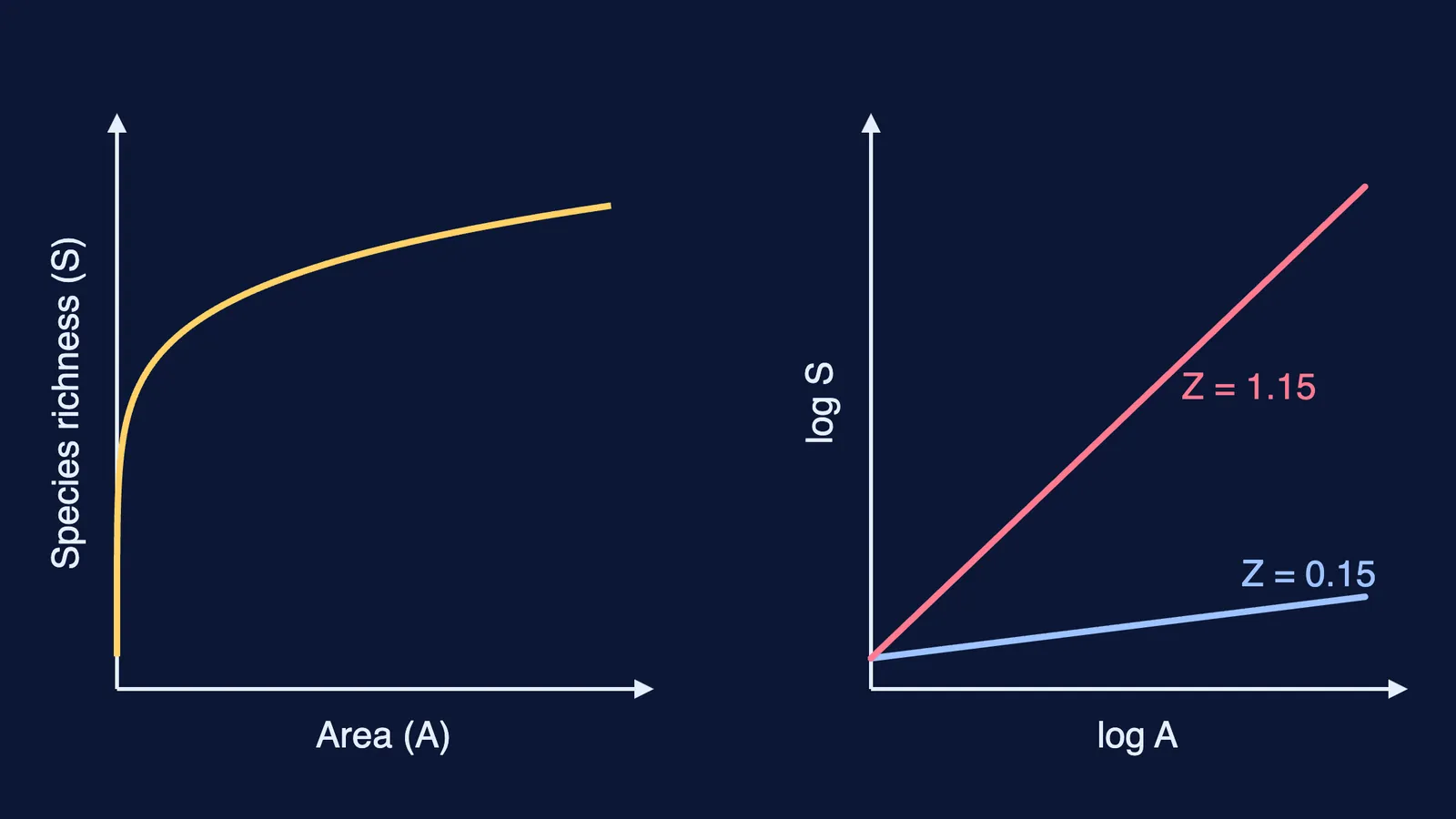
Species-area relationship: within a region, the number of species found grows as a larger area is surveyed, then levels off; Alexander von Humboldt first noticed it. Plotted normally it is a rectangular hyperbola; on log scales it is the straight line log S = log C + Z log A.
Regression coefficient (Z): the slope of that line; C is the Y-intercept. Example: 0.1 to 0.2 within regions, 0.6 to 1.2 across whole continents, and 1.15 for fruit-eating birds and mammals of tropical forests compared across continents.
Why does species diversity matter to an ecosystem?
Stable community: one whose productivity changes little from year to year, which resists or recovers from disturbances and resists alien species. Example: in David Tilman's plots, described in NCERT, more species meant steadier biomass and higher productivity.
Rivet popper hypothesis: Paul Ehrlich's analogy: the ecosystem is an aeroplane and species are its rivets. A few lost rivets seem harmless, but losses add up, and a wing rivet (a key species) matters more than a seat rivet.
What causes biodiversity loss?
Figures are from the NCERT chapter.
Extinction: the permanent disappearance of a species. Example: the IUCN Red List (2004) records 784 extinctions in the last 500 years, such as the dodo and quagga.
Threatened or endangered organism: a species likely to vanish from the wild soon unless urgent action is taken.
Sixth Extinction: the human-driven loss happening now, 100 to 1,000 times faster than pre-human rates. Don't confuse with: the five earlier mass extinctions in the fossil record.
Evil Quartet: NCERT's name for the four main causes of extinction, below.
Habitat loss and fragmentation: destroying habitat or breaking it into patches; the most important cause. Example: tropical rain forests have shrunk from over 14 per cent of Earth's land surface to 6 per cent or less.
Over-exploitation: harvesting a species faster than it can recover. Example: Steller's sea cow and the passenger pigeon.
Alien species invasion: an introduced species that turns invasive and harms native ones. Example: the Nile perch in Lake Victoria wiped out more than 200 cichlid species; in India, *Parthenium* and *Lantana*.
Co-extinction: when a species dies out, the species that depend on it completely are lost too. Example: a host fish and its parasites. Don't confuse with: alien invasion, where a newcomer causes the loss.
Why should we conserve biodiversity?
Narrowly utilitarian argument: nature gives direct economic benefits such as food, fibre, firewood and medicines. Example: NCERT says more than 25 per cent of drugs sold worldwide come from plants; searching nature for such products is bioprospecting.
Broadly utilitarian argument: biodiversity runs ecosystem services. Example: NCERT says the Amazon forest is estimated to produce 20 per cent of the oxygen in Earth's atmosphere.
Ecosystem services: benefits nature provides, such as pollination, pest control and flood control.
Ethical argument: each species is worth protecting for its own sake, whatever its economic use.
How do we conserve biodiversity?
In situ conservation: protecting species in their natural home by protecting the whole ecosystem. Example: NCERT puts it as saving the entire forest to save the tiger.
Biodiversity hotspot: a region with very high species richness and high endemism (species found nowhere else), chosen for maximum protection. Example: of 34 hotspots, three cover India: Western Ghats and Sri Lanka, Indo-Burma, and Himalaya.
Biosphere reserves, national parks and wildlife sanctuaries: legally protected areas in India. NCERT counts 14 biosphere reserves, 90 national parks and 448 wildlife sanctuaries.
Sacred groves: forest patches protected for religious or cultural reasons. Example: Khasi and Jaintia Hills in Meghalaya, and the Aravalli Hills of Rajasthan.
Ex situ conservation: moving threatened species out of their habitat into protected care. Example: zoos, botanical gardens and wildlife safari parks.
Cryopreservation: storing gametes of threatened species at very low temperature so they stay viable for long periods. Seed banks keep seeds of different strains of commercially important plants for long periods.
Convention on Biological Diversity: the agreement from the 1992 Earth Summit in Rio de Janeiro, which asked all nations to conserve biodiversity and use it sustainably.
The syllabus also names Red Data Book and Ramsar sites, which NCERT does not explain; ask your teacher how deep to go. For examples sorted by method, see in situ vs ex situ conservation.
How to learn these terms
Learn in pairs: genetic vs species diversity, in situ vs ex situ, narrowly vs broadly utilitarian, co-extinction vs alien invasion.
Draw the species-area graph as a curve and as a log line; label S, A, C and Z.
Say the Evil Quartet aloud with one example each.
If a term stays vague, the Fermi Concept Library gives each biology concept its own lesson and its place in the map.